The Birth of Nations: ENGLAND
The number of Germanic tribesmen who migrated to Britain during the 5th and 6th centuries is an ongoing subject of debate. These immigrants and their descendants are known generically as Anglo-Saxons (or simply ‘the English’), and, in a famous passage from his Historia Ecclesiastica Gentis Anglorum (Ecclesiastical History of the English Nation), the Anglo-Saxon historian Bede indicates that the numbers were so great that part of the Continental homeland was left depopulated:
They came from three very powerful peoples of Germany, that is, the Saxons, the Angles and the Jutes. From the Jutes are descended the people of Kent, and of the Isle of Wight, including those in the province of the West Saxons who are to this day called Jutes, seated opposite to the Isle of Wight. From the Saxons, that is, the country which is now called Old Saxony, came the East Saxons, the South Saxons, and the West Saxons. From the Angles, that is, the country which is called Angulus, and which is said, from that time, to have remained desert to this day, between the provinces of the Jutes and the Saxons, are descended the East Angles, the Middle Angles, the Mercians, all the race of the Northumbrians, that is, of those nations that dwell on the north side of the river Humber, and the other peoples of the Angles.[*]Historia Ecclesiastica Gentis Anglorum I, 15
The traditional scholarly view is based on this notion of a mass migration – the Anglo-Saxons were so numerous that, as they moved into the South and East, they displaced the native Britons (known to the Anglo-Saxons as Wealas or Walas, which translates into modern English as ‘Welsh’[*]), forcing them North and West (and sufficient numbers emigrated to the Armorican peninsula for it to become known as Brittany). Frank Stenton, in his Anglo-Saxon England (Third Edition, 1971), writes:
The Germanic peoples who descended on Britain in the late fifth century were not seeking their fortune in an unexplored land. Men who had taken part in the earlier raids upon the Saxon shore must have gained a detailed knowledge [of the coast, its rivers and weather conditions] … Without such a knowledge the migration to Britain, unique in any case among contemporary movements, could never have been attempted… They [late-5th century Anglo-Saxon pioneers, such as Ælle and Cerdic] could use the knowledge acquired by their nameless predecessors, choose the best harbours, and hold the neighbouring country until reinforcements came. They could prepare the way for a series of national migrations. That such national movements followed in course of time is certain. An invasion of Britain by a small number of chiefs, each accompanied by his personal followers, might perhaps have conquered the midlands and the south, but would not have produced the social order that is afterwards found there.Anglo-Saxon England Chapter 9 (p.277)
More recently, however, based on the interpretation of archaeological discoveries, some scholars have argued that it was, indeed, a relatively small number of Anglo-Saxons who crossed to Britain. Michael Jones, British Archaeology magazine (Issue 20, December 1996), says:
Although Saxon raiding troubled Britain in the early 5th century, and possibly in the later 4th, Anglo-Saxon settlement seems to begin c. AD 430 with the main episode of early settlement in the mid-5th century. Only in the 6th century did the Anglo-Saxons win control of the bulk of lowland Britain… Estimates of early population are notoriously speculative, but recent estimates share the same order of magnitude, with a minimal immigrant population of perhaps 10,000 and a maximum migration of perhaps 100,000 people. In contrast, the population of Roman Britain at the end of the 4th century probably numbered three or four million. In this context, an invasion hypothesis relying on a mass migration of Anglo-Saxons to displace the native population and destroy the Roman order seems far-fetched.[*] In fact, archaeological and literary evidence indicate that not until the 7th century did the Scandinavian and northern Germanic peoples, including the Angles and Saxons, adopt the use of mast and sail. A mass-migration across the North Sea using open, clinker-built, oar-driven warships such as the Sutton Hoo, Nydam (northern Germany) and Kvalsund (western Norway) vessels seems to be a logistical impossibility.‘Rebellion remains the decisive factor’
In this ‘minimalist’ view, most native Britons were not displaced, but were assimilated – they abandoned their own culture and language, and adopted those of the Anglo-Saxons. In a later edition of British Archaeology (Issue 23, April 1997), Martin Evison notes:
A re-consideration of the linguistic evidence began some decades ago and also suggests that the displacement of the native language was not caused by a displacement of native people. There is historical and linguistic evidence that suggests it may have been common for place-names to be translated from Brythonic into Old English. Inter-marriage between members of ‘Anglo-Saxon’ and ‘Welsh’ houses is also evident in the texts, and personal names occur which contain ‘Welsh’ elements in parts of England long after ‘Anglo-Saxon’ domination was thought complete. Many place-names in England have Brythonic origins, although these diminish in frequency toward the South and East. Whilst the English language was clearly in the ascendant, there is evidence to support a continued presence of an identifiably Brythonic population as the early medieval period began to unfold, even in southern England, and for a degree of bilingualism.‘Lo, the conquering hero comes (or not)’
On the other hand, in the Introduction to his paper ‘Invisible Britons: The View from Linguistics’ (2007), Richard Coates writes:
It has long been believed that the Britons of what became England were effectively exterminated – whether killed, driven out and/or culturally effaced by enslavement – by the incoming Anglo-Saxons; the basis for this belief was essentially derived from the documentary record.[*] Over recent years, a competing view has arisen on the basis of a more critical assessment of the historical record as English foundation-mythmaking: that the Britons did not wholly disappear in any of these ways but that many ‘became English’ by taking on English practices, including the English language. This paper shows that the new view is not tenable in the light of what generally happens to languages involved in contact situations and that, at least in the English heartland, the observed patterns of lexical and onomastic borrowing suggest that the traditional view is more likely to be correct… The strongest reason for thinking the Angles and Saxons did not take over in the conventional sense seems to be the fundamentally logistic idea that they just could not have done it: either there could not have been enough immigrants, or they could not or would not have displaced practically all the Britons even with sufficient manpower. Whilst archaeological evidence may eventually show much Brittonic survival, it is not available yet … DNA analysis of skeletal material has been patchy, and we await a fuller representative survey of burial sites, but some recent research is broadly, and strikingly, consistent with the traditional view. The possible continuation of religious practices in Wessex is interestingly set out by Yorke, and there is an arguable case for agricultural continuity. But in this paper I argue that the linguistic evidence favours the traditional view, at least for the south and east, considering not merely place-name and vocabulary borrowing in this area but comparing the linguistic consequences of other conquests by military aristocracies and the settlers who possibly followed them. I argue that there is no reason to believe large-scale survival of an indigenous population could so radically fail to leave linguistic traces.Publications of the Manchester Centre for Anglo-Saxon Studies Vol. 7: Britons in Anglo-Saxon England §14
And, in an article published in The New Cambridge Medieval History Volume 1 (2005), Helena Hamerow argues that:
… the widespread adoption by the mid-sixth century of continental-style dress, itself a powerful symbol of group self-consciousness and common descent, as well as the burial of thousands of individuals in cremation urns which are effectively indistinguishable from Continental examples, cannot be convincingly explained without accepting that immigration, at least viewed cumulatively over a period of some hundred years, took place on a significant scale. Indeed, archaeological and palynological evidence from Schleswig-Holstein appears to support Bede’s account of a dramatic depopulation of Angulus during the fifth to eighth centuries… There is today little doubt that the early accounts of mass invasion and population replacement in fifth-century Britain are in large part ‘origin myths’ devised to serve the interests of the ruling elites of later periods by offering a unifying, stabilising ideology which would confer political legitimacy. Archaeology nevertheless indicates that immigration did play a critical role in the formation of an Anglo-Saxon identity. Large-scale migration into certain regions and substantial indigenous survival are, however, not mutually exclusive. Yet the complex and absorbing problem of the exact fate of the indigenous population of southern and eastern Britain in the fifth and sixth centuries remains to be resolved. Ethnic identity is of course determined not by biology, but by personal and historical circumstance; under certain conditions, individuals may switch their ethnic affiliation and ‘change the label by which they are known … according to biographical convenience’.[*] One can only conclude that large numbers of Britons did precisely this and that direct evidence of assimilation and hybridisation will therefore continue to prove elusive. In those areas less directly affected by the collapse of Roman rule and barbarian assaults, for example in the Peak District and the west midlands, very few Anglo-Saxon-style burials of the sixth century have been found and local groups presumably maintained their position; in east Yorkshire, Roman-style burial rites survived well into the post-Roman period. In short, the same demographic model will not do for the whole of Anglo-Saxon England. While the precise demographic composition of sixth-century England will probably always elude us, we can be sure that the truth was far less clear-cut than Bede’s account of the Angles, Saxons and Jutes. By the middle of the sixth century, however, new, relatively coherent regional identities had formed, identities that found expression in the archaeological record several generations before the earliest written accounts.Chapter 10: ‘The Earliest Anglo-Saxon Kingdoms’ (pp.268–9)
The results of DNA research carried out by a team of geneticists and archaeologists, published in 2022[*], indicates that there was indeed large-scale migration across the North Sea into Britain – of both men and women – and that:
… these migrations started earlier than previously assumed, as evidenced by individuals with CNE [Continental North European] ancestry from later Roman contexts, and continued throughout the middle Anglo-Saxon period [c.650–850].‘The Anglo-Saxon migration and the formation of the early English gene pool’
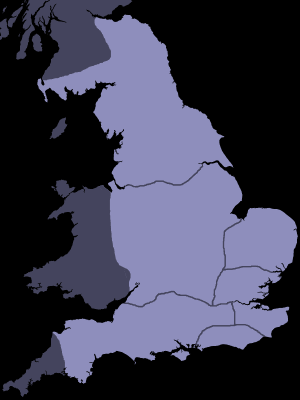
At any rate, as territory fell under their control, so new Anglo-Saxon kingdoms were founded. 12th century historian Henry of Huntingdon states:
Now when the Saxons subjected the land to themselves, they established seven kings, and imposed names of their own choice on the kingdoms.[*] The first kingdom was called Kent. The second Sussex, in which Chichester is situated. The third Wessex, of which the capital was Wilton, now given over to nuns. In this kingdom are the cities of Winchester, Salisbury and several others. The fourth kingdom was Essex, which did not long survive, but was subjected to other kingdoms. The fifth was East Anglia, in which are the counties called Norfolk and Suffolk. The sixth was Mercia, in which are Lincoln, Leicester and some others. The seventh was Northumbria, in which is York.Historia Anglorum I, 4
At the end of the 8th century a cloud appeared on the Anglo-Saxon horizon: Vikings. These Scandinavian pirates eventually organised themselves into armies and established a permanent presence on English soil. Finally, it was the kings of Wessex who led the Anglo-Saxon resurgence.
Although the concept of ‘the Heptarchy’ (as the English kingdoms enumerated by Henry of Huntingdon had become known by the sixteenth century[*]) is a simplification of what was a complex and fluid political situation, it does provide a convenient framework on which to set-out the history of this turbulent period:
A chronological ‘Mainline’ through the period, highlighted by a coloured right-hand margin (as shown here), can be navigated by clicking on the link adjacent to the end of each section of coloured margin.
The Vikings’ progress can be followed by clicking on the links: V ►