ESSEX
Essex – the kingdom of the East Saxons – was, according to Roger of Wendover at any rate, founded in 527. By about 600 the East Saxons had absorbed the Middle Saxons (Middlesex, but also including modern-day southern and eastern Hertfordshire). London was Essex’s chief town. During the second half of the 7th century, Essex came under Mercian domination. Following the decisive defeat of Mercia by the West Saxons, at the battle of Ellendun in 825, Mercian supremacy came to an end. Subsequently, Essex was absorbed into Wessex (i.e. the kingdom of the West Saxons).
King of the East Saxons
527 ? – 587 ? Erkenwine / Æscwine ?
Henry of Huntingdon (HA II, 19) states: “The kingdom of Essex, that is of the East Saxons, began. It is thought that the first to hold it was Erkenwine, according to what I can gather from the writings of the ancients.” Henry places that passage between events that are dated 527 and 530 in the Anglo-Saxon Chronicle. Roger of Wendover echoes Henry, but pins the founding of Essex firmly to 527.
Henry and Roger say Erkenwine was the father of Sledd. The name of Sledd’s father is given as Æscwine in a late-9th century pedigree of Offa son of Sigehere (British Library Additional Manuscript 23211), and also in a genealogical table of the East Saxon kings found in a collection of various lists and genealogies prefixed to the Chronicon ex Chronicis of Florence of Worcester. This genealogical table and the two other East Saxon pedigrees in BL Add. MS 23211 (of Swithred and Sigered) indicate that it was actually Sledd who was regarded as the founder of Essex, and William of Malmesbury states (GR I §98): “First, then, Sledd, the tenth from Woden, reigned over them [the East Saxons]”.[*]
Be that as it may, Roger of Wendover maintains that Erkenwine was still ruling in 586, and places his death in 587. Although not impossible, it is somewhat improbable that one king could reign for sixty years.
587 ? – pre 604 Sledd
Son of Erkenwine/Æscwine.
According to Roger of Wendover, Sledd succeeded his father, Erkenwine, in 587.[*] Sledd was married to Ricula, daughter of Eormenric, king of Kent. Roger of Wendover dates the birth of Sæberht, their son, to 589, but, since Sæberht succeeded Sledd by 604, and he was succeeded by his three sons in 616/7, this is too late.
pre 604 – 616/7 Sæberht
Son of Sledd.
Manuscript E of the Anglo-Saxon Chronicle says (s.a. 604) that Sæberht had been “set as king” in Essex by, his uncle and king of Kent, Æthelberht.
In 597, Augustine (St Augustine of Canterbury) had arrived in Kent to begin his mission to convert the Anglo-Saxons to Christianity. Bede notes: “At that time, King Æthelberht, who reigned in Kent, was most powerful; he had extended his dominions as far as the boundary formed by the great river Humber, by which the southern Angles are divided from the northern.”[*] (HE I, 25). In due course, Æthelberht had been converted and was baptized. A mission was sent to Essex, and Sæberht followed his uncle/overlord’s example:
In the year of our Lord 604, Augustine, archbishop of Britain, ordained two bishops, to wit, Mellitus and Justus; Mellitus to preach to the province of the East Saxons, who are divided from Kent by the river Thames, and border on the Eastern sea. Their metropolis is the city of London, which is situated on the bank of the aforesaid river, and is the mart of many nations resorting to it by sea and land. At that time, Sæberht, nephew to Æthelberht through his sister Ricula, reigned over the nation, though he was under subjection to Æthelberht, who, as has been said above, had command over all the nations of the English as far as the river Humber. But when this province [Essex] also received the word of truth, by the preaching of Mellitus, King Æthelberht built the church of St Paul the Apostle, in the city of London, where he [Mellitus] and his successors should have their episcopal see.HE II, 3
Bede (HE II, 5) dates Æthelberht’s death to 24th February 616. He implies that Sæberht died soon afterwards. Following the deaths of the two Christian kings there was a pagan resurgence.
616/7 – 623 ? Seaxred, Sæweard (and Seaxbald ?)
Sons of Sæberht.
Bede says (HE II, 5) that Sæberht “left three sons, still pagans, to inherit his temporal crown”, but he does not name them. The late-9th century pedigree (BL Add. MS 23211) of Swithred names one son as Seaxred, whilst the pedigree of Offa son of Sigehere, names another as Sæweard. It is possible that Seaxbald – whom Bede notes (HE III, 22) was the father of Swithhelm – was the third son of Sæberht.
Sæberht’s uncle and overlord, Æthelberht, king of Kent, had converted to Christianity (the first Anglo-Saxon king to do so), and Sæberht had followed suit.[*] Æthelberht evidently died shortly before Sæberht. Bede reports that, when Sæberht died, his three sons:
… immediately began openly to give themselves up to idolatry, which, during their father’s lifetime, they had seemed somewhat to abandon, and they granted free licence to their subjects to serve idols. And when they saw the bishop [Mellitus, bishop of London], whilst celebrating Mass in the church, give the Eucharist to the people, filled, as they were, with barbarian folly, they said to him, as is commonly reported, “Why do you not give us also that white bread, which you used to give to our father Saba (for so they were wont to call him), and which you still continue to give to the people in the church?” To whom he answered, “If you will be washed in that font of salvation, in which your father was washed, you may also partake of the holy Bread of which he partook; but if you despise the laver of life, you can in no wise receive the Bread of life.” They replied, “We will not enter into that font, because we know that we do not stand in need of it, and yet we will be refreshed by that bread.” And being often earnestly admonished by him, that this could by no means be done, nor would any one be admitted to partake of the sacred Oblation without the holy cleansing, at last, they said, filled with rage, “If you will not comply with us in so small a matter as that which we require, you shall not stay in our province.” And they drove him out and bade him and his company depart from their kingdom.HE II, 5
Mellitus apparently became archbishop of Canterbury in early February 619 (HE II, 7), prior to which he had spent a year in Gaul. It would seem, then, that his expulsion from London cannot be later than January 618.
Bede depicts the actions of Sæberht’s sons in purely religious terms, but it is easy to envisage them as a reaction against Kentish domination, which Christianity and Mellitus represented, as much as a reaction against Christianity itself. Be that as it may, the brothers:
… did not continue long unpunished in their worship of devils. For marching out to battle against the nation of the Gewisse [the West Saxons], they were all slain with their army. Nevertheless, the people having been once turned to wickedness, though the authors of it were destroyed, would not be corrected, nor return to the unity of faith and charity which is in Christ.HE II, 5
After Æthelberht’s death, overlordship of the English kingdoms south of the Humber was acquired by Rædwald, king of the East Angles. He had, ostensibly, become a Christian under Æthelberht’s overlordship, but simply worshipped Christ alongside pagan deities. Anyway, Æthelberht’s successor in Kent, his son Eadbald, who, like Sæberht’s sons, was pagan at the time of his succession (but, unlike them, he eventually became a Christian), made an attempt to reinstate Mellitus:
… but the people of London would not receive Bishop Mellitus, choosing rather to be under their idolatrous high priests; for King Eadbald had not so much authority in the realm as his father, and was not able to restore the bishop to his church against the will and consent of the pagans.HE II, 6
By Bede’s own numbers, Eadbald’s failed attempt to reinstall Mellitus in London must have occurred before February 619, at which time Mellitus became archbishop of Canterbury. The implication of Bede’s narrative would seem to be that Sæberht’s sons were killed before that, i.e. in 618. However, Bede may have run events together in order to directly link the brothers’ punishment (their violent deaths) to their crimes (the rejection of Christianity and expulsion of Bishop Mellitus). Roger of Wendover places their deaths in 623.
623 ? – pre 653 Sigeberht I ‘Parvus’ (the Little)
Son of Sæweard?
Bede (HE III, 22) simply provides his name – “Sigeberht surnamed the Little” – to distinguish him from his successor, also called Sigeberht, who was the real subject of Bede’s interest. Nothing else is known about Sigeberht the Little.[*]
pre 653 – 6 . . Sigeberht II
Son of Sæweard?[*]
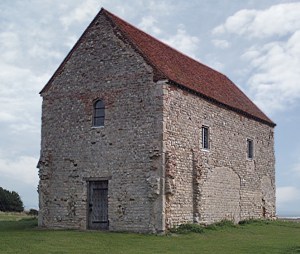
Sigeberht was persuaded to become a Christian by, his friend, the Northumbrian king, Oswiu. In about 653, on one of his frequent visits to Northumbria, Sigeberht and his retinue were baptized by Finan, bishop of Lindisfarne.[*] Bede relates that Sigeberht:
… having now become a citizen of the eternal kingdom, returned to the seat of his temporal kingdom, requesting of King Oswiu that he would give him some teachers, to convert his nation to the faith of Christ, and cleanse them in the fountain of salvation. Wherefore Oswiu, sending into the province of the Middle Angles [the east Midlands], summoned the man of God, Cedd, and, giving him another priest for his companion, sent them to preach the Word to the East Saxons. When these two, travelling to all parts of that country, had gathered a numerous Church to the Lord, it happened once that Cedd returned home, and came to the church of Lindisfarne to confer with Bishop Finan; who, finding that the work of the Gospel had prospered in his hands, made him bishop of the nation of the East Saxons, calling to him two other bishops to assist at the ordination. Cedd, having received the episcopal dignity, returned to his province, and pursuing the work he had begun with more ample authority, built churches in divers places, and ordained priests and deacons to assist him in the Word of faith, and the ministry of Baptism, especially in the city which, in the language of the Saxons, is called Ythancæstir [Bradwell-on-Sea], as also in that which is named Tilaburg [Tilbury]. The first of these places is on the bank of the Penta [Blackwater], the other on the bank of the Thames. In these, gathering a flock of Christ’s servants, he taught them to observe the discipline of a rule of life, as far as those rude people were then capable of receiving it.HE III, 22
At some indeterminate time after Cedd had returned to Essex – “no small time”, says Bede – Sigeberht was murdered by two brothers, relatives of his, and, according to Bede, when asked why they had killed Sigeberht, the brothers replied that:
… they had been incensed against the king, and hated him, because he was too apt to spare his enemies, and calmly forgave the wrongs they had done him, upon their entreaty.HE III, 22
Bede then goes on to explain that, in fact, Sigeberht’s death was divine retribution. In earlier times, he had dined at the house of one of his killers when forbidden to do so, because the man had been excommunicated by Cedd for being unlawfully married. On his journey home, Sigeberht had been met by Cedd:
The king, beholding him, immediately dismounted from his horse, trembling, and fell down at his feet, begging pardon for his offence; for the bishop, who was likewise on horseback, had also alighted. Being much incensed, he touched the prostrate king with the rod he held in his hand, and spoke thus with the authority of his office: “I tell thee, forasmuch as thou wouldest not refrain from the house of that sinful and condemned man, thou shalt die in that very house.” Yet it is to be believed, that such a death of a religious man not only blotted out his offence, but even added to his merit; because it happened on account of his piety and his observance of the commands of Christ.HE III, 22
6 . . – 664 Swithhelm
Son of Seaxbald. Co-ruler of Swithfrith?
6 . . – 66 . Swithfrith ?
Son of Seaxbald? Co-ruler of Swithhelm?
Bede says (HE III, 22) that Sigeberht II: “was succeeded in the kingdom by Swithhelm, the son of Seaxbald”.[*] He adds that Swithhelm was baptized by Cedd, bishop of the East Saxons, at Rendlesham – a “royal township” of the East Angles – and that Æthelwald, king of the East Angles, stood as Swithhelm’s godfather, which circumstance very much suggests that Æthelwald had secured overlordship of Essex. Bede implies (HE III, 30) that Swithhelm died around the time that the “disastrous plague” struck, in 664.
A King Swithfrith, otherwise unknown, appears in a charter (S1246) as the donor of land at Barking, used for the foundation of a double monastery (i.e. with a community of men and a community of women). The foundation date of the monastery is not precisely known, but the early 660s seems likely.
Barbara Yorke has made the attractive suggestion that Swithhelm and Swithfrith were the brothers who, as Bede reported, killed Sigeberht II.[*]
664 – 688 ? Sigehere
Son of Sigeberht. Co-ruler of Sæbbi.
664 – 694 Sæbbi (St Sebbi)
Son of Seaxred. Co-ruler of Sigehere. [*]
Bede:
… the Kings Sigehere and Sæbbi, though themselves subject to Wulfhere, king of the Mercians, governed the province of the East Saxons after Swithhelm …[*]HE III, 30
… [in 664] a sudden pestilence depopulated first the southern parts of Britain, and afterwards attacking the province of the Northumbrians, ravaged the country far and near, and destroyed a great multitude of men.HE III, 27
When that province [i.e. Essex] was suffering from the aforesaid disastrous plague, Sigehere, with his part of the people, forsook the mysteries of the Christian faith, and turned apostate. For the king himself, and many of the commons and nobles, loving this life, and not seeking after another, or even not believing in any other, began to restore the temples that had been abandoned, and to adore idols, as if they might by those means be protected against the plague. But Sæbbi, his companion and co-heir of the same kingdom, with all his people, very devoutly preserved the faith which he had received, and, as we shall show hereafter, ended his faithful life in great felicity.HE III, 30
Wulfhere despatched his bishop, Jaruman, to restore Sigehere’s territory to Christianity:
He [Jaruman] acted with much discretion, as I was informed by a priest who bore him company in that journey, and had been his fellow labourer in the Word, for he was a religious and good man, and travelling through all the country, far and near, brought back both the people and the aforesaid king to the way of righteousness, so that, either forsaking or destroying the temples and altars which they had erected, they opened the churches, and gladly confessed the Name of Christ, which they had opposed, choosing rather to die in the faith of resurrection in Him, than to live in the abominations of unbelief among their idols. Having thus accomplished their works, the priests and teachers returned home with joy.HE III, 30
Mercia’s fortunes suffered a setback when, probably in 674, Wulfhere was defeated by Ecgfrith, king of Northumbria. In fact, although his position is not acknowledged by Bede, and the Anglo-Saxon Chronicle doesn’t grant him the title Bretwalda, it seems likely that Wulfhere had, indeed, become overlord of all the English kingdoms south of the Humber. The army that fought Ecgfrith contained forces from all of southern England.[*] Wulfhere’s defeat loosened his grip on power. In 675 he is reported fighting against the West Saxons (Anglo-Saxon Chronicle), and in the same year he died.
According to Roger of Wendover, Sigehere died in 683, but, as we shall see, this would appear to be too early. In 686, as reported by the Anglo-Saxon Chronicle, Kent was ravaged by Cædwalla, the newly established king of Wessex, and his brother, Mul. Cædwalla evidently installed Mul as king in Kent. Mul was burned to death by Kentish rebels in 687, and Cædwalla, once more, assailed Kent. In 688, however, perhaps realizing he was fatally ill, Cædwalla abdicated. During this brief period, it seems likely that Cædwalla had also established himself as overlord of Essex.
A Kentish charter of Cædwalla (S233) is witnessed by Sigehere, and refers to Sigehere’s conquest of Kent. It would seem, then, that Sigehere had aided Cædwalla, and, like Mul, ruled in Kent. In 689, though, Sæbbi’s son, Swæfheard, appears as co-ruler of Kent, alongside Oswine, a member of the Kentish royal family. Both of these kings acknowledged Æthelred of Mercia as their overlord (S10 and S12).[*] So, perhaps, whilst Sigehere had thrown in his lot with Cædwalla, Sæbbi had been unimpressed, and, when Cædwalla abdicated, he and Æthelred took the opportunity to turn the situation to their own advantage. Sigehere would have been removed from power, both in Kent and Essex, at this time – certainly, nothing more is heard of him. Æthelred appears, from charters, to have had authority in London and Middle Saxon territory, but not in the East Saxon heartland.
Bede (HE IV, 7–10) quotes a number of stories from a book (which itself no longer exists) concerned with miraculous happenings at the monastery of Barking. He rounds off his extracts:
At that time, as the same little book informs us, Sæbbi, a very devout man, of whom mention has been made above, governed the kingdom of the East Saxons. His mind was set on religious acts, frequent prayer and pious fruits of almsgiving; he esteemed a private and monastic life better than all the wealth and honours of his kingdom, and he would have long before left his kingdom and adopted that life, had not his wife firmly refused to be divorced from him; for which reason many were of opinion and often said that a man of such a disposition ought rather to have been made a bishop than a king. When he had spent 30 years as a king and a soldier of the heavenly kingdom, he fell into great bodily infirmity, of which he afterwards died, and he admonished his wife, that they should then at least together devote themselves to the service of God, since they could no longer together enjoy, or rather serve, the world. Having with much difficulty obtained this of her, he went to Waldhere, bishop of London, who had succeeded Eorcenwald, and with his blessing received the religious habit, which he had long desired. He also carried to him a considerable sum of money, to be given to the poor, reserving nothing to himself, but rather coveting to remain poor in spirit for the sake of the kingdom of Heaven.
When the aforesaid sickness increased, and he perceived the day of his death to be drawing near, being a man of a royal disposition, he began to apprehend lest, when in great pain, at the approach of death, he might commit anything unworthy of his character, either by word or gesture. Wherefore, calling to him the aforesaid bishop of London, in which city he then was, he entreated him that none might be present at his death, besides the bishop himself, and two of his own attendants. The bishop having promised that he would most willingly grant his request, not long after the man of God composed himself to sleep, and saw a consoling vision, which took from him all anxiety concerning the aforesaid uneasiness; and, moreover, showed him on what day he was to end his life. For, as he afterwards related, he saw three men in shining garments come to him; one of whom sat down by his bed, whilst his companions who had come with him stood and inquired about the state of the sick man they had come to visit, and he said that the king’s soul should quit his body without any pain, and with a great splendour of light; and told him that he should die the third day after. Both these things came to pass, as he had learnt from the vision; for on the third day after, at the ninth hour [about 3 in the afternoon], he suddenly fell, as it were, into a light slumber, and without any sense of pain he gave up the ghost.
A stone sarcophagus had been prepared for his burial, but when they came to lay him in it, they found his body a hand’s breadth longer than the sarcophagus. Hereupon they chipped away as much of the stone as they could, and made the sarcophagus about two fingers’ breadth longer; but not even so would it contain the body. Wherefore because of this difficulty of entombing him, they had thoughts either to get another coffin, or else to shorten the body, by bending it at the knees, if they could, so that the coffin might contain it. But a wonderful thing, wrought by Heaven alone, prevented the execution of either of those designs; for on a sudden, in the presence of the bishop and Sigeheard (who was the son of that same king and monk, and who reigned after him jointly with his brother Swæfred), and of no small number of men, that sarcophagus was found to fit the length of the body, insomuch that a pillow might even be put in at the head; and at the feet the sarcophagus was 4 fingers’ breadth longer than the body.[*] He was buried in the church of the blessed teacher of the Gentiles [St Paul’s, London], by whose doctrine he had learned to hope for heavenly things.HE IV, 11
694 – after 704 Sigeheard
Son of Sæbbi. Co-ruler of Swæfred.
694 – after 705 Swæfred
Son of Sæbbi. Co-ruler of Sigeheard.[*]
70 . – 709 Offa
Son of Sigehere. Sub-king?
Bede says (HE IV, 11) that Sigeheard and Swæfred succeeded their father, Sæbbi, after the latter’s reign of thirty years, which means they came to the throne c.694.
Æthelred, king of Mercia, was succeeded in 704 by his nephew, Cenred. Like his uncle, Cenred seems to have had overlordship of London and the Middle Saxons, but not of the East Saxon heartland.
A letter from Waldhere, bishop of London, to Berhtwald, archbishop of Canterbury, written in 704 or 5, tells of disputes between Ine, king of Wessex and “the rulers of our country”, a phrase which could include Cenred as well the East Saxon kings. A peace treaty had been arranged – the East Saxons agreed not to shelter West Saxon exiles, Ine agreed not to carry out his threats – and Waldhere was keen to attend a council at Brentford to settle the matter.
When the reigns of Sigeheard and Swæfred ended is not known. Sigeheard features in a charter of 704x709 (S1785) – he and Cenred gave permission for a transfer of land at Fulham, in Middlesex, to Waldhere. Swæfred granted land at Dengie, in Essex, to Ingwald, Waldhere’s successor (S1787). Ingwald’s succession is only loosely dated 705x716.
William of Malmesbury states (GR I §98) that Sæbbi’s sons: “Sigeheard and Swæfred reigned after him. On their decease, Offa, the son of Sigehere, governed the kingdom for a short time”.[*] However, charters indicate that Offa’s reign overlapped with Swæfred’s,[*] so it could have overlapped with Sigeheard’s also. Further, it may be, as argued by Barbara Yorke, that Offa was a lower ranking ruler than Sigeheard and Swæfred.[*] Bede calls him “Offa, king of the East Saxons” in the heading for Chapter 19 of HE Book V, but in the text describes Offa as “the son of Sigehere, the king of the East Saxons whom we mentioned before … a youth of a most pleasing age and comeliness, and greatly desired by all his nation to have and to hold the sceptre of the kingdom”, which would seem to be saying that, though the East Saxons were looking forward to his accession, Offa was not yet a full king. On the other hand, Offa’s is one of the late-9th century East Saxon royal pedigrees in BL Add. MS 23211, and he is rex (king) in the extract of his grant of land at Hemel Hempstead, in Hertfordshire, to Bishop Waldhere (S1784).
The water is further clouded by a charter (S64) which records the grant of parcels of land in the West Midlands – in the territory of the Hwicce – to the church of Worcester, by an Offa. As it has survived (in 11th century cartularies), the charter calls this Offa rex Merciorum (king of the Mercians), but later he is referred to as subregulus (sub-king). The charter’s witness-list is chronologically incompatible with, the famous, Mercian Offa, but it is compatible with the East Saxon Offa. It is generally supposed that Offa rex Merciorum is actually Offa of Essex. On the assumption that this identification is correct, J.R. Maddicott points out: “although a case has been made for seeing him as sub his two putative East Saxon partners, it is perhaps more likely that he was under-king to a Mercian overlord.”[*] Whatever his exact status, it is possible that Offa had a Hwiccian mother, whose estates would have enabled him to make the grant.
Offa evidently had close ties to Cenred. In 709:
… Cenred, who had for some time nobly governed the kingdom of the Mercians, much more nobly quitted the sceptre of his kingdom. For he went to Rome, and there receiving the tonsure and becoming a monk, when Constantine was pope [708–715], he continued to his last hour in prayer and fasting and alms-deeds at the threshold of the Apostles… With him went the son of Sigehere, the king of the East Saxons whom we mentioned before, by name Offa, a youth of a most pleasing age and comeliness, and greatly desired by all his nation to have and to hold the sceptre of the kingdom. He, with like devotion, quitted wife, and lands, and kindred and country, for Christ and for the Gospel, that he might “receive an hundred-fold in this life, and in the world to come life everlasting.” He also, when they came to the holy places at Rome, received the tonsure, and ending his life in the monastic habit, attained to the vision of the blessed Apostles in Heaven, as he had long desired.[*]HE V, 19
Barbara Yorke suggests that, rather than choosing to make a pilgrimage to Rome out of religious devotion, Cenred and Offa were in fact political exiles – they were ousted.[*] Be that as it may, both men evidently died soon after their arrival in Rome.[*]
Offa is the last East Saxon king mentioned by Bede.
7 . . – 738 Swæfberht
Co-ruler of Selered?
Symeon of Durham (HR), s.a. 738, notes that “Swæfberht, king of the East Saxons, died.” Swæfberht does not feature in any surviving genealogy or charter.
709 ? – 746 Selered
Son of Sigeberht.[*] Co-ruler of Swæfberht?
The Chronicon genealogical table, Chronicon memorandum and William of Malmesbury have no knowledge of Swæfberht, and Selered is presented as successor to Offa (who abdicated in 709).
A charter (S87) of the Mercian king Æthelbald has a Selered in the witness-list. The charter is ostensibly dated 737/38 (i.e. Æthelbald’s 22nd regnal year), but there are suspicions that this date is too late – it has been suggested that the charter actually belongs to Æthelbald’s 1st year, i.e. 716/7.[*] Assuming the charter is earlier than it purports to be, and assuming the Selered (Seleræd) in the witness-list is the East Saxon King Selered (the witnesses are not given titles in this charter), then Selered’s reign overlapped with that of Swæfberht.
Bede notes (HE V, 23) that, in 731, the time he was writing, Æthelbald was overlord of all the English kingdoms south of the Humber. The freedom with which his charters show Æthelbald operating in London and the Middle Saxon province indicates ownership of that territory finally passed from Essex to Mercia during his reign.
The Anglo-Saxon Chronicle reports s.a. 746: “In this year King Selered was slain.”
746 – after 758 Swithred
Son of Sigemund.
According to the Chronicon genealogical table and memorandum, and William of Malmesbury, Swithred succeeded Selered. Swithred’s pedigree (BL Add. MS 23211) shows him to be the son of, the otherwise unknown, Sigemund, and grandson of King Sigeheard.[*]
Florence of Worcester, s.a. 758: “At this period Swithred was king of the East Saxons”.
7 . . – 798 Sigeric
Son of Selered. Died after 798.
Sigeric is shown as Swithred’s successor in the Chronicon genealogical table. He is identified as Selered’s son in the table and in the pedigree of his own son, Sigered, in BL Add. MS 23211.
In 757 Æthelbald had been murdered. Mercian overlordship of the southern kingdoms evidently died with him. Offa emerged from a civil war as the new king of Mercia, and he began the process of re-establishing Mercian supremacy. How Essex fared during Offa’s reign is not known. There can be no certainty that an East Saxon king continued to rule. Soon after Offa’s death in 796, however, the East Saxon dynasty reappears. Anglo-Saxon Chronicle Manuscript F has an addition s.a. 798, in the margin, which states: “Sigeric, king of the East Saxons, went to Rome.” Possibly Sigeric, with the title dux, had witnessed a charter of Ecgfrith, Offa’s successor, in 796 (S151).
798 ? – 825 ? Sigered
Son of Sigeric.
Sigered is the final East Saxon king in the Chronicon genealogical table. He is identified as Sigeric’s son in the table and in his pedigree – the third and last East Saxon pedigree in BL Add. MS 23211. He figures in the witness-list of two charters of, Mercian king, Cenwulf, dated 811 (S165; S168), in which he is titled rex, but just a year later his status has been downgraded to subregulus (S170). He also appears as subregulus in a charter of, Cenwulf’s successor, Ceolwulf, dated 823 (S187).[*]
Following his victory over Beornwulf of Mercia, in 825, Egbert of Wessex despatched a force into Kent. The incumbent ruler (Baldred, apparently a Mercian appointee) was driven off. Kent, Essex, Sussex, and also Surrey, then submitted to Egbert – perhaps Sigered, like Baldred, was expelled – and these provinces were combined to form an eastern sub-kingdom of Wessex.
In 827 Wiglaf became king of Mercia. He was expelled by Egbert in 829. Egbert appears to have overreached himself, however, and Wiglaf was restored in 830 (he ruled until 839/40). The bishop of London leased a parcel of land at Braughing, in Hertfordshire, to a minister of Wiglaf called Sigeric, who is styled “king of the East Saxons” (S1791). No doubt this Sigeric was a close relative of Sigered. Possibly he was operating only in the, Mercian held, Middle Saxon province (i.e. Middlesex and southern and eastern Hertfordshire), but there is a possibility that Wiglaf had managed to recover Mercian overlordship of Essex. If so, it was a temporary blip, and in 860 the eastern sub-kingdom was integrated into Wessex.