KENT
According to tradition, the first Anglo-Saxon settlers were invited to Britain by King Vortigern.[*] Led by brothers Hengist and Horsa, they were employed as mercenaries – fighting off the predatory Picts and Scots. Bede provides a date of 449 for this so-called Adventus Saxonum (Coming of the Saxons). At the time, Kent was a British kingdom, but legend tells how Vortigern exchanged it for Hengist’s beautiful daughter, over the head of Gwyrangon, the incumbent British ruler.
The main town of Anglo-Saxon Kent developed on the site of the Roman town of Durovernum Cantiacorum. It was called Cantwaraburh (‘stronghold of the people of Kent’), now Canterbury. The kingdom’s influence peaked under Æthelberht I (d.616). Æthelberht received missionaries sent by Pope Gregory I, and he became the first Christian Anglo-Saxon king. Canterbury, albeit by default, became the centre of the English Church. By the end of the 8th century Kent was firmly under Mercian control. In the aftermath of the decisive defeat of Mercia by Wessex (at the battle of Ellendun in 825), Kent surrendered to, and in the fullness of time was absorbed into, Wessex.
King of Kent
488 – 512 Oisc / Æsc
Son of Hengist.
512 – 5 . . Octa
Son of Oisc.
5 . . – 560 ? Eormenric
Son of Octa.
Bede says that Hengist’s son was called Oeric, but he was known as Oisc, and was apparently regarded as founder of the ruling dynasty of Kent:
… Æthelberht was the son of Eormenric, whose father was Octa, whose father was Oeric, surnamed Oisc, from whom the kings of the people of Kent are wont to be called Oiscingas. His father was Hengist, who, being invited by Vortigern, first came into Britain, with his son Oisc …[*]HE II, 5
Hengist’s brother, Horsa, is said to have died in battle against Vortigern (in 455 says the Anglo-Saxon Chronicle), leaving Hengist and his son Æsc (Bede’s Oisc) in control of Kent. The Chronicle reports that, in 488, “Æsc succeeded to the kingdom, and for 24 winters was king of the people of Kent”, but it makes no mention of Oisc/Æsc’s supposed son, Octa.
Octa figures briefly in the yarn spun by the Historia Brittonum (§38),[*] where he is Hengist’s son, not Oisc’s son as stated by Bede. Octa and his cousin, Ebissa, were settled in the North, but after Hengist’s death, Octa “came from the sinistral part of Britain [i.e. the North] to the kingdom of the people of Kent, and from him are sprung the kings of the people of Kent.” (§56).
Whilst Hengist, Oisc and Octa are characters in a story, Æthelberht’s father, Eormenric (his name is only known from genealogies), is clearly a historical figure.
Eormenric had a daughter called Ricula – actually, Bede (HE II, 3) says only that she was Æthelberht’s sister – who was married to Sledd, king of Essex. Indeed, Sledd may well have owed his position to Kentish support.[*]
560 ? – 616 Æthelberht I (St Ethelbert)
Son of Eormenric.
According to an entry found only in Manuscript F of the Anglo-Saxon Chronicle, Æthelberht was born in 552. Manuscript F is relatively late (c.1100x1110), and its source for this snippet of information is not evident. It would make Æthelberht only eight-years-old when he succeeded to the kingdom, assuming it took place in 560, as implied by Bede (HE II, 5). In this instance, however, Bede’s dating is problematic, and Æthelberht’s accession may well have been considerably later. All manuscripts of the Chronicle agree that, in 568, Æthelberht was defeated by the West Saxon king, Ceawlin, and his brother Cutha, who “drove him into Kent; and slew two ealdormen at Wibbandune [unidentified], Oslaf and Cnebba.” This is the first recorded conflict between Anglo-Saxon kingdoms – it was probably over the control of Surrey – however, there are also chronological difficulties with the Chronicle in its record of Wessex’s beginnings, and it seems likely that it is dated much too early. At any rate, despite his apparently inauspicious start, Æthelberht went on to become “the third of the English kings who ruled over all the southern provinces that are divided from the northern by the river Humber and the borders contiguous to it”. (HE II, 5). Taking its cue from Bede, the Chronicle lists him as the third Bretwalda. How and when Æthelberht achieved this accolade is not recorded, but the previous ruler so honoured was Ceawlin, who the Chronicle indicates had been overthrown in 591.
In 596, Pope Gregory I (‘the Great’), “being moved by Divine inspiration”, says Bede (HE I, 23), despatched a team of missionaries “to preach the Word of God to the English nation”. Christianity had, of course, been introduced into Britain centuries earlier, before the end of Roman times, and it still flourished amongst the Britons in the West, but the Anglo-Saxon incomers had brought their pagan religion with them, and there had, apparently, been no attempt by the resident British clergy to convert them to Christianity.[*] And so it was that a band of monks, from the monastery of St Andrew, which Gregory had founded, led by Augustine, prior of the monastery, set off from Rome. They soon got cold feet, however:
… when they had gone but a little way on their journey, [they] were seized with craven terror, and began to think of returning home, rather than proceed to a barbarous, fierce, and unbelieving nation, to whose very language they were strangers …HE I, 23
Augustine was sent back to ask Gregory to cancel the mission. Gregory replied in a letter (quoted by Bede), dated 23rd July 596, in which he, in effect, told the monks to pull themselves together and get on with it:
Forasmuch as it had been better not to begin a good work, than to think of desisting from one which has been begun, it behoves you, my beloved sons, to fulfil with all diligence the good work, which, by the help of the Lord, you have undertaken. Let not, therefore, the toil of the journey, nor the tongues of evil-speaking men, discourage you; but with all earnestness and zeal perform, by God’s guidance, that which you have set about; being assured, that great labour is followed by the greater glory of an eternal reward. When Augustine, your Superior, returns, whom we also constitute your abbot, humbly obey him in all things; knowing, that whatsoever you shall do by his direction, will, in all respects, be profitable to your souls. Almighty God protect you with His grace, and grant that I may, in the heavenly country, see the fruits of your labour, inasmuch as, though I cannot labour with you, I shall partake in the joy of the reward, because I am willing to labour. God keep you in safety, my most beloved sons.HE I, 23
In 597, probably in Spring, Augustine’s party arrived in Britain:
At that time, King Æthelberht, who reigned in Kent, was most powerful; he had extended his dominions as far as the boundary formed by the great river Humber, by which the southern Angles are divided from the northern. On the east of Kent is the large Isle of Thanet, containing, according to the English way of reckoning, 600 families, divided from the mainland by the river Wantsum, which is about three furlongs (600 metres) in breadth, and which can be crossed only in two places; for at both ends it runs into the sea.[*] On this island landed the servant of the Lord, Augustine, and his companions, being, as is reported, nearly 40 men. They had obtained, by order of the blessed Pope Gregory, interpreters of the nation of the Franks, and sending to Æthelberht, signified that they were come from Rome, and brought a joyful message, which most undoubtedly assured to those that hearkened to it everlasting joys in heaven, and a kingdom that would never end, with the living and true God. The king hearing this, gave orders that they should stay in the island where they had landed, and be furnished with necessaries, till he should consider what to do with them. For he had before heard of the Christian religion, having a Christian wife of the royal family of the Franks, called Bertha; whom he had received from her parents, upon condition that she should be permitted to preserve inviolate the rites of her religion with the Bishop Liudhard, who was sent with her to support her in the faith. Some days after, the king came into the island, and sitting in the open air, ordered Augustine and his companions to come and hold a conference with him. For he had taken precaution that they should not come to him in any house, lest, by so coming, according to an ancient superstition, if they practised any magical arts, they might impose upon him, and so get the better of him. But they came endued with Divine, not with magic power, bearing a silver cross for their banner, and the image of our Lord and Saviour painted on a board; and chanting litanies, they offered up their prayers to the Lord for the eternal salvation both of themselves and of those to whom and for whom they had come. When they had sat down, in obedience to the king’s commands, and preached to him and his attendants there present the Word of life, the king answered thus: “Your words and promises are fair, but because they are new to us, and of uncertain import, I cannot consent to them so far as to forsake that which I have so long observed with the whole English nation. But because you are come from far as strangers into my kingdom, and, as I conceive, are desirous to impart to us those things which you believe to be true, and most beneficial, we desire not to harm you, but will give you favourable entertainment, and take care to supply you with all things necessary to your sustenance; nor do we forbid you to preach and gain as many as you can to your religion.” Accordingly he gave them an abode in the city of Canterbury, which was the metropolis of all his dominions, and, as he had promised, besides supplying them with sustenance, did not refuse them liberty to preach. It is told that, as they drew near to the city, after their manner, with the holy cross, and the image of our sovereign Lord and King, Jesus Christ, they sang in concert this litany: “We beseech thee, Lord, for Thy great mercy, that Thy wrath and anger be turned away from this city, and from Thy holy house, for we have sinned. Hallelujah.”Bede HE I, 25
Augustine’s team took up residence in Canterbury, in the house allotted them by Æthelberht, and began “preaching the Word of life to as many as they could”:
In brief, some believed and were baptized, admiring the simplicity of their blameless life, and the sweetness of their heavenly doctrine. There was, moreover, near the city itself, to the east, a church built in ancient times in honour of St Martin, whilst the Romans still inhabited Britain, wherein the queen, who, as has been said before, was a Christian, was wont to pray. In this they [Augustine’s party] also first began to come together, to chant the Psalms, to pray, to celebrate Mass, to preach, and to baptize, till when the king had been converted to the faith, they obtained greater liberty to preach everywhere and build or restore churches. When he [Æthelberht], among the rest, believed and was baptized, attracted by the pure life of these holy men and their gracious promises, the truth of which they established by many miracles, greater numbers began daily to flock together to hear the Word, and, forsaking their heathen rites, to have fellowship, through faith, in the unity of Christ’s Holy Church. It is told that the king, while he rejoiced at their conversion and their faith, yet compelled none to embrace Christianity, but only showed more affection to the believers, as to his fellow citizens in the kingdom of Heaven. For he had learned from those who had instructed him and guided him to salvation, that the service of Christ ought to be voluntary, not by compulsion. Nor was it long before he gave his teachers a settled residence suited to their degree in his metropolis of Canterbury, with such possessions of divers sorts as were necessary for them.Bede HE I, 26
At this point, Bede says that Augustine travelled all the way back to the south of Gaul: “to Arles, and, according to the orders received from the holy Father Gregory, was ordained archbishop of the English nation by Etherius, archbishop of that city.” (HE I, 27). However, one of Pope Gregory’s surviving letters (MGH VIII, 29), written to Eulogius, patriarch of Alexandria, in July 598, indicates that Augustine had already been ordained by the time he arrived in Britain:
The English race, situated in the far corner of the world, has hitherto remained in unbelief, worshiping stocks and stones; but aided by your prayers I made up my mind (it was God who prompted me) to send a monk of my own monastery to them to preach. With my leave, he was made a bishop by the bishops of Germany, and, with their encouragement, reached that nation at the end of the world. And now letters have just arrived telling us of his safety and of his work. They show that he and those who were sent out with him shine amongst that nation with such miracles that they seem to imitate the mighty works of the Apostles in the signs which they display. And at Christmas last more than ten thousand English people, we are informed, were baptized by our brother and fellow-bishop. I tell you this that you may know not only what your words are doing at Alexandria, but also what your prayers are doing at the world’s end.
Presumably Bede didn’t have access to this letter – it is hard to believe that he would not have quoted the supposed number of converts (clearly “more that ten thousand” is an exaggeration) made at Christmas 597 – so, presumably, he inferred the time and place of Augustine’s ordination from the materials he did have access to.[*]
At any rate, in 601:
… Pope Gregory, hearing from Bishop Augustine, that the harvest which he had was great and the labourers but few, sent to him … certain fellow labourers and ministers of the Word, of whom the chief and foremost were Mellitus, Justus, Paulinus, and Rufinianus, and by them all things in general that were necessary for the worship and service of the Church, to wit, sacred vessels and altar-cloths, also church-furniture, and vestments for the bishops and clerks, as likewise relics of the holy Apostles and martyrs; besides many manuscripts. He also sent a letter, wherein he signified that he had despatched the pallium to him, and at the same time directed how he should constitute bishops in Britain.Bede HE I, 29
Bede quotes Gregory’s letter to Augustine, which is dated 22nd June 601. In a nutshell, Gregory’s grand plan (which never came to fruition) was that there should be an archbishop in London and an archbishop in York, each having twelve bishops under him. The senior archbishop would be whichever of the two had been ordained first, but, in the meantime, Augustine would be the senior churchman in Britain for as long as he lived.[*]
In another letter dated 22nd June 601, also quoted by Bede, Pope Gregory wrote to Æthelberht:
Bishop Gregory, to his most excellent son, the glorious lord Æthelberht, king of the English.
Almighty God advances good men to the government of nations, that He may by their means bestow the gifts of His loving kindness on those over whom they are placed. This we know to have come to pass in the English nation, over whom your Highness was placed, to the end, that by means of the blessings which are granted to you, heavenly benefits might also be conferred on your subjects. Therefore, my illustrious son, do you carefully guard the grace which you have received from the Divine goodness, and be eager to spread the Christian faith among the people under your rule; in all uprightness increase your zeal for their conversion; suppress the worship of idols; overthrow the structures of the temples; establish the manners of your subjects by much cleanness of life, exhorting, terrifying, winning, correcting, and showing forth an example of good works, that you may obtain your reward in Heaven from Him, Whose Name and the knowledge of Whom you have spread abroad upon earth. For He, Whose honour you seek and maintain among the nations, will also render your Majesty’s name more glorious even to posterity… let your Highness hasten to impart to the kings and peoples that are subject to you, the knowledge of one God, Father, Son, and Holy Ghost; that you may surpass the ancient kings of your nation in praise and merit, and while you cause the sins of others among your own subjects to be blotted out, become the more free from anxiety with regard to your own sins before the dread judgement of Almighty God…HE I, 32
In the year of our Lord 604, Augustine, archbishop of Britain, ordained two bishops, to wit, Mellitus and Justus; Mellitus to preach to the province of the East Saxons, who are divided from Kent by the river Thames, and border on the Eastern sea. Their metropolis is the city of London, which is situated on the bank of the aforesaid river, and is the mart of many nations resorting to it by sea and land. At that time, Sæberht, nephew to Æthelberht through his sister Ricula, reigned over the nation, though he was under subjection to Æthelberht, who, as has been said above, had command over all the nations of the English as far as the river Humber. But when this province also received the word of truth, by the preaching of Mellitus, King Æthelberht built the church of St Paul the Apostle, in the city of London, where he and his successors should have their episcopal see. As for Justus, Augustine ordained him bishop in Kent itself, in the city of Dorubrevis, which the English call Hrofæscæstræ [Rochester], from one that was formerly the chief man of it, called Hrof. It is about 24 miles distant from the city of Canterbury to the westward, and in it King Æthelberht dedicated a church to the blessed Apostle Andrew, and bestowed many gifts on the bishops of both those churches, as well as on the bishop of Canterbury, adding lands and possessions for the use of those who were associated with the bishops.Bede HE II, 3
The creation of a diocese at Rochester is one of a number of hints tending to suggest that the kingdom of Kent had been formed from two pre-existing ‘peoples’.[*] Presumably during the 6th century, the eastern-Kentish people had annexed the territory of the western-Kentish, and, as a result, there was a dominant king, the nominal king of Kent, based in Canterbury, but there was also a subordinate king who ruled in West Kent, based in Rochester. Barbara Yorke, indeed, asserts that later forged charters “preserve a tradition” that Æthelberht’s son, Eadbald, ruled alongside his father.
As well as his nephew, Sæberht (who, according to Manuscript E of the Anglo-Saxon Chronicle, s.a. 604, had been “set as king” of the East Saxons by Æthelberht), Æthelberht persuaded/coerced Rædwald, king of the East Angles, to be “initiated into the mysteries of the Christian faith in Kent” (HE II, 15). This was hardly a successful conversion, however, since its only practical result would appear to have been that Rædwald had a Christian altar installed alongside the pagan altar in his temple.
Augustine had restored:
… with the support of the king, a church, which he was informed had been built of old by the faithful among the Romans, and consecrated it in the name of the Holy Saviour, our Divine Lord Jesus Christ, and there established a residence for himself and all his successors [this is the beginning of Canterbury Cathedral]. He also built a monastery not far from the city to the eastward, in which, by his advice, Æthelberht erected from the foundation the church of the blessed Apostles, Peter and Paul, and enriched it with divers gifts; wherein the bodies of the same Augustine, and of all the bishops of Canterbury, and of the kings of Kent, might be buried [this is the beginning of St Augustine’s Abbey].Bede HE I, 33
On the 26th of May, of a year between 604 and 609 (Bede had no knowledge of which year), Augustine died:
… and his body was laid outside, close by the church of the blessed Apostles, Peter and Paul, above spoken of, because it was not yet finished, nor consecrated, but as soon as it was consecrated, the body was brought in, and fittingly buried in the north chapel thereof …HE II, 3
Laurence succeeded Augustine in the bishopric, having been ordained thereto by the latter in his lifetime, lest, upon his death, the Church, as yet in so unsettled a state, might begin to falter if it should be destitute of a pastor even for an hour.HE II, 4
Laurence, being advanced to the rank of archbishop, laboured indefatigably, both by frequent words of holy exhortation and constant example of good works to strengthen the foundations of the Church, which had been so nobly laid, and to carry it on to the fitting height of perfection. In short, he not only took charge of the new Church formed among the English, but endeavoured also to bestow his pastoral care upon the ancient inhabitants of Britain, as also of the Scots, who inhabit the island of Ireland, which is next to Britain. For when he understood that the life and profession of the Scots in their aforesaid country, as well as of the Britons in Britain, was not truly in accordance with the practice of the Church in many matters, especially that they did not celebrate the festival of Easter at the due time, but thought that the day of the Resurrection of our Lord ought, as has been said above [HE II, 2], to be observed between the 14th and 20th of the moon; he wrote, jointly with his fellow bishops, a hortatory epistle, entreating and conjuring them to keep the unity of peace and Catholic observance with the Church of Christ spread throughout the world… Also Laurence, with his fellow bishops, wrote a letter worthy of his rank to the priests of the Britons, by which he endeavoured to confirm them in Catholic unity; but what [little] he gained by so doing the present times still show. About this time, Mellitus, bishop of London, went to Rome, to confer with the Apostolic Pope Boniface [Boniface IV, 608–615] about the necessary affairs of the English Church. And when the same most reverend pope called a synod of the bishops of Italy, to prescribe rules for the life and peace of the monks, Mellitus also sat among them, in the 8th year of the Emperor Phocas, the 13th indiction, on the third of the Kalends of March [i.e. on the 27th of February 610], to the end that he also might sign and confirm by his authority whatsoever should be regularly decreed, and on his return into Britain might carry the decrees to the Churches of the English, to be committed to them and observed; together with letters which the same pope sent to the beloved of God, Archbishop Laurence, and to all the clergy; as likewise to King Æthelberht and the English nation.HE II, 4
Bede reports that:
In the year of our Lord 616, which is the 21st year after Augustine and his company were sent to preach to the English nation, Æthelberht, king of the people of Kent, having most gloriously governed his temporal kingdom 56 years, entered into the eternal joys of the kingdom of Heaven.[*]HE II, 5
Nothing could be clearer, Æthelberht died in 616, but Bede then adds:
King Æthelberht died on the 24th day of the month of February, 21 years after he had received the faith, and was buried in St Martin’s chapel within the church of the blessed Apostles Peter and Paul, where also lies his queen, Bertha.[*]HE II, 5
Bede had earlier (HE I, 26) given the impression that Æthelberht was baptized shortly after Augustine’s arrival in Kent, in 597, in which case, Æthelberht’s death, twenty-one years later (assuming “received the faith” means baptized), would be in 618, not 616. Possibly this is just a slip-up on Bede’s part.[*] If, though, Æthelberht had in fact already become a Christian in 595, before Augustine’s arrival – after all, Bertha had brought Bishop Liudhard to Kent with her (presumably he died prior to the arrival of Gregory’s missionaries) – Bede’s numbers would be reconciled. Pope Gregory, however, wrote to Bertha in 601 (MGH XI, 35; not quoted by Bede), criticizing her for having failed to convert her husband (“since you, illustrious Lady, are, as I said, furnished with right faith, and are also instructed in letters, this ought not to have been a slow or a difficult task for you”), but encouraging her to now make amends:
Confirm therefore the mind of your illustrious consort in his attachment to the Christian faith by constant exhortation; let your care pour into him an increased love of God, and inflame his soul for the complete conversion of the race of his subjects … Set yourself so earnestly and whole-heartedly to help our most reverend brother and fellow-bishop aforesaid [i.e. Augustine], and the servants of God whom we sent to those parts for the conversion of your nation, that you may reign here happily with our illustrious son, your consort, and after many years may receive also the joys of the life to come, which know no end.
This letter to Bertha would certainly seem to rule out the possibility that Æthelberht had been converted before Augustine’s arrival; and Gregory’s letter to Æthelberht, precisely dated 22nd June 601[*], surely leaves no room to doubt that he had been baptized by that time (see above). It is, moreover, difficult to imagine that the mass baptism at Christmas 597 could have taken place whilst the king himself remained pagan, so, on balance, it seems reasonable to suppose: that Æthelberht “received the faith” in 597 (as Bede suspected, though he didn’t know for sure); Bede’s remark that the king died “21 years after” is a careless error; that Bede believed Æthelberht died in 616.
A further implication of Bede’s figures is that Æthelberht succeeded to the kingdom of Kent in 560.[*] A reign of fifty-six years, though plainly not impossible, is somewhat unlikely for this period. It is widely suggested, therefore, that Æthelberht lived, rather than reigned, for that length of time, in which case he would have been born in 560. As previously mentioned, an entry in Manuscript F of the Anglo-Saxon Chronicle dates his birth to 552. The Frankish historian Gregory of Tours (538–594) says, after reporting Charibert’s succession to his share of his father’s kingdom in 561: “King Charibert took Ingoberg to wife, by whom he had a daughter, who afterwards married a man from Kent and was taken there.” (DLH IV, 26). The daughter of Charibert and Ingoberg is presumed to be Bertha, and the “man from Kent” Æthelberht. Charibert had a roving eye, and soon cast Ingoberg aside in favour of one of her servants. It would seem reasonable, therefore, to date Bertha’s birth to about 562, which would put her at marriageable age by 580. Gregory of Tours visited Ingoberg “a few months” before her death in 589, and he notes that she died: “leaving one daughter, who was married to the son of a certain king in Kent.” (DLH IX, 26). That Æthelberht was being described as the son of a king, presumably by his mother-in-law, in 589, suggests that, as far as Ingoberg knew at least, his father, Eormenric, was still ruling at that time.[*] Perhaps then, it is possible to suggest that, in round figures, Æthelberht was born about 560, was married to Bertha about 580 and became king of Kent about 590.[*]
Bede sums up Æthelberht’s reign:
Among other benefits which he conferred upon the nation under his care, he established, with the help of his council of wise men, judicial decrees [i.e. a law-code], after the Roman model; which are written in the language of the English, and are still kept and observed by them. Among which, he set down first what restitution should be made by anyone who steals anything belonging to the Church, the bishop, or the other clergy, for he was resolved to give protection to those whom he had received along with their doctrine.HE II, 5
Æthelberht’s law-code was drawn-up sometime after the arrival of Augustine. It still survives, albeit in a 12th century copy.[*]
616 – 640 Eadbald
Son of Æthelberht.
“But after the death of Æthelberht, the accession of his son Eadbald proved very harmful to the still tender growth of the new Church”, says Bede. Eadbald had refused to become a Christian and compounded this by marrying his father’s widow (whose name is not recorded):
By both which crimes he gave occasion to those to return to their former uncleanness, who, under his father, had, either for favour or fear of the king, submitted to the laws of the faith and of a pure life. Nor did the unbelieving king escape without the scourge of Divine severity in chastisement and correction; for he was troubled with frequent fits of madness, and possessed by an unclean spirit. The storm of this disturbance was increased by the death of Sæberht, king of the East Saxons …HE II, 5
Sæberht, Æthelberht’s Christian nephew, was succeeded by three sons who rejected Christianity and, subsequently, expelled Mellitus, bishop of London. It seems reasonable to suspect that their actions were as much to do with politics as religion. Christianity had been foisted on their father by his overlord, Æthelberht, and Mellitus had been installed in London by Æthelberht. So Sæberht’s sons were, in effect, throwing-off Kentish domination. They could do this because Kentish supremacy collapsed with Æthelberht’s death. The new power in southern England was the East Anglian king Rædwald. He had been converted to Christianity under Æthelberht’s auspices, but hedged his bets by continuing to worship pagan gods alongside Christ. At any rate, the ejected Bishop Mellitus travelled to Kent, to consult with Justus, bishop of Rochester, and Laurence, archbishop of Canterbury. Bede takes up the story:
… with one consent they determined that it was better for them all to return to their own country, where they might serve God in freedom of mind, than to continue to no purpose among barbarians, who had revolted from the faith. Mellitus and Justus accordingly went away first, and withdrew into the parts of Gaul, intending there to await the event of things.HE II, 5
Laurence was about to follow, when he had a dream:
… in the dead of night, the blessed chief of the Apostles [i.e. St Peter] appeared to him, and scourging him grievously a long time, asked of him with apostolic severity, why he was forsaking the flock which he had committed to him; or to what shepherd he was leaving, by his flight, Christ’s sheep that were in the midst of wolves. “Hast thou,” he said, “forgotten my example, who, for the sake of those little ones, whom Christ commended to me in token of His affection, underwent at the hands of infidels and enemies of Christ, bonds, stripes, imprisonment, afflictions, and lastly, death itself, even the death of the cross, that I might at last be crowned with Him?” Laurence, the servant of Christ, roused by the scourging of the blessed Peter and his words of exhortation, went to the king as soon as morning broke, and laying aside his garment, showed the scars of the stripes which he had received. The king, astonished, asked who had presumed to inflict such stripes on so great a man. And when he heard that for the sake of his salvation the bishop had suffered these cruel blows at the hands of the Apostle of Christ, he was greatly afraid; and abjuring the worship of idols, and renouncing his unlawful marriage, he received the faith of Christ, and being baptized, promoted and supported the interests of the Church to the utmost of his power. He also sent over into Gaul, and recalled Mellitus and Justus, and bade them return to govern their churches in freedom. They came back one year after their departure, and Justus returned to the city of Rochester, where he had before presided; but the people of London would not receive Bishop Mellitus, choosing rather to be under their idolatrous high priests; for King Eadbald had not so much authority in the realm as his father, and was not able to restore the bishop to his church against the will and consent of the pagans. But he and his nation, after his conversion to the Lord, sought to obey the commandments of God.HE II, 6
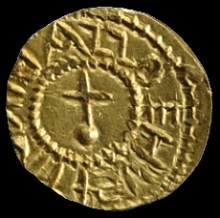
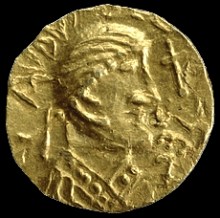 The inscription on the obverse is read as AVDVARLD REGES, which is interpreted as ‘of King Eadbald’. The inscription on the reverse is corrupt, but seems to include the name LONDENVS, i.e. London. The cross-on-globe motif, found on both sides of these coins, indicates that they were minted after Eadbald’s conversion. That they were minted in London suggests that Eadbald managed to re-establish some kind of authority in the city.
Before the end of the 7th century gold shillings had become very debased. They were supplanted by silver coins, frequently, though inappropriately, called ‘sceattas’.[*]
The inscription on the obverse is read as AVDVARLD REGES, which is interpreted as ‘of King Eadbald’. The inscription on the reverse is corrupt, but seems to include the name LONDENVS, i.e. London. The cross-on-globe motif, found on both sides of these coins, indicates that they were minted after Eadbald’s conversion. That they were minted in London suggests that Eadbald managed to re-establish some kind of authority in the city.
Before the end of the 7th century gold shillings had become very debased. They were supplanted by silver coins, frequently, though inappropriately, called ‘sceattas’.[*]The story of Eadbald’s conversion is clearly the stuff of legend, and other evidence indicates that he remained pagan for a number of years after Mellitus and Justus returned to Kent. Presumably Eadbald was the son of Æthelberht’s Frankish wife, Bertha, and according to tradition he married a Frankish princess, Emma, so perhaps it was Frankish diplomacy that persuaded him to allow the bishops to return and work under his protection, but, in the event, he didn’t have the power to force Mellitus back on the East Saxons. As it turned out, Mellitus was not out of a job for long. According to Bede’s figures (HE II, 7), Laurence died and was buried on 2nd February 619. Mellitus succeeded him as archbishop of Canterbury. He died and was buried on 24th April 624. Justus then succeeded to the post. Bede (HE II, 8) quotes a letter written to Justus by Pope Boniface V. The letter is undated, but, since Boniface died on 25th October 625, it can be placed during the year-and-a-half following Justus’ succession. It contains the following passage:
… having received letters from our son King Aduluald, we perceive with how much knowledge of the Sacred Word you, my brother, have brought his mind to the belief in true conversion and the certainty of the faith. Therefore, firmly confiding in the long-suffering of the Divine clemency, we believe that, through the ministry of your preaching, there will ensue most full salvation not only of the nations subject to him, but also of their neighbours; to the end, that as it is written, the recompense of a perfect work may be conferred on you by the Lord, the Rewarder of all the just; and that the universal confession of all nations, having received the mystery of the Christian faith, may declare, that in truth “Their sound is gone out into all the earth, and their words unto the end of the world.” We have also, my brother, moved by the warmth of our goodwill, sent you by the bearer of these presents, the pallium, giving you authority to use it only in the celebration of the Sacred Mysteries; granting to you likewise to ordain bishops when there shall be occasion, through the Lord’s mercy;[*] that so the Gospel of Christ, by the preaching of many, may be spread abroad in all the nations that are not yet converted.
In two other letters of Pope Boniface, quoted later by Bede, the name Eadbald appears in the form Audubald. The name Aduluald, in the above letter, is, however, a form of Æthelwald. Perhaps, then, this is evidence of joint rule in Kent. Perhaps this, otherwise unknown, King Æthelwald was the junior partner of Eadbald, ruling in West Kent, where Justus had previously been bishop. Or perhaps the likelihood is that Aduluald is simply a scribal error, and Pope Boniface is actually referring to Audubald, i.e. Eadbald.[*] Assuming the latter to be the case, however, the implication would seem to be that Eadbald had only lately been converted by Justus, in contradiction of the legendary tale that had him converted, before 619, by Laurence. As will be seen, the letters of Boniface quoted later by Bede, in which Eadbald is indisputably meant, also imply that he was converted considerably later than 619. Bede says (HE II, 6), though, that Mellitus consecrated a church founded, at Canterbury, by Eadbald, in which case the king would appear to have adopted Christianity before 24th April 624.[*]
Bede reports that the pagan Northumbrian king, Edwin, asked, via emissaries, to marry Eadbald’s sister, Æthelburh (“otherwise called Tata”). Edwin had previously spent many years as a wandering exile (during which time, incidentally, he had been married to a Mercian princess) so it doesn’t seem unreasonable to suppose he was already familiar with the Kentish royal family. At any rate, Eadbald replied:
That it was not lawful to give a Christian maiden in marriage to a pagan husband, lest the faith and the mysteries of the heavenly King should be profaned by her union with a king that was altogether a stranger to the worship of the true God.HE II, 9
In response, Edwin assured Eadbald:
… that he would in no manner act in opposition to the Christian faith, which the maiden professed; but would give leave to her, and all that went with her, men and women, priests and servants, to follow their faith and worship after the custom of the Christians. Nor did he refuse to accept that religion himself, if, being examined by wise men, it should be found more holy and more worthy of God.
So the maiden was promised, and sent to Edwin, and in accordance with the agreement, Paulinus [who had come to Kent in 601, with Mellitus and Justus], a man beloved of God, was ordained bishop, to go with her, and by daily exhortations, and celebrating the heavenly Mysteries, to confirm her, and her company, lest they should be corrupted by the society of pagans. Paulinus was ordained bishop by the Archbishop Justus, on the 12th of the Kalends of August [21st July], in the year of our Lord 625, and so came to King Edwin with the aforesaid maiden as an attendant on their union in the flesh. But his mind was wholly bent upon calling the nation to which he was sent to the knowledge of truth …HE II, 9
Bede reproduces an undated letter from Boniface V to Edwin, encouraging the king to become a Christian, in which the pope says:
… we suppose, since the two countries are near together, that your Highness has fully understood what the clemency of our Redeemer has effected in the enlightenment of our illustrious son, King Eadbald [Audubald], and the nations under his rule; we therefore trust, with assured confidence that, through the long-suffering of Heaven, His wonderful gift will be also conferred on you; since, indeed, we have learnt that your illustrious consort, who is discerned to be one flesh with you, has been blessed with the reward of eternity, through the regeneration of Holy Baptism.HE II, 10
Bede follows this letter with another one, also undated, from Boniface to Queen Æthelburh, in which the pope exhorts her to persuade Edwin to adopt Christianity:
… we have been informed by those who came to acquaint us with the laudable conversion of our illustrious son, King Eadbald [Audubald], that your Highness, also, having received the wonderful mystery of the Christian faith, continually excels in the performance of works pious and acceptable to God; that you likewise carefully refrain from the worship of idols, and the deceits of temples and auguries, and with unimpaired devotion, give yourself so wholly to the love of your Redeemer, as never to cease from lending your aid in spreading the Christian faith. But when our fatherly love earnestly inquired concerning your illustrious consort, we were given to understand, that he still served abominable idols, and delayed to yield obedience in giving ear to the voice of the preachers. This occasioned us no small grief, that he that is one flesh with you still remained a stranger to the knowledge of the supreme and undivided Trinity. Whereupon we, in our fatherly care, have not delayed to admonish and exhort your Christian Highness, to the end that, filled with the support of the Divine inspiration, you should not defer to strive, both in season and out of season, that with the co-operating power of our Lord and Saviour Jesus Christ, your husband also may be added to the number of Christians; that so you may uphold the rights of marriage in the bond of a holy and unblemished union.HE II, 11
Boniface’s turns of phrase certainly imply that, at the time of writing – on the face of it, between 21st July 625 (when Paulinus was ordained, before he and Æthelburh embarked for Northumbria) and 25th October 625 (when Boniface V died) – Eadbald had only recently converted to Christianity.[*]
According to Bede (HE II, 14), Edwin was eventually baptized on Easter Day 627. He is the fifth “of the English kings who ruled over all the southern provinces that are divided from the northern by the river Humber and the borders contiguous to it” (and, consequently, is the fifth Bretwalda listed by the Anglo-Saxon Chronicle), but the marriage of Æthelburh and Edwin seems to have forged a ‘special relationship’ between Northumbria and Kent, since Bede adds a proviso, saying Edwin: “ruled over all the inhabitants of Britain, both English and Britons, except only the people of Kent” (HE II, 5).
In 633 Edwin’s army was defeated, and he was killed, by the combined forces of the king of Gwynedd, Cadwallon, and Penda of Mercia.
The affairs of the Northumbrians being thrown into confusion at the moment of this disaster, when there seemed to be no prospect of safety except in flight, Paulinus, taking with him Queen Æthelburh, whom he had before brought thither, returned to Kent by ship, and was very honourably received by Archbishop Honorius [successor to Justus at Canterbury] and King Eadbald. He came thither under the conduct of Bass, a most valiant thegn of King Edwin, having with him Eanflæd, the daughter, and Uscfrea, the son of Edwin, as well as Yffi, the son of Osfrith, Edwin’s son [by his first wife]. Afterwards Æthelburh, for fear of the kings Eadbald and Oswald, sent Uscfrea and Yffi over into Gaul to be bred up by King Dagobert [of the Franks], who was her friend; and there they both died in infancy, and were buried in the church with the honour due to royal children and to Christ’s innocents. He also brought with him many rich goods of King Edwin, among which were a large gold cross, and a golden chalice, consecrated to the service of the altar, which are still preserved, and shown in the church of Kent.HE II, 20
Edwin had become king thanks to the action of Rædwald, who, in 616, had defeated and killed the incumbent Northumbrian king, Oswald’s father, Æthelfrith. Oswald and his brothers had lived in exile during Edwin’s reign. After a year of chaos in Northumbria, following Edwin’s death, Oswald secured his succession to the throne by defeating Cadwallon in battle. Oswald also succeeded Edwin as overlord of southern England (he is the 6th Bretwalda). Bede (HE II, 5) appears to say that, like Edwin, Oswald did not have the overlordship of Kent, but later (HE III, 6) maintains that Oswald “brought under his dominion all the nations and provinces of Britain”, which must include Kent. It would certainly seem that Æthelburh believed Oswald had sufficient power over her brother to pose a threat to the lives of Uscfrea and Yffi. Eanflæd, daughter of Edwin and Æthelburh, later married Oswald’s brother and successor, Oswiu. Æthelburh herself is said to have become founding abbess of the monastery at Lyminge.
“In the year of our Lord 640, Eadbald, king of the people of Kent, departed this life, and left the government of the kingdom to his son Eorcenberht” (HE III, 8). Frankish annals provide the precise day on which Eadbald was buried: Friday, 20th January (though, actually, in 640, a leap year, 20th January was a Thursday).