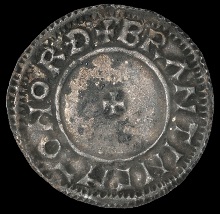
In 957 the rule of England had been divided between Eadwig, south of the Thames, and his younger brother, Edgar (Eadgar), north of the Thames. When Eadwig died, on 1st October 959, Edgar immediately became king of the reunited realm. At the time, the archbishop of Canterbury was Eadwig’s recent appointee, Byrhthelm. By the end of the year, Edgar had returned Byrhthelm to his former bishopric of Wells, and advanced Dunstan, bishop of both Worcester and London, to the archbishopric of Canterbury.[*] Dunstan was one of the chief architects of the restoration of monasticism in England – the so-called ‘Benedictine Reform’ – and, just as Eadwig’s reputation suffered as a result of his animosity to Dunstan, so Edgar’s reputation was enhanced by his support of Dunstan:
… Edgar, the honour and delight of the English … a youth of sixteen years old, assuming the government, held it for a similar period [i.e. sixteen years]. The transactions of his reign are celebrated with peculiar splendour even in our times. The divine love, which he sedulously procured by his devotion and energy of counsel, shone propitious on his years. It is commonly reported that at his birth Dunstan heard an angelic voice saying, “Peace to England so long as this child shall reign, and our Dunstan shall live.” The succession of events was in unison with the heavenly oracle – so much, while he lived, did ecclesiastical glory flourish, and martial clamour decay: scarcely does a year elapse in the Chronicles, in which he did not perform something great and advantageous to his country, in which he did not build some new monastery. He experienced no internal treachery, no foreign attack.
There is remarkably little incident recorded during Edgar’s reign. Manuscript A of the Anglo-Saxon Chronicle notes that in 962 there was a “very great mortality”, i.e. a pestilence, and that St Paul’s minster was burned down in a “great fatal fire” that happened in London (the minster was refounded the same year).[*] Manuscripts D, E and F report, s.a. 966, that:
In this year Thored, Gunner’s son, harried Westmorland. And in the same year Oslac succeeded to the ealdordom.
In 963, Edgar had granted (S716) an estate at Newbald, in Yorkshire, to a Gunner, his ‘faithful’ dux – a Latin rendition of the English title ‘ealdorman’ and its Scandinavian equivalent jarl (in Old English eorl), i.e. ‘earl’. It doesn’t seem unreasonable to suppose that Thored’s father was this same Gunner. S716 also features Oslac, titled dux, in the witness-list.
edgar01
Gunner dux occasionally pops-up in charters from 931 (S416) – the last appearances are in 963. It is possible, though perhaps unlikely, that it is the same man throughout the whole period – there is, for instance, an 18 year gap between the first appearance (S416 of 931) and the next (S550 of 949, in which the magnates aren’t actually titled).
The witness-list of S716 features Oslac and another northern dux, one Cytelbearn. This is the latter’s only appearance. The witness-list of another of Edgar’s charters dated 963 (S712a) features Gunner dux, a Myrdah dux, and then Oslac, who on this occasion is titled dominus (‘lord’). A further charter from 963 (S712) records a grant of land in Sherburn-in-Elmet, Yorkshire, made by Edgar to one Æslac, who is given no title. Gunner dux features in the witness-list, but Oslac doesn’t. Simon Keynes, in his essay ‘Edgar, rex admirabilis’ (Edgar, King of the English 959–975: New Interpretations, 2008), equates Æslac to Oslac, and, in a footnote (p.16 fn.65), comments: “It need not occasion concern that Oslac should be described as dominus in one context (S712a), as dux in another (S716), and be accorded no style in a third (S712), since there may have been different ways of expressing his status at this stage, before his formal appointment or succession in 966”. The name Myrdah is an English rendition of the Irish name Muiredach, so he may have been an earl amongst the Hiberno-Norse settlers of western Northumbria. He (Mirdach dux) attests one other charter (S679), a grant, by Edgar, of land in Nottinghamshire to the see of York, dated 958.
In S712, the name immediately following Gunner’s is Durre dux. Lesley Abrams (‘King Edgar and the Men of the Danelaw’, in Edgar, King of the English 959–975: New Interpretations, 2008, p.185) equates this Durre with Thored (Þored), Gunner’s son.
So, what was the ealdordom that Oslac gained in 966? Well, more than a decade previously, King Eadred had placed all Northumbria under the care of an Ealdorman/Earl Oswulf,[*] but, according to an early-12th century Durham text, De Primo Saxonum Adventu:
… under King Edgar, Oslac was appointed earl over York and the districts pertaining to it; and Eadwulf surnamed Evil-child [Yvelcild] was placed over the Northumbrians from the Tees to Myreford.
A.O. Anderson, in a footnote to the above translation, identifies Myreford as: “The Firth of Forth”[*]. As will become apparent, however, it seems unlikely that English-held territory extended as far north as the Forth by this time, so Myreford must remain unidentified. As for Thored, Gaimar has it that:
Never was anyone found to war with him [i.e. Edgar],
Nor any who entered his land for ill,
Except Thored, who rebelled.
He seized Westmorland from him.
For this wrong he received death.
Woe to him for beginning a wrongful war.
lines 3583–3588
The entry s.a. 969 in Manuscripts D, E and F of the Anglo-Saxon Chronicle states:
In this year King Edgar commanded all Thanet-land to be ravaged.
Roger of Wendover (in his entry s.a. 974) explains that:
… there landed in the isle of Thanet some merchants from York, who were immediately taken prisoners by the islanders, and spoiled of all their property; on which king Edgar, moved with exceeding rage against the spoilers, deprived them of all their goods, and put some of them to death.
The merchants from York would, most likely, be of Danish extraction – as, indeed, was much of the population of eastern England (north of the Thames). Edgar realised that their loyalty was crucial to the stability of the country, and, in his legislation, he gave them permission to follow their own legal traditions:
And I will that secular rights stand among the Danes with as good laws as they best may choose. But with the English, let that stand which I and my witan have added to the dooms of my forefathers, for the benefit of all the people…
Then will I, that, with the Danes, such good laws stand as they may best choose, and as I have ever permitted to them, and will permit, so long as life shall last me, for your fidelity which you have ever shown me …
Edgar’s law-code issued at Wihtbordesstane (§2 and §12)[*]
The rigour of Edgar’s justice was equal to the sanctity of his manners, so that he permitted no person, be his dignity what it might, to elude the laws with impunity. In his time there was no private thief, no public freebooter, unless such as chose to venture the loss of life for their attacks upon the property of others.
William of Malmesbury GR II §155
… at the command of the glorious King Edgar, a law of great severity was promulgated throughout England to serve as a deterrent against all sorts of crime by means of a dreadful punishment: that, if any thief or robber were found anywhere in the country, he would be tortured at length by having his eyes put out, his hands cut off, his ears torn off, his nostrils carved open and his feet removed; and finally, with the skin and hair of his head flayed off, he would be abandoned in the open fields, dead in respect of nearly all his limbs, to be devoured by wild beasts and birds and hounds of the night.
Lantfred Translatio et Miracula Sancti Swithuni Ch.26[*]
In the winter and the spring he [Edgar] used to make a progress through every province in England, and diligently inquire into the mode of the administration of justice, and the observance of the laws by the nobles, so that the poor might not suffer oppression at the hands of the powerful.
Florence of Worcester s.a. 975
an especial slave to lust
In 971, Edgar’s son, Edmund (Eadmund), died.[*] Edgar had married Edmund’s mother, Ælfthryth, in 964.[*] She was apparently his third wife, and they also had a younger son, Æthelred (Æþelred). Edgar’s eldest son, Edward (Eadweard), was by his first wife, Æthelflæd Candida, but his younger half-brothers evidently took precedence over him.
a jaunt on the Dee
Edgar had begun ruling England north of the Thames in 957, and had ruled the whole kingdom since 959, and yet his coronation apparently took place, at Bath, on Sunday 11th May 973. Manuscripts A, B and C of the Anglo-Saxon Chronicle report the event in verse[*]:
In this year Edgar, ruler of the English, with a great company, was consecrated king in the ancient borough, Acemannesceaster – the men who dwell in this island also call it by another name, Bath. There great joy had come to all on that blessed day which the children of men call and name the day of Pentecost.[*] There was assembled a crowd of priests, a great throng of learned monks, as I have heard tell.[*] And then had passed from the birth of the glorious King, the Guardian of Light, ten-hundred years reckoned in numbers, except that there yet remained, by what documents say, seven-and-twenty of the number of years, so nearly had passed away a thousand years of the Lord of Victories, when this took place. And Edmund’s son [i.e. Edgar], bold in battle, had spent nine-and-20 years in the world when this came about, and then in the 30th was consecrated king.
… this is certain, that from the sixteenth year of his age, when he was appointed king, till the thirtieth, he reigned without the insignia of royalty.[*]
It is, though, hard to believe that Edgar had reigned for so long without being crowned, and modern historians generally suppose the ceremony at Bath to be a second coronation – perhaps a conspicuous display of power, designed to demonstrate his superiority over the other rulers in Britain.[*] From the outset of his reign over the reunited English kingdom, Edgar’s charters had claimed he was ‘king of the whole of Britain’ (or similar), and Manuscripts D, E and F of the Anglo-Saxon Chronicle note that, immediately after his coronation, Edgar:
… led all his naval-force to Chester; and there came to meet him 6 kings, and they all gave him pledges that they would be his fellow-workers on sea and on land.
8 under-kings [subreguli], namely, Kenneth, king of the Scots, Malcolm, king of the Cumbrians [i.e. of Strathclyde],[*] Maccus, king of many islands, and 5 others named Dufnal, Siferth, Huwal [Huuual], Iacob, and Iuchil, met him there as he had appointed, and swore that they would be faithful to him, and assist him by land and by sea. —
— On a certain day they [the “8 under-kings”] attended him [Edgar] into a boat, and when he had placed them at the oars, he himself took the helm and skilfully steered it down the river Dee, and thus, followed by the whole company of ealdormen and nobles, in this order went from the palace to the monastery of St John the Baptist. After having prayed there, he returned with the same pomp to the palace.[*] As he was entering it, he is reported to have said to his nobles that each of his successors might boast themselves to be kings of the English, when, attended by so many kings, they enjoyed the pomp of such honours.
Whether this rowing episode has any basis in fact, or is simply a 12th century whimsy, is a subject for debate, as, indeed, is the whole nature of the meeting at Chester.[*] Modern scholars tend to present it as a ‘summit conference’ – an assembly of leaders where treaties were negotiated – rather than a group of minor rulers being summoned to swear their acceptance of Edgar’s overlordship.
Wales
THE NORTH In 967, English forces, led by Ælfhere, ealdorman of Mercia, for some reason, ravaged north Wales (i.e. Gwynedd) – called in the Annales Cambriae (B-text): “the region of the sons of Idwal” – which was ruled by brothers, sons of Idwal Foel, of whom there appear to have been five: Iago (who seems to have had seniority), Ieuaf, Idwal, Rhodri and Meurig.[*] In 968, Rhodri was killed, probably by Irish Vikings.[*] Seemingly, his death disturbed the balance of power in the kingdom, and a struggle for control ensued. In 969, Iago captured and imprisoned Ieuaf.[*] By the time of Edgar’s convention at Chester, 973, it appears that Ieuaf’s son, Hywel, had won himself a share of Gwynedd, since both he and Iago were probably among the “under-kings” whose attendance is noted by Florence of Worcester.[*]
Another of the attendees named by Florence, “Maccus, king of many islands”, seems to be the “son of Harald” who, presumably taking advantage of the disharmony in Gwynedd, is reported, by the Welsh annals, to have raided Anglesey in 971.[*] The following year, another ‘son of Harald’, this time Guthfrith, is said, by the Brut y Tywysogion, to have: "devastated Môn [Anglesey] and by great craft subjugated the whole island.”
In 974, Hywel succeeded in driving Iago from Gwynedd, and Iago’s brother, Meurig, was blinded (at Hywel’s instigation?). Hywel was now in control.
THE SOUTH The Welsh annals continue, largely, to ignore the south-eastern corner of Wales (i.e. Morgannwg). Owain ap Hywel Dda, ruler of the rest of south Wales (i.e. Deheubarth), however, did not. In 960 he raided Morgannwg. In 970, and again in 977, Owain’s son, Einion, devastated Gower. Gower was, at some stage, wrested from Morgannwg – the eponymous king of which, Morgan Hen, died in 974.
Be that as it may, the preface to the Regularis Concordia – composed about 973, and attributed to Æthelwold, bishop of Winchester – begins:
Edgar the glorious, by the grace of Christ illustrious King of the English and of the other peoples dwelling within the bounds of the island of Britain …
And Byrhtferth of Ramsey, in a ‘Life’ of St Ecgwine, written c.1020, says (IV, 11):
And when he [Edgar] had mightily subjected to his authority all kingdoms of peoples whom the ocean surrounds, and had conquered the ferocious and foolish kings of the Scots and Cumbrians,[*] he glittered thereafter … governing regally the people entrusted to him … the king made everyone frightened through strength and fear …
According to the early-12th century Durham text, De Primo Saxonum Adventu:
These two earls [i.e. Oslac and Eadwulf Evil-child] along with Ælfsige, who was bishop beside St Cuthbert[*], conducted Kenneth king of Scots to King Edgar. And when [Kenneth] had done him homage, King Edgar gave him Lothian; and with great honour sent him back to his own.
Roger of Wendover places his elaborated version of this event s.a. 975, though the context is a look-back at Edgar’s career (975 being the year of his death) and most scholars associate it with the ceremonials of 973:
… Bishop Ælfsige and Earl [comes] Eadwulf conducted Kenneth king of Scots to King Edgar, who made him many presents of his royal bounty; among the rest a hundred ounces of the purest gold, many ornaments of silk, rings, and precious stones. He gave him, moreover, the whole of the district called Lothian in the native tongue, on this condition, that every year, on particular festivals, when the king and his successors wore the crown, he should come to court and celebrate the festival with the other princes of the realm. The king gave him besides many mansions on the road, that he and his successors might find entertainment in going to the feast, and returning; and these houses continued to belong to the kings of the Scots until the times of King Henry the Second [r.1154–89].
Roger’s elaborations might be just conjecture, but, be that as it may, the gift of Lothian – the land between the rivers Tweed and Forth – to Kenneth, on the face of it, seems to be an extremely generous gesture on the part of Edgar. However, the Scottish Chronicle in the Poppleton Manuscript had noted that, at some time during the reign of Indulf (954–962):
… the fortress [oppidum] of Eden was evacuated, and abandoned to the Scots right until the present day.
It would appear that the Scots had forced the English out of “the fortress of Eden”, i.e. Edinburgh, which they had held for the previous three centuries. Further, the Scottish Chronicle also refers to Kenneth (who came to power in 971) plundering “Saxonia” as far south as the Yorkshire borders, and, on another raid, he is said to have “carried off the son of the king of the Saxons”. It is not remotely likely that it was Edgar’s son that Kenneth “carried off” – perhaps it was the son of Eadwulf Evil-child, who ruled Northumbria beyond the Tees on behalf of Edgar.[*] At any rate, it seems reasonable to suppose that Edgar simply agreed to recognize a fait accompli: that Lothian was already under Scots’ control.
On the 8th of July 975 Edgar died. He was buried at Glastonbury.[*]
Nothing could be more holy than his life, nothing more praiseworthy than his justice, those vices excepted which he afterwards obliterated by abundant virtues: a man who rendered his country illustrious through his distinguished courage, and the brilliancy of his actions, as well as by the increase of the servants of God. After his death, the state and the hopes of the English met with a reverse.
Byrhthelm had only been in place at Canterbury a matter of months. According to Dunstan’s earliest biographer (known only by his initial, B, writing c.1000), Byrhthelm was too “gentle and modest and humble and kind” to maintain discipline.
Dunstan witnesses a charter of Edgar’s (S681), dated 959, but pre-reunification (Edgar is styled ‘ruler of the whole province of Mercia and the surrounding peoples’), as bishop of London, and another (S680), also dated 959, but post-reunification (Edgar is styled ‘ruler of the whole of Albion’) as archbishop.
A white, scarf-like, vestment worn by the pope, and bestowed by him on archbishops as a symbol of delegated papal authority.
Latin pacificus. Florence of Worcester is the earliest source to give Edgar this epithet. It is widely translated as ‘the Peaceful’, however, this implies that Edgar was a placid, rather insipid, character, which, as will become apparent, hardly seems appropriate – ‘the Peacemaker’ is perhaps more suitable, in the same way that the famous ‘gun that won the West’ is the Colt Peacemaker.
Oswald was apparently more subtle than indicated by Florence. William of Malmesbury (GP III §115): “There [in Worcester] Oswald gradually formed the view that there was potentiality for good in the minds of the clerks there, if anyone knew the way to bring it to life by exhortation; so he did not make a scene by sending them packing, but rather got round them by a pious trick. The episcopal see was dedicated to St Peter. Oswald therefore built a second church in the same precinct in the name of the Mother of God, moved the monks there, and lived happily with them, taking part in the services as one of their family. The people saw this, and all flocked there, thinking it appalling to have to go without the blessings of a bishop so devout. That left the clerks out on a limb, and they decided that it was better to put on the garb of monks than to disadvantage themselves and become a laughing stock to the common people at the same time. From then on the saint who holds the keys of paradise has yielded place to her who guards the door of heaven: a fair exchange between two inhabitants of the skies, and one made with no rancour. The news of this coup made Oswald a great favourite with king and nobility.”
Manuscripts B and C place Oscytel’s death in 971. Florence of Worcester, though, records Oscytel’s death and Oswald’s election as his successor s.a. 972. Symeon of Durham, in a letter concerning the archbishops of York (Epistola de archiepiscopis Eboraci), says that Oscytel died in 970 and was initially succeeded by one Edwald, who “preferred a quieter life”, and so it was that Oswald became archbishop in 971 – travelling to Rome the next year to collect his pallium. A charter of Edgar’s dated 971 (S782) is witnessed by Oswald as archbishop of York.
Click here to access a high quality photographic copy of British Library MS Cotton Vespasian A viii, on the British Library website.
The remainder of Annal 962 in Manuscript A (the only Anglo-Saxon Chronicle manuscript to have an entry under that year) comprises three obits, the second of which reads: “King Sigferth [Sigferð] killed himself, and his body lies at Wimborne [in Dorset].” Sigferth is a Scandinavian name. He may be the Siferth (Syferð) who appears in the witness-list of a charter of King Eadred (S566, dated 955) in the company of three Welsh rulers.
The body of St Cuthbert (bishop of Lindisfarne, d.687) would eventually end up at Durham. According to the traditionally accepted church of Durham origin-story, the body was at Chester-le-Street from 883 until 995, but there is evidence to suggest this may not have been the case. See St Cuthbert’s Journey to Durham.
In the Latin text, the title is comes. Like dux (from which the English ‘duke’), comes (from which the English ‘count’) is employed by Latin-writers to represent the title ealdorman/earl.
Prior to being given responsibility for all Northumbria in 954, Oswulf had governed northern Northumbria (i.e. beyond the Tees), with the title ‘high-reeve’, from Bamburgh (see Bloodaxe). He features in charters in his earlier rôle, but not after his promotion. It is not certainly known when he died.
In the Story of Inglande (completed 1338), Robert Mannyng of Brunne (now Bourne, Lincolnshire) tells a brief tale in which a giant of a man called Scarthe or Scardyng (both forms of the name are used) is given Scarborough (Scardeburghe) by one Engle, a Briton, after whom England is named. Robert Mannyng names his sources as Mayster Edmund and Thomas of Kendal (their works are no longer extant), and says that, according to the latter, Scarthe had a brother named Flayn. Though this Scarthe/Scardyng is placed in a fantastical setting, it has been proposed that he should be equated to Thorgils Ogmundsson (Skarthi), in which case, Flayn, that is to say Fleinn, which means ‘arrow’ in Old Norse, is the nickname of his brother, Kormak. Further, in the same way that Scarborough is ‘Skarthi’s (i.e. Thorgil’s) stronghold’, nearby Flamborough may be ‘Fleinn’s (i.e. Kormak’s) stronghold’.
R.M. Wilson, ‘More Lost Literature in Old and Middle English’ (pp.19–22), Leeds Studies in English 5 (1936), freely available online.
Diana Whaley, ‘Scarborough Revisited’, Nomina Vol.33 (2010), freely available online.
The king’s advisory council, composed of important secular and ecclesiastical personages.
Wihtbordesstane is unidentified. Edgar issued this law-code following: “the pestilence which much afflicted and decreased his people, widely throughout his dominion.” The only known pestilence during Edgar’s reign is the one recorded in Manuscript A of the Anglo-Saxon Chronicles.a. 962. However, an instruction at the end of the code that: “Earl Oslac [Oslac eorl], and all the army [here] dwelling in his ealdordom, further this, that it stand to the glory of God, and to the benefit of the souls of us all”, would seem to place it after 966, when Manuscripts D, E and F report that “Oslac succeeded to the ealdordom”. Incidentally, the word here, originally meaning Viking raiding armies, is now being used simply to mean Danish inhabitants.
Dorothy Whitelock’s rendition of this entry (in The Anglo-Saxon Chronicle, a Revised Translation, 1961) is used here. In a footnote, she comments: “This passage is written in alliterative prose, and is in the style of Archbishop [from 1002 to 1023] Wulfstan II of York.” The first part of the passage, following on from the notice of Eadwig’s death and Edgar’s succession, reads:
… in his [Edgar’s] days things improved greatly, and God granted him that he lived in peace as long as he lived; and, as was necessary for him, he laboured zealously for this; he exalted God’s praise far and wide, and loved God’s law; and he improved the peace of the people more than the kings who were before him in the memory of man. And God also supported him so that kings and earls willingly submitted to him and were subjected to whatever he wished. And without battle he brought under his sway all that he wished. He came to be honoured widely throughout the countries, because he zealously honoured God’s name, and time and again meditated on God’s law, and exalted God’s praise far and wide, and continually and frequently directed all his people wisely in matters of Church and State.
The entry s.a. 971 has been erased in Manuscript A of the Anglo-Saxon Chronicle, but it survived in Manuscript G (an early copy of Manuscript A): “In this year died Edmund ætheling, and his body lies at Romsey.” Edmund’s obit is placed s.a. 972 by Manuscript C, but the next entry, recording an event known to have occurred in 973, is s.a. 974, so it doesn’t seem unreasonable to suggest that the same one year error also applies to Annal 972. Similarly, in Manuscripts D and E, Edmund’s obit is s.a. 970, but the event of 973 is s.a. 972. In Manuscript B, the entry actually relating to 973 has no date, but that year is assigned to the previous entry, i.e. Edmund’s obit. Manuscript F does not record Edmund’s death. Florence of Worcester places Edmund’s obit s.a. 971. Incidentally, only Manuscript G and Florence mention that Edmund was buried at Romsey.
The marriage of Edgar to Ælfthryth is placed s.a. 965 in Manuscripts D and F of the Anglo-Saxon Chronicle. (There are four annals – 948, 955, 957 and 965 – where material from a manuscript akin to D has been worked into F.) Florence of Worcester, however, records the event s.a. 964, and charter evidence supports this date. In S725, dated 964, Edgar grants a parcel of land to Ælfthryth, his ‘consort’ (lateranea). Further, Ælfthryth’s father, Ordgar, had featured in the witness-lists of charters since 958 as a thegn (minister), and that is the title he receives in S725, but in another charter of 964 (S724) he has been promoted to ealdorman (dux), in which capacity he witnesses until 970. Florence of Worcester places Ordgar’s death s.a. 971.
Florence uses the Latin title dux.
Both Edmund and Edward are given the title clito, which is the Latin equivalent of the Old English æþeling, i.e. ‘ætheling’ – meaning a male of royal blood who is considered to be eligible for the throne.
Eadmer, following Prior Nicholas, makes Ordmær, the father of Æthelflæd Candida, ealdorman (dux) of East Anglia. Ealdorman Ordmær is only known as Æthelflæd’s father – he is otherwise not recorded – and he certainly wasn’t ealdorman of East Anglia. Preserved in the, late-12th century, Liber Eliensis (Book of Ely) is reference (II, 7) to an estate at Hatfield, Hertfordshire: “which a certain powerful man called Ordmær and his wife Æalde bequeathed to him [Edgar] on their death.” It is widely suggested that this Ordmær could be Æthelflæd’s father.
William of Malmesbury (GR II §159) clearly equates Eadmer’s young lady of Wilton, who pretends to be a nun, with Wulfthryth: “[Edgar] begat … St Edith, of Wulfthryth, who it is certain was not a nun at that time, but being a lay virgin, had assumed the veil through fear of the king, though she was immediately afterwards forced to the royal bed”.
Gaimar tells a similar, though longer and more elaborate, story. In Gaimar’s tale, having become besotted with Ælfthryth, Edgar sends Æthelwold off to York. On the way, he is set upon by a band of outlaws, who kill him:
Some said that this company
Was sent against him by king Edgar,
But none knew, who dared say,
That they were so, who went to kill him.
lines 3857–3860
The events of 973 are correctly dated by Manuscript A of the Anglo-Saxon Chronicle (and by Florence of Worcester), but are placed s.a. 974 by Manuscript C, and s.a. 972 by Manuscripts D, E and F. (The annal has no date in Manuscript B.)
i.e. Whit Sunday. Manuscripts D, E and F (and Florence of Worcester) give the date 11th May, which was Whit Sunday in 973.
Archbishops Dunstan and Oswald officiated at the ceremony, which is described in detail in the ‘Life’ of St Oswald, written c.1000, by one Byrhtferth, a monk at Ramsey Abbey (north of Huntingdon). Ramsey Abbey was founded c.966, by Oswald and Æthelwine, who evidently succeeded his brother, Æthelwold, as ealdorman of East Anglia in 962. Æthelwold’s widow, Ælfthryth, was, of course, now Edgar’s wife. Byrhtferth (IV,7) notes that, after the ceremony:
The king, crowned with laurel and decorated in roseate splendour, was, as I have said, sitting with bishops; with him also were all the handsome ealdormen and all the English nobility, gleaming attractively and rejoicing in the Heavenly King Who bestowed on them such a king, in whose mind dwelled mercy and truth. The queen, together with the abbots and abbesses, had a separate feast. Being dressed in linen garments and robed splendidly, adorned with a variety of precious stones and pearls, she loftily surpassed the other ladies present; a regal bearing was befitting to her, since after the death of the distinguished ealdorman [dux], she had been found worthy to marry the king.
The following translation is by Dorothy Whitelock (1961).
Osbern of Canterbury, in his ‘Life’ of St Dunstan, says that Dunstan gave Edgar a seven year penance for seducing an unnamed nun (see above), and his coronation took place after that. William of Malmesbury (GR II §158) takes the same line (though, whilst Osbern alleges that the nun gave birth to Edward, William, like Eadmer of Canterbury and Florence of Worcester, makes Edward’s mother Æthelflæd Candida). This whimsical notion, however, still doesn’t explain a delay of over thirteen years between Edgar assuming the throne of the whole kingdom and the ceremony at Bath. Eadmer’s informant, Prior Nicholas, makes the unlikely suggestion that Edgar, himself, postponed his coronation until he had outgrown the passions of youth. In modern times, it has been suggested (e.g. Frank Stenton: Anglo-Saxon England Third Edition, 1971, Chapter 11) that Edgar waited until he had reached the canonical age for ordination into the priesthood, i.e. thirty. The problem here is that Edgar wasn’t yet thirty, he was twenty-nine, and, furthermore, when he became king there could be no certainty that he would live to the age of thirty – his father and brother hadn’t.
Byrhtferth of Ramsey, in his ‘Life’ of St Oswald (IV, 4), records that Edgar sent the abbot of Bath, Æscwig, with “wonderful gifts to the emperor [i.e. Otto the Great, king of Germany, crowned emperor by the pope in 962, died in 973]”, and returned with “even more wonderful gifts, which served to establish a treaty of steadfast peace.” Byrhtferth doesn’t specify a time for Æscwig’s mission, but places it just before Oswald’s trip to Rome to collect his pallium, which he probably undertook in Spring 972. In fact, Otto was in Italy between 966 and August 972, when he returned to Germany. On Palm Sunday (16th March) and Easter Sunday (23rd March) of 973, Otto held two major assemblies. Simon Keynes (‘Edgar, rex admirabilis’, in Edgar, King of the English 959–975: New Interpretations, 2008) wonders whether Æscwig was still in Germany at that time: “It is difficult to resist the thought that Æscwig was reminded by whatever he saw in Germany of the value of grand ceremonial, and that he was instrumental in applying this lesson for the meeting convened at Bath over Pentecost (11 May) in 973.”
William of Malmesbury (GR II §148) lists the tributary kings’ names a little differently: “Kenneth king of the Scots, Malcolm of the Cumbrians, that prince of pirates [archipirata] Mascusius, all the Welsh kings, whose names were Dufnal, Giferth, Huual, Iacob, Iudethil, being summoned to his [Edgar’s] court, were bound to him by one, and that a lasting oath”.
Henry of Huntingdon, another 12th century historian, knows nothing of these eight kings, and his report (HA V, 26) is taken from the Anglo-Saxon Chronicle entry, as in Manuscripts D, E and F, mentioning only six, unnamed, kings.
It would seem that, by 927, the Strathclyde Britons had extended their territories south of the Solway Firth, to the river Eamont (just below Penrith), which is on the border of the traditional English counties of Cumberland (to the north) and Westmorland. In 1974, Cumberland and Westmorland (with a part of Lancashire) were merged to form the new county of Cumbria. Originally, though, ‘Cumbria’ was synonymous with ‘the kingdom of Strathclyde’. Whilst the name Strathclyde, i.e. ‘Valley of the Clyde’, is geographically derived, the names Cumbria (Latinized) and Cumberland (English) are derived from the ethnicity of its people. They come from the Britons’ own name for themselves – in modern Welsh, Wales is Cymru (pronounced: Cum-ri), and the Welsh are Cymry (also pronounced: Cum-ri) – and simply mean ‘Land of the Britons’.
Ecgwine was bishop of Worcester between 692 and 717 (Florence of Worcester’s dates), and founder of the monastery of Evesham.
William of Malmesbury’s version of this tale (GR II §148) is less detailed, but also slightly at variance with Florence’s: “he [Edgar] exhibited them [the eight] on the river Dee in triumph: for putting them all on board the same vessel, he compelled them to row him as he sat at the prow, thus displaying his regal magnificence, who held so many kings in subjection.”
13th century chronicler Roger of Wendover (s.a. 974) identifies Maccus (Macon) as “king of Mona [Anglesey or the Isle of Man] and many islands”, Dufnal as “king of Demetia [i.e. Dyfed]”, Siferth and Huwal as “kings of Wales”, Iacob as “king of Galloway”, and concludes with: “Iukil of Westmorland”. Iacob is almost certainly Iago of Gwynedd, so there is no reason to put any trust in Roger’s other identifications.
Latin: feroces ac stolidos reges Scottorum atque Cumbriensium. It may be that the Cumbrians meant here are not specifically the Strathclyde Britons, but all Britons (indeed, Michael Lapidge, whose translation this is, in fact uses the word ‘Welsh’ in preference to ‘Cumbrians’). It seems that Ælfric too, in the previously mentioned ‘Life’ of St Swithun, might well have used Cumbrians in a general sense: “all the kings that were in this island, of Cumbrians and of Scots [Cumera and Scotta]”.
This quote is taken from the Epilogue to Ælfric’s Old English version of the Book of Judges (translation by A.O. Anderson, in Early Sources of Scottish History A.D. 500 to 1286 Vol.1, 1922, p.479 fn.1).
Ann Williams (‘An Outing on the Dee: King Edgar at Chester, AD 973’, from Mediaeval Scandinavia Vol.14, 2004, paper freely available online): “Like the tenth-century apologists of Edgar, the twelfth-century writers had their own agenda. Their accounts of the meeting at Chester must be linked with the attempts of the Norman kings to impose their suzerainty on the other rulers of Britain, especially the Scottish kings, and thus to be able to boast that they were kings of the English, with so many kings at their command. It has been observed that such pretensions gave Anglo-Norman historians ‘a vested interest in re-writing Anglo-Scottish history in a way that showed the Dark-Age Scottish realm as a client kingdom of Wessex’* and the same holds true for English relations with the Welsh.”
* This is a quote from Alfred P. Smyth’s Warlords and Holy Men: Scotland AD80–1000 (1984), Chapter 7 (p.237–8): “from the twelfth-century onwards Anglo-Norman historians had a vested interest in rewriting Anglo-Scottish history in a way that showed the Dark Age Scottish realm as a client kingdom of Wessex. Their task was made easier because the Anglo-Saxon Chronicle on which they relied so heavily for information, provided a West-Saxon account of events which lent itself easily to a more developed feudal interpretation. And so any meetings between Scot and Saxon where oaths were sworn and alliances formed were later easily transformed into accounts of the English suzerain receiving the homage of subservient northern kings.”
In a footnote to his translation of the Scottish Chronicle (The Scottish Historical Review Vol.77.2, 1998), Benjamin T. Hudson comments: “This might refer to the giving of a hostage prior to the meeting of Kenneth with the English monarch Edgar”.
William of Malmesbury tells (GR II §160) how, in 1052, Æthelweard, abbot of Glastonbury, set about moving Edgar’s remains. When the tomb was opened, his body was found to be completely undecayed. “This circumstance, instead of inclining him [Abbot Æthelweard] to reverence, served only to increase his audacity; for when the receptacle which he had prepared seemed too small to admit the body, he profaned the royal corpse by cutting it; the blood immediately gushing out in torrents, struck terror into the hearts of the bystanders. In consequence, his royal remains were placed above the altar, in a shrine which he [Edgar] had himself given to this church, with the head of St Apollinaris and the relics of Vincent the martyr, which, purchased at a great price, he had added to the beauty of the house of God. The violator of the sacred body presently became distracted [i.e. lost his mind], and not long after, going out of the church, met his death by a broken neck. Nor did the display of royal sanctity stop thus; it proceeded still further, a man, lunatic and blind, being there cured. Deservedly then does the report prevail among the English, that no king, either of his own or former times in England, could be justly and fairly compared to Edgar.”
It is clear from surviving coinage that this reform occurred at some point not very long before Edgar’s death in July 975. Roger of Wendover, the only literary source to mention it, says that Edgar: “ordered a new coinage for the whole of England, for the old was so debased by clipping that a penny barely weighed a halfpenny in the scales.” Roger makes this comment s.a. 975, but it is in a section evidently looking back at Edgar’s reign, and is linked by the phrase ‘at the same time’ to the story of Edgar gifting Lothian to Kenneth, king of Scots. This story is generally associated with the events of 973, and, similarly, the coinage reform is usually placed about 973. Incidentally, the reason Roger gives for the reform, coin-clipping, is not substantiated by surviving pennies. He may have made an assumption based on the practices of his own time.
Morgan’s epithet, Hen, means ‘the Old’, and he had ruled for over forty years when he died in 974 – the year after the Chester meeting. Perhaps he was too decrepit to attend, hence his absence from Florence of Worcester’s list.
These five appear as sons of Idwal in the Welsh annals. However, the B-text of the Annales Cambriae doesn’t use the name Ieuaf (which translates as ‘Junior’), but substitutes the name Idwal instead. John Edward Lloyd (A History of Wales from the Earliest Times to the Edwardian Conquest Vol.1 Second Edition, 1912, Chapter 10, p.337), therefore, believed that Ieuaf and Idwal were one and the same person; but a character who was killed in 980, referred to in most incarnations of the Welsh annals simply as Idwal, appears in some Brut y Tywysogion texts as ‘Idwal Fychan (an epithet which also translates as ‘Junior’) son of Idwal Foel’. Further, in a late-medieval genealogical tract, Achau Brenhinoedd a Thywysogion Cymru (§7c), both Ieuaf and Idwal Fychan are named as sons of Idwal Foel. (This tract names five sons of Idwal, but has Cynan instead of Rhodri.) It seems, then, that Idwal and Ieuaf (called Idwal by AC B-text) are different sons of Idwal.
The Welsh annals present Iago and Ieuaf (Idwal in AC B-text) as leaders of the campaign that wrested Gwynedd from the sons of Hywel Dda in the early-950s (the other brothers are not mentioned at that time). It was, though, Iago who represented Gwynedd at the English court – he features in the witness-lists of a charter of Eadred (Edgar’s uncle) dated 955 (S566).
‘the Good’
The Annals of Ulster, s.a. 975, state: “Domnall mac Eógan, king of the Britons, died on pilgrimage”. The Brut y Tywysogion does not mention his death, but does report his pilgrimage: “Dunwallon, king of Strathclyde, went to Rome.”
‘the Bald’
The Brut y Tywysogion suggests he was killed in Anglesey: “Rhodri ab Idwal was slain, and Aberfraw was devastated.” The perpetrators are not named, but, according to The Historie of Cambria, now called Wales: a part of the most famous Yland of Brytaine, written in the Brytish Language about two hundred years past. Translated into English by H. Lhoyd, Gentleman. Corrected, augmented, and continued out of records and best approoved authors, by David Powel, Doctor in Divinitie. Published in 1584: “Roderike the sonne of Edwal Voel was slaine by the Irishmen, by whom Aberfraw was destroyed.”
It is possible that Rhodri’s son had previously been killed by Irish Vikings. In 961, recorded by the Brut y Tywysogion, “the sons of Abloec [= Olaf]” had ravaged Holyhead, on Anglesey, and the Llŷn peninsula. Then, in the following year (962), it is noted that “Idwal ap Rhodri was killed”. In the Annals of the Four Masters, an Irish compilation made in the 1630s, a single “son of Amlaíb [= Olaf]” is said to have led an expedition from Ireland to Anglesey in 962 (s.a. 960 = 962). Perhaps the two incidents of 962 are related, and Rhodri’s son, Idwal, was killed by the ‘son of Olaf’. On the other hand, the Rhodri whose son was killed by persons unknown in 962, may have been Rhodri ap Hywel Dda, who died in 953.
The Brut y Tywysogion reports that, in 963: “Towyn [near Rhyl] was devastated by the Pagans [i.e. Vikings]”.
Some Brut y Tywysogion texts indicate that Ieuaf was promptly hanged, however, his death is also reported some two decades later, in common with the other Welsh annals. Ieuaf (called Idwal in Annales Cambriae B-text) apparently died in 988, though he had played no part in history since his imprisonment.
According to William of Malmesbury (GR II §155), Edgar wanted to: “exterminate every beast of prey from his kingdom; and commanded Iudual, king of the Welsh, to pay him yearly a tribute of three hundred wolves. This he performed for three years, but omitted in the fourth, declaring that he could find no more.” Assuming there is some historical basis for this tale, Iudual, i.e. Idwal, can hardly be, the virtually invisible, Idwal Fychan. John Edward Lloyd, who believed that Idwal equated to Ieuaf, reckoned that it was Ieuaf who was meant (A History of Wales from the Earliest Times to the Edwardian Conquest Vol.1 Second Edition, 1912, Chapter 10, p.349). It would, however, seem to make more sense if the Idwal in the story was Idwal Foel (father of Idwal Fychan and Ieuaf) and the English king was not Edgar, but was Athelstan (see King of All Britain).[*]
Speaking of wolves and Athelstan, 15th century tradition – preserved in an entry on a Patent Roll (25 Henry VI, part 2, membrane 17), dated 24th June 1447 – has it that, during Athelstan’s reign, a certain “noble and pious knight named Acehorne” established a hospital (i.e. a guest-house) in Flixton, about 6 miles south of Scarborough, Yorkshire: “for the preservation of the people passing that they should not be devoured by wolves and other savage beasts of the forest there”. (Calendar of the Patent Rolls Henry VI Vol.5)
The Chester convention is recorded in the Welsh annals, though not in AC B-text. AC C-text: “The gathering of ships at Chester by Edgar king of the Saxons.” In some Brut y Tywysogion texts, the translations of this notice are a little confused – variously calling Edgar ‘Edward’ and identifying Chester as ‘Caerleon-on-Usk’.
According to the Brut y Tywysogion, it was Penmon, on the south-eastern tip of Anglesey, that was ravaged. The Annales Cambriae (B-text only) simply refer to the person responsible as “son of Harald”. The Brut y Tywysogion texts variously name him Marc, Madoc, Mactus. He is identified with the Maccus son of Harald (Maccus mac Arailt) who, “along with the Lawmen of the Isles”, captured the Viking ruler of Limerick at Scattery Island, in the Shannon estuary, in 974 (Annals of the Four Masterss.a. 972 = 974).
s.a. = sub anno = ‘under the year’.
Gesta Regum Anglorum (Deeds of the Kings of England).
Anglo-Saxon charters are referred to by their number in Sawyer’s catalogue.
Available online: The Electronic Sawyer.
Gesta Pontificum Anglorum (Deeds of the Bishops of England).
Alan O. Anderson, Scottish Annals from English Chroniclers, A.D. 500 to 1286 (1908), p.77 fn.3.
Anglo-Norman chronicler Geffrei Gaimar wrote his Estoire des Engleis (History of the English), for a Lincolnshire patroness, round-about 1140. It is the earliest known historical work to have been written in the French language, and is in verse (actually, octosyllabic rhymed couplets). In fact, the Estoire des Engleis is the latter part of a longer work, but the earlier part has not survived. The existing work covers the period from the arrival in Britain of Cerdic (495) to the death of William Rufus (1100). Up to 959, it is based on a lost version of the Anglo-Saxon Chronicle.
On 15th July 971, Æthelwold, bishop of Winchester, had the remains of a previous bishop, Swithun (d.863), moved from a tomb outside the Old Minster into the church itself. The story of the translation and miracles of St Swithun (Translatio et Miracula Sancti Swithuni) was written soon afterwards (c.975), by Lantfred, a monk of Frankish origins, at the Old Minster.
The severe punishment described by Lantfred is not to be found in any of Edgar’s surviving law-codes. However, a similar range of tortures is found in the laws of Cnut (II Cnut 30), which are largely culled from the laws of previous kings, and this could well have been taken from the decree that Lantfred is talking about.
Henry, archdeacon of Huntingdon, first produced his Historia Anglorum (History of the English) about 1130. He later revisited the work – revising and extending – several times. The final version concludes with the accession of Henry II in 1154.
The Regularis Concordia (a rule-book for monks and nuns in England) is the major document of the Benedictine Reform movement.