In this year [975] Edgar, king of the English, reached the end of earthly joys, chose for him the other light, beautiful and happy, and left this wretched and fleeting life. The sons of nations, men on the earth, everywhere in this country – those who have been rightly trained in computation – call the month in which the young man Edgar, dispenser of treasure to warriors,[*] departed from life on the eighth day, the month of July.
It seems that Edgar’s personal magnetism had been the only force holding the English governing class together. Florence of Worcester, s.a. 975, reports:
At his death the whole kingdom sustained a shock, and after the glad time of peace, which existed all his life, troubles began to come in on every side. For, dazzled by numerous presents, Ælfhere, ealdorman of the Mercians, and very many nobles of the kingdom, expelled the abbots and monks from the monasteries in which King Edgar the Pacific had placed them, and introduced clerks [i.e. secular clergy] and their wives. But this piece of madness was opposed by some conscientious men, to wit, Æthelwine, ealdorman of the East Angles, a friend of God, and his brother Ælfwold, and the pious ealdorman [of Essex], Byrhtnoth; who meeting together, declared that they could not permit the monks, who were the depositaries of all the religion of the kingdom, to be expelled therefrom. They then assembled a great army, and bravely defended the monasteries of the East Angles. —
— In the meantime the nobles of the kingdom were very much at variance in the matter of electing a king: for some chose the king’s son Edward, and some chose his brother Æthelred.[*] On this account the archbishops Dunstan [of Canterbury] and Oswald [of York], with a great number of bishops, abbots, and ealdormen, met in a body, and chose Edward; according as his father had desired; and after his election crowned and anointed him king.
Manuscript E of the Anglo-Saxon Chronicle:
In this year [975] Edward, Edgar’s son, succeeded to the kingdom. And in this same year, during harvest, the star cometa appeared; and in the following year came a very great famine, and very many troubles over the English race.And Ealdorman Ælfhere commanded the monasteries to be demolished, which King Edgar had before commanded the holy Bishop Æthelwold [of Winchester] to found.And at that time, also, was Oslac the great earl [of York] expelled from England.[*]
There was evidently a flurry of activity in an attempt to settle the discord that had erupted following Edgar’s death. Manuscripts B and C of the Anglo-Saxon Chronicle record “the great assembly at Kirtlington [in Oxfordshire], after Easter” s.a. 977,[*] whilst Manuscripts D and E report on a large meeting, at which a freak accident occurred, s.a. 978 (though it too almost certainly belongs in 977):
Here in this year all the chief councillors [witan] of the English race fell at Calne [in Wiltshire] from an upper floor, except the holy Archbishop Dunstan, who alone was stayed upon a beam; and some there were sorely maimed, and some did not escape with their lives.[*]
Florence of Worcester places the incident at Calne s.a. 977, and also places a subsequent “synod”, as he characterizes these councils, at Amesbury in Wiltshire, in that same year.[*] The late-12th century Liber Eliensis (Book of Ely) indicates (II, 11) that a “General Meeting” was also held at London in 977.
In 978 Edward was murdered. Manuscripts D and E of the Anglo-Saxon Chronicle report:
In this year King Edward was slain at eventide, at Corfe-gate, on the 15th of the Kalends of April [18th March], and then was buried at Wareham without any kingly honour. —
— To the English race was no worse deed done than this was, since they first sought Britain. Men murdered him, but God him glorified. He was in life an earthly king, he is now, after death, a heavenly saint. Him his earthly kinsmen would not avenge, but his heavenly Father has amply avenged him. The earthly murderers would his memory blot out on earth; but the Avenger above has spread abroad memory in the heavens and on earth. They who before would not to his living body bow, now humbly bend on their knees to his dead bones. Now we may understand, that men’s wisdom, and their machinations, and their counsels, are like naught against God’s decree.[*] Then Æthelred succeeded to the kingdom …
Who done it? Well, the earliest account of Edward’s murder appears in a ‘Life’ of St Oswald, written c.1000, attributed to Byrhtferth of Ramsey.[*] Edward, accompanied by just a few men, is said (IV, 18) to have gone to visit “his dear brother”, i.e. Æthelred, who lived with “the dowager queen”, i.e. Ælfthryth (Æthelred’s mother, Edward’s stepmother). When Edward arrived at their residence (its location is not mentioned), he was surrounded by a group of Æthelred’s supporters, described as: “the magnates and leading men”. Before Edward could dismount he was stabbed: “And suddenly he fell from his horse; and he was dead.” There are no suggestions that anyone other than Æthelred’s supporters, acting on their own initiative, were involved in the murder. In a sermon of 1014, Archbishop Wulfstan of York refers to the murder, but names no names:
They plotted against Edward and then killed and afterwards burnt him.[*]
Before the end of the 11th century, however, it was commonly alleged that Ælfthryth had planned the killing.
Florence of Worcester’s entry for 978 announces:
Edward, king of the English, was wickedly slain at Corfe-gate, by his own servants, acting under the commands of his stepmother, queen Ælfthryth …
martyr01
William of Malmesbury writing c.1125 (GR II §162): “King Edward conducted himself with becoming affection to his infant brother and his stepmother; retained only the name of king, and gave them the power; followed the footsteps of his father’s piety, and gave both his attention and his heart to good counsel. The woman, however, with a stepmother’s hatred, began to meditate a subtle stratagem, in order that not even the title of king might be wanting to her child, and to lay a treacherous snare for her son-in-law, which she accomplished in the following manner. He was returning home, tired with the chase, and gasping with thirst from the exercise, while his companions were following the dogs in different directions as it happened, when hearing that they dwelt in a neighbouring mansion, the youth proceeded thither at full speed, unattended and unsuspecting, as he judged of others by his own feelings. On his arrival, alluring him to her with female blandishment, she made him fix his attention upon herself, and after saluting him, while he was eagerly drinking from the cup which had been presented, the dagger of an attendant pierced him through. Dreadfully wounded, with all his remaining strength he spurred his horse in order to join his companions; when one foot slipping, he was dragged by the other through the winding paths, while the streaming blood gave evidence of his death to his followers.”
William of Malmesbury appears to have derived his story from the Passio et Miracula Sancti Eadwardi Regis et Martyris (Passion and Miracles of St Edward King and Martyr), which Christine E. Fell has suggested may have been written by Goscelin (a monk from Flanders who worked as a hagiographer in England): “If the work is Goscelin’s, it seems probable that it was written during the same decade as the rest of his work on the saints of the Midlands and Western England, i.e. 1070–1080, since in the following decade he settled at Canterbury and worked on the Canterbury saints.”[*]Barbara Yorke: “However, the role of Ælfthryth in the Passio account is likely to have been developed from models provided in the accounts of other young Anglo-Saxon princes, such as the brothers Æthelbert and Æthelred of Kent[*], King Æthelbert of the East Angles[*] and Kenelm of Mercia[*] who met untimely, violent deaths.… One of the common features that the Passio Eadwardi shares with the accounts of other royal martyrdoms is the role of a wicked royal woman in encompassing the death of an innocent victim in order to benefit a member of her own family. The crime of Ælfthryth in the Passio therefore seems to have been as much derived from a hagiographical stereotype than from any reliable transmission of the events that had led up to Edward’s death.”
There are variations on the basic Passio Eadwardi theme. Henry of Huntingdon, a contemporary of William of Malmesbury, comments (V, 27): “It is reported that his stepmother, that is the mother of King Æthelred, stabbed him with a dagger while she was in the act of offering him a cup to drink.” Whilst, late in the 12th century, Walter Map writes (V, 3): “The mother of the young son, envying Edward the kingdom, first gave him poison, and, when this failed of its effect, had him slain at Shaftesbury by the soldiers of his company.” (In fact, Shaftesbury is where Edward’s remains were taken the year after his murder.) Two lengthier variations of the tale, each featuring a novel additional embellishment, are told by Geffrei Gaimar (mid-12th century) and in a chronicle attributed (wrongly) to John of Wallingford (mid-13th century). According to Wallingford, Edward had received many complaints about his stepmother, because she “did not care to govern her people with justice”. He, with just a few men, visited her to give her, “with all filial respect”, a ticking-off. As he was preparing to leave, she stabbed him. His attendants immediately fled, abandoning the king’s body: “She, however, wrapped it, it is said, in lead, and for a long time hid it in the river Stour.” In Gaimar’s variant:
He [Edward] had a dwarf named Wolstanet
Who could dance and play.
He could leap and pipe,
And play many other tricks.
(3991–3994)
On the fateful day, Edward commands Wolstanet to perform. The dwarf refuses and rides off “to the house of Elstruet [i.e. Ælfthryth]”. Edward follows. He is greeted by Ælfthryth, who hands him a drink, at which point he is stabbed “by some foe, I know not who”.
Byrhtferth, in the earliest account of Edward’s murder (Vita Sancti Oswaldi IV, 18), is clear that Ælfthryth remained indoors, with Æthelred, throughout the whole proceedings.
Even if Ælfthryth was not complicit in the murder, she certainly benefitted from it. Her young son, Æthelred (ten years-old), was chosen to succeeded Edward (there was no other obvious candidate). Anglo-Saxon Chronicle Manuscripts D and E say:
… he [Æthelred] was after that, very quickly, with great rejoicing of the councillors of the English race, hallowed king at Kingston [Kingston upon Thames].
How quickly is “very quickly”? Manuscript C follows its announcement of Edward’s ‘martyrdom’ with the comment:
… and Æthelred ætheling, his brother, succeeded to the kingdom; and in the same year [i.e. 978] he was hallowed king.[*]
However, Manuscript C’s next annal, i.e. for 979, begins:
In this year Æthelred was hallowed king at Kingston, on the Sunday, fourteen nights after Easter; and there were at his hallowing two archbishops [Dunstan and Oswald], and ten diocesan bishops.
Also, Manuscript F places Æthelred’s hallowing, i.e. his coronation, in the year following his succession.[*] It seems, then, that Manuscript C’s annal 978 jumps the gun, and that, although Æthelred succeeded Edward in 978, Æthelred’s coronation did not take place until until a fortnight after Easter, i.e. on 4th May, 979.[*] But why would there be a delay of over a year between Æthelred being chosen king and his coronation? Well, Manuscripts D and E might provide a clue:
In this year [979] Ealdorman Ælfhere fetched the holy king’s body from Wareham, and conveyed it with great honour to Shaftesbury.[*]
Edward’s body had been unceremoniously disposed-of after the murder. It was nearly a year later that the (supposed) corpse was dug-up and taken to Shaftesbury Abbey, where it was given a proper burial (on the 18th of February according to the Passio Eadwardi).
martyr02
Byrhtferth of Ramsey claims (Vita Sancti Oswaldi IV, 19) that, when Ealdorman Ælfhere exhumed Edward, although he had been buried for a year, his body was found to be: “as free from decay and corruption as he had originally been.” However, it may be recalled that Archbishop Wulfstan, in his sermon of 1014, said that Edward’s body had been burned. Simon Keynes comments: “It strikes me as more likely that Edward’s corpse was indeed destroyed, and that when political circumstances demanded a decent burial for the murdered king in 979, a body of some other person was produced to serve the purpose.”
According to Byrhtferth, Edward was quietly dead for eleven years, but after that:
… so many miracles took place at his tomb that no one could write them down as quickly as they were taking place. Archbishop Ælfric of Canterbury [995–1005] is a witness to this fact; there are a good many other distinguished witnesses to the fact that what I say is true. Christ Himself is a witness, Who once having been transported to the ethereal realm, now always reigns with His angels over all the heavens, with Whom [Edward] king and martyr rejoices in heaven.
Vita Sancti Oswaldi IV, 21
In 1001, according to the Passio Eadwardi, Edward’s remains were moved to a more prominent position in Shaftesbury Abbey’s church. In a charter of the same year (S899), Æthelred granted the monastery (cenobium) at Bradford on Avon to the nuns of Shaftesbury, as a refuge for them, and “the relics of the blessed martyr and of the other saints”, from Viking raids. Æthelred says he makes the gift: “to Christ and His saint, my brother Edward, whom, covered in his own blood, the Lord Himself has deigned to magnify by many signs of power”. A 1008 law-code of Æthelred’s states: “And the councillors have decreed that St Edward’s festival is to be celebrated over all England on the 15th of the Kalends of April [i.e. 18th March, the day he was killed].” (V Æthelred, 16).[*]
Shaftesbury Abbey became a victim of Henry VIII’s Dissolution of the Monasteries in 1539. In 1931, a lead casket containing bones was unearthed on the site of the abbey church. It was straightaway believed that Edward’s relics had been discovered. The bones were examined by a surgeon, Thomas Stowell, who reported, in 1970, that they were of a young man round-about twenty years-old, and exhibited damage consistent with the manner in which Edward is purported to have died.[*] The bones were also examined at the British Museum, in 1973–4, but this time it was concluded that they were of a man aged round-about thirty, and that the damage had probably been sustained post-mortem. However, a radiocarbon assay on one of the bones, in 1989, indicated a date of round-about 900, give or take a century or so. Perhaps, then, the bones are, indeed, the bones that were revered as the relics of St Edward the Martyr (although it may well have been a substitute body that was brought to Shaftesbury in 979).
Ownership of the bones has been a contentious issue, but they are now enshrined in the church of the Saint Edward Brotherhood, an Orthodox monastery in Brookwood Cemetery, Woking, Surrey.
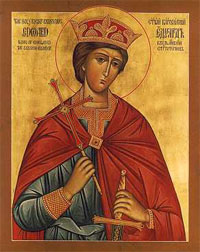
Icon of St Edward the Martyr.
Possibly, then, Edward’s translation to Shaftesbury, “with great honour”, was a key stage in reconciling a divided nobility, allowing Æthelred to be hallowed “with great rejoicing” less than three months later.
The Old English is beahgifa – literally ‘ring-giver’. The term ‘ring-giver’ is called a ‘kenning’ – a metaphorical compound word or phrase, used especially in Old English and Old Norse literature – and has the meaning ‘lord’ or ‘king’.
This entry falls into three sections. The first is also in Manuscript D. In place of the second, however, Manuscript D has a poetic passage, which, according to Dorothy Whitelock, whose translation (from her 1961 edition of the Anglo-Saxon Chronicle) follows, is “in the style” of Wulfstan, archbishop of York from 1002 to 1023: “In his [i.e. King Edward’s] days because of his youth, the adversaries of God, Ealdorman Ælfhere and many others, broke God’s law and hindered the monastic life, and destroyed monasteries and dispersed the monks and put to flight the servants of God, whom King Edgar had ordered the holy Bishop Æthelwold to institute; and they plundered widows time and again. And many wrongs and evil lawless acts rose up afterwards, and ever after that it grew much worse.” The third section is, once again, common to both Manuscript D and Manuscript E.
Dorothy Whitelock, whose translation (from her 1961 edition of the Anglo-Saxon Chronicle) follows, in a footnote, comments: “The entry in ‘A’, ‘B’, ‘C’ is in alliterative metre, of a quality to make one glad that the chroniclers mainly used prose.”
Annal 977 concludes Manuscript B of the Chronicle.
The material reported thus far by Florence of Worcester is presented at greater length in a Vita Sancti Oswaldi (Life of St Oswald) written c.1000 and attributed to Byrhtferth of Ramsey.[*] Byrhtferth tells (IV, 14) how Ælfwold had an unnamed man killed because he “had illegally sought to claim for himself an estate” that belonged to the monastery of Peterborough. From a story preserved in the late-12th century Liber Eliensis (Book of Ely: II, 11), it seems clear that the man was called Leofsige. Following Edgar’s death, this “enemy of God and deceiver of men” seized lands from Peterborough. After two years, during which time the lands had been untended, Æthelwold, bishop of Winchester – Æthelwold was a key figure of the Benedictine Reform, and had refounded the monasteries at Peterborough and Ely – brought the case before a “General Meeting” in London. The upshot was that the Church recovered the lands and Leofsige had a heavy fine imposed upon him. Before he could pay it, however, through “divine vengeance”, Leofsige “died shamefully and miserably”.
Byrhtferth and Florence do not use the vernacular title ‘ealdorman’, but a variety of Latin terms – in this passage, Ælfhere is princeps, Æthelwine is dux, and Byrhtnoth is comes.
According to William of Malmesbury (GR II §161), Æthelred was seven in 975 (i.e. he was born in 968). Simon Keynes comments: “the authority for this statement is uncertain.” However, Edgar had married Æthelred’s mother in 964, and whilst their first son, Edmund (who died in 971), is mentioned in a charter of 966 (S745), Æthelred is not, so William of Malmesbury’s claim is not unreasonable. Though William knows Æthelred’s age, he is silent in respect of Edward’s age (which perhaps gives credibility to his claim regarding Æthelred). The year of Edward’s birth is generally placed around 962.
See Edgar: an especial slave to lust.
According to an early-12th century Durham text, De Primo Saxonum Adventu: “under King Edgar, Oslac was appointed earl over York and the districts pertaining to it”.
In fact, Manuscripts D and E (and F, which has an abbreviated version of this entry) place Edward’s death in the year 979. Manuscripts A and C, and Florence of Worcester, place it in the preferred year of 978.
It would appear that entries for the years 977, 978, 979 and 980 are dated one year later than true date in Manuscripts D and E (and in F, which does not have an entry corresponding to the year 980).
Corfesgeate (Corfgeate and Porta Corf in Manuscript F): now called Corfe Castle (in Dorset) – the castle itself is post-Conquest, and was rendered ruinous in the Civil War – situated in the narrow gap where the Wareham to Swanage road passes through the Purbeck Hills.
Wulfstan wrote this sermon under his Latin pseudonym Lupus (Wolf) – though the work itself is written in Old English. Wulfstan was bishop of London from 996 to 1002, then archbishop of York from 1002 until his death in 1023. (The bishopric of Worcester was held, simultaneously, by the archbishop of York between 971 and 1016.)
A note added after the original text was written.
Christine E. Fell suggests that Osbern’s remark is made in such a casual manner that he was: “mentioning a well-known fact, nothing new or disputable.”
Osbern of Canterbury links the council at Calne with another that had been previously held at Winchester. He places both councils during Edgar’s lifetime and says (Vita Sancti Dunstani §36) they were convened as a result of complaints by the secular clergy about their treatment under Dunstan’s reforms (see Peace to England) – God’s support for Dunstan being demonstrated by a talking crucifix at Winchester and the incident at Calne that the archbishop survived. Osbern also indicates that there was a considerable gap between the meetings – saying it was “the sons” of those who had opposed Dunstan at Winchester that took up the cudgels at Calne. The Calne meeting certainly took place after Edgar’s death, and William of Malmesbury (GR II §161; and also in his own ‘Life’ of Dunstan written c.1130) places the earlier one, at Winchester, after Edgar’s death too – saying it was precipitated by Ealdorman Ælfhere’s actions taken against monasteries founded by Bishop Æthelwold.
As would be expected, Manuscript F (which was produced at Canterbury early in the 12th century) also records the incident at Calne s.a. 978. However, the final phrase, “some did not escape with their lives”, is replaced with: “some paid for it with their lives”. Osbern of Canterbury, in his Vita Sancti Dunstani (Life of St Dunstan), written about 1090, presents the council at Calne as a challenge to Dunstan, and the floor-collapse that spared him as divine judgement. Presumably, this notion persuaded the compiler of Manuscript F to make the subtle modification which implies the councillors who were injured or killed got their just deserts.
Ætheling: a male of royal blood; an eligible candidate for the throne.
Æthel (Æþel), meaning ‘noble’, features as an element of many Anglo-Saxon names – Æthelred is a compound of Æþel and ræd = ‘Noble counsel’.
Manuscript F places Edward’s murder and Æthelred’s succession s.a. 979, and Æthelred’s hallowing s.a. 980.
Florence of Worcester, though, places Edward’s murder, Æthelred’s succession and Æthelred’s coronation all s.a. 978. He dates Æthelred’s coronation Sunday 14th April, which is what a fortnight after Easter would have been in 978.
Manuscript A reports Edward’s killing s.a. 978, and continues: “in this same year Æthelred ætheling, his brother, succeeded to the kingdom.” Æthelred’s hallowing is not recorded. (From now on, there are only occasional entries in Manuscript A.)
Though Manuscripts D and E, apparently a year in advance at this time, date the annal 980.
In Manuscript F (s.a. 980), this entry follows on from the report of Æthelred’s hallowing, but it begins: “And St Dunstan and Ealdorman Ælfhere fetched …” In addition, in case there was any doubt, Manuscript F names the “holy king” (Edward of course).
Ann Williams suggests that Edward’s death was an accident: “in that, far from being planned, it arose from a provocative confrontation between the young king (prone to violent behaviour, according to Byrhtferth) and one or more of the noblemen attending on his brother. It remains curious that the perpetrator is not named; Edward’s grandfather King Edmund was killed in similar circumstances but ‘it was widely known how he ended his life, that Liofa stabbed him at Pucklechurch’.[*] Could it be that too many people (perhaps not all of them belonging to Ælfthryth’s faction) were secretly relieved to be rid of a violent and unstable youth?”
Highlighted quote from Anglo-Saxon Chronicle Manuscript D s.a. 946. (See Bloodaxe.)
Paul Antony Hayward believes it is “highly unlikely” that Goscelin was the author: “The Passio Eadwardi is arguably an imitation of Goscelin’s Lives of Edith, Kenelm and Wulfsige composed for – and probably written by one of – the nuns of Shaftesbury during the 1080s or 1090s.”
Byrhtferth describes Edward’s death:
… when the conspirators surrounded him – and it was just as the Jews once surrounded our Lord – he remained sitting on his horse, fearless.… The soldiers laid hold of him: one on his right-hand side drew him towards him, as if he wished to give him a kiss; another grabbed his left side firmly and gave him the death-blow. And the king shouted out, as best he could: “What are you doing, breaking my right hand?” And suddenly he fell from his horse; and he was dead.
Vita Sancti Oswaldi IV, 18
Given that Æthelred was calling Edward a martyr and a saint in 1001, it is not implausible that he and his council would prescribe the celebration of St Edward’s feast day throughout England in 1008. However, some scholars* suggest that, on stylistic grounds, the clause in question (16) in ‘V Æthelred’ is a later addition, made during King Cnut’s reign. If this really is the case, then the clause’s first appearance is in, what is believed to be, an interim law-code (found in Cambridge, Corpus Christi College MS 201) produced early in Cnut’s reign – at Oxford in 1018, to be precise.
* Kenneth Sisam: “the three manuscripts of V Æthelred derive from one defective copy, and the law relating to Edward may hve been interpolated in that copy: i.e. it may be the decision of a later witan. A detail of phrasing favours this view.”
The highlighted lament is clearly a later interpolation – made when Edward’s sainthood had been established, and when God’s vengeance for his murder had become apparent (see Unready) – “probably written in the late tenth century” and “during the lifetime of the murderers”, comments Simon Keynes.
s.a. = sub anno = ‘under the year’.
St Oswald (d.992) became bishop of Worcester in 961 and archbishop of York in 971. When he became archbishop of York, however, he also retained the bishopric of Worcester. Byrhtferth was a monk at Ramsey Abbey (north of Huntingdon), which was founded c.966, by Oswald and Æthelwine, ealdorman of East Anglia.
Gesta Regum Anglorum (Deeds of the Kings of England).
The Gesta Hammaburgensis Ecclesiae Pontificum (Deeds of Bishops of the Hamburg Church) was written between 1072 and 1076, though Adam continued to revise it until his death c.1081.
Charters are referred to by their number in Sawyer’s catalogue.
Available online: The Electronic Sawyer.
Henry of Huntingdon first produced his Historia Anglorum (History of the English) around 1130. He then revisited the work – revising and extending – several times before his death. The final version concludes with the accession of Henry II in 1154.
Walter Map’s De Nugis Curialium (Courtiers’ Trifles) – an entertaining collection of gossip and anecdotes – was written, piecemeal, between about 1181 and 1192.
Anglo-Norman chronicler Geffrei Gaimar wrote his Estoire des Engleis (History of the English), for a Lincolnshire patroness, round-about 1140. It is the earliest known historical work to have been written in the French language, and is in verse (actually, octosyllabic rhymed couplets). In fact, the Estoire des Engleis is the latter part of a longer work, but the earlier part has not survived. The existing work covers the period from the arrival in Britain of Cerdic (495) to the death of William Rufus (1100). Up to 959, it is based on a lost version of the Anglo-Saxon Chronicle.
Edward King and Martyr (1971) Introduction.
‘The Women in Edgar’s Life’, in Edgar, King of the English 959–975: New Interpretations (2008).
‘Æthelred the Unready: The Ill-Counselled King’ (2003) Chapter 1.
Passio et Miracula Sancti Eadwardi Regis et Martyris (Passion and Miracles of St Edward King and Martyr) – possibly written in the 1070s, by Goscelin, a monk of Saint-Bertin, at Saint-Omer in Flanders (now France), who worked as a hagiographer in England.
‘Translation-Narratives in Post-Conquest Hagiography and English Resistance to the Norman Conquest’, in Anglo-Norman Studies XXI: Proceedings of the Battle Conference 1998 (1999).
‘King Alfred the Great and Shaftesbury Abbey’, in Studies in the Early History of Shaftesbury Abbey (1999).
Studies in the History of Old English Literature (1953), Note A (The Relationship of Æthelred’s Codes V and VI).
The Diplomas of King Æthelred ‘the Unready’ 978–1016 (1980) Chapter 4.