RUIN
The End of Roman Britain
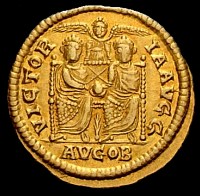
On 19th January 379, Gratian appointed Theodosius, an ex military commander from Spain, co-Augustus, and gave him charge of the Eastern empire. Gratian and his young half-brother, Valentinian II, ruled in the Western empire.[*]
… he [Gratian] would have been fitted with all good qualities, if he had attended to comprehending the science of ruling the state, from which he was almost a stranger not only by inclination but also by practice. For he aroused the hatred of the troops against himself when he neglected the army and preferred to the venerable Roman soldier a few from the Alans whom he had arrogated to himself by an immense payment of gold, and with the retinue of barbarians he had almost even begun to have friendship …Anonymous Epitome de Caesaribus §47 (c.395)
Having accepted the counsel of those courtiers who usually corrupt the manners of princes, he gave a reception to some Alan fugitives, whom he not only introduced into his army, but honoured with valuable presents, and confided to them his most important secrets, esteeming his own soldiers of little value. This produced among his soldiers a violent hatred against him, which being gradually inflamed and augmented incited in them a disposition for innovation, and most particularly in that part of them which was in Britain, since they were the most resolute and vindictive. In this spirit they were encouraged by Maximus, a Spaniard, who had been the fellow-soldier of Emperor Theodosius in Britain.[*] He was offended that Theodosius should be thought worthy of being made emperor, while he himself had no honourable employment. He therefore cherished the animosity of the soldiers towards the emperor. They were thus easily induced to revolt and to declare Maximus emperor.Zosimus New History IV, 35 (c.500)
It is not known what command Magnus Maximus was holding in Britain when, in 383, he was proclaimed emperor by the troops – perhaps, in view of a comment in the anonymous Gallic Chronicle of 452 (named after the year of its final entry), that “Maximus vigorously overcame invading Picts and Scots”, he was dux Britanniarum, based in the North.[*] At any rate, Maximus promptly took an army across the Channel into Gaul.
As the Emperor Gratian was at this period occupied with a war against the Alamanni, Maximus quitted Britain, with the design of usurping the imperial power. Valentinian was then residing in Italy, but as he was a minor, the affairs of state were transacted by Probus, a Praetorian prefect, who had formerly been consul.Sozomen Ecclesiastical History VII, 13 (c.445)
Gratian’s forces soon defected to Maximus, and he was forced to flee. Maximus despatched Andragathius, his magister equitum (commander of horse), in pursuit. Gratian was caught, at Lyon, and executed on 25th August 383 – he was twenty-four years old. Maximus sent an ambassador to Theodosius:
The purport of his mission was to propose to Theodosius a treaty of amity, and of alliance, against all enemies who should make war on the Romans; and on refusal, to declare against him open hostility. Upon this, Theodosius admitted Maximus to a share in the empire, and in the honour of his statues and his imperial title. Nevertheless, he was at the same time privately preparing for war, and endeavouring to deceive Maximus by every species of flattery and observance.Zosimus New History IV, 37
Maximus, out of fear of the leader of the Eastern empire, Theodosius, entered into a treaty with Valentinian.Gallic Chronicle of 452 (Theodosius I[*])
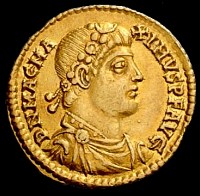
Maximus was in effect accepted as Gratian’s successor. He ruled Britain, Gaul and Spain, whilst young Valentinian held Italy.
 (•)
(•)
When a number of bishops from different parts of the world came together to visit the emperor Maximus, a man of a fierce nature who was proud of his victory in the civil wars, the revolting sycophancy of all of them towards the emperor was noted, as was the fact that their priestly dignity had, as a result of their despicable weakness, stooped to the level of imperial clients: in Martin alone did the apostolic authority remain intact. For even though he had to intercede with the king on behalf of a number of people, he demanded rather than begged, and although he was frequently invited, he refused to dine with Maximus, saying that he could not share the table of a person who had deprived one emperor of his sovereignty, another of his life. Finally Maximus protested that he had not taken up power voluntarily, but that he had used arms to defend the sovereign power imposed upon him by the soldiers in accordance with the divine will: he did not think that God’s will could be at odds with someone who had gained such a remarkable victory, and none of his enemies had been killed except in battle. Martin was at last convinced by his arguments or by his entreaties and attended the banquet, while the ruler was extraordinarily pleased to have achieved this… To this same Maximus, Martin predicted long in advance that if he went to Italy where he planned to go to wage war against the emperor Valentinian, he ought to be aware that he would be victorious in the first onslaught but that he would die shortly afterwards.Sulpicius Severus Vita Sancti Martini (Life of St Martin) §20 (c.395)
… Maximus, who deemed his appointments inferior to his merits, being only governor of the countries formerly under Gratian, projected how to depose the young Valentinian from the empire …Zosimus New History IV, 42
In 387:
Maximus, saying that an unworthy action had been taken against the position of the Church, discovered a way to break the treaty he had made with Valentinian.Gallic Chronicle of 452 (Theodosius III[*])
… Maximus raised a large army of Britons, neighbouring Gauls, Celts, and other nations, and marched into Italy.Sozomen Ecclesiastical History VII, 13
Valentinian, fearing the usurper, who was already a threat to his life, fled to Theodosius [at Thessalonica].Gallic Chronicle of 452 (Theodosius III)
… placing his faith in God, he [Theodosius] took himself off against the usurper Maximus, being his superior only in faith – for he was by far his inferior in every sort of supplies needed for war. At that time, Maximus had established his court at Aquileia to view his victory. Andragathius, his count, saw to the necessities of war. Using an enormous body of troops and tactics that counted for more than the strength of his forces, he blocked off in an astounding fashion all the entrances to the Alps and river estuaries. But, through the ineffable will of God, while he was preparing a naval expedition to surprise and overwhelm his enemy unawares, of his own free will he abandoned those very gates that he had barred. So Theodosius, without anyone realising, let alone resisting, crossed the abandoned Alps and unexpectedly advanced upon Aquileia. Without any trickery or opposition, he surrounded, captured, and killed his great enemy, Maximus, a brutal man, who had exacted tribute and taxes from the most savage German tribes merely through the terror of his reputation. Valentinian, his power restored, took control of Italy. Count Andragathius, after learning that Maximus was dead, hurled himself from his ship into the waves and drowned. Through God’s protection, Theodosius had won a bloodless victory… On the death of Maximus and his son Victor, whom Maximus had left as emperor of the Gauls, the younger Valentinian’s rule was restored and he himself crossed over into Gaul.Orosius Historiarum Adversus Paganos Libri Septem VII, 35 (c.417)
Maximus was executed on either 28th July or 28th August 388 (the sources are divided).
At length also, as thickets of tyrants [i.e. usurpers] were growing up and bursting forth soon into an immense forest, the island [Britain] retained the Roman name, but not the morals and law; nay rather, casting forth a shoot of its own planting, it sends out Maximus to the Gauls, accompanied by a great crowd of followers, with an emperor’s ensigns in addition, which he never worthily bore nor legitimately, but as one elected after the manner of a tyrant and amid a turbulent soldiery. This man, through cunning art rather than by valour, first attaches to his guilty rule certain neighbouring countries or provinces against the Roman power, by nets of perjury and falsehood. He then extends one wing to Spain, the other to Italy, fixing the throne of his iniquitous empire at Trier [in modern Germany], and raged with such madness against his lords that he drove two legitimate emperors, the one from Rome, the other from a most pious life. Though fortified by hazardous deeds of so dangerous a character, it was not long ere he lost his accursed head at Aquileia: he who had in a way cut off the crowned heads of the empire of the whole world.Gildas De Excidio Britanniae §13
That, somewhat vitriolic, summary of Magnus Maximus’ imperial career comes from De Excidio Britanniae (On the Ruin of Britain), written c.545(?), by the British cleric Gildas. His purpose was not to write an accurate work of history. He is sketchy on detail, chronology is almost absent, and it is difficult to reconcile his story with other sources, but Gildas provides the earliest narrative of the demise of Roman Britain. He continues:
After this, Britain is robbed of all her armed soldiery, of her military supplies, of her rulers, cruel though they were, and of her vigorous youth who followed the footsteps of the above-mentioned tyrant [i.e. Maximus] and never returned. Completely ignorant of the practice of war, she is, for the first time, open to be trampled upon by two foreign tribes of extreme cruelty, the Scots from the north-west, the Picts from the north; and for many years continues stunned and groaning.
Owing to the inroads of these tribes and the consequent dreadful prostration, Britain sends an embassy with letters to Rome, entreating in tearful appeals an armed force to avenge her, and vowing submission on her part to the Roman power, uninterrupted and with all strength of heart, if the enemy were driven away. A legion is forthwith prepared, with no remembrance of past evil, and fully equipped. Having crossed over the sea in ships to Britain, it came into close engagement with the oppressive enemies; it killed a great number of them and drove all over the borders, and freed the humiliated inhabitants from so fierce a violence and threatening bondage. The inhabitants were commanded to build a wall across the island …
The legion returned home in great triumph and joy, when [suddenly] their old enemies, like rapacious wolves, fierce with excessive hunger, jump with greedy maw into the fold, because there was no shepherd in sight. They rush across the boundaries, carried over by wings of oars, by arms of rowers, and by sails with fair wind. They slay everything, and whatever they meet with they cut it down like a ripe crop, trample under foot and walk through.Gildas De Excidio Britanniae §§14–16
Meanwhile, on 15th May 392, Valentinian was found dead:
… he was strangled at Vienne [south of Lyon], through the treachery, men say, of his count, Arbogastes, and then hanged up on a noose in order that he might be thought to have willingly taken his own life. On the death of the Augustus Valentinian, Arbogastes soon found the nerve to set up Eugenius as a usurper. He picked a man to whom he could give the title of emperor, but he, a barbarian overly endowed with audacity and might in mind, council, and deed, intended to run the empire.Orosius Historiarum Adversus Paganos Libri Septem VII, 35
On 6th September 394, Theodosius defeated Eugenius at the river Frigidus, in north-eastern Italy. Eugenius was executed and Arbogastes committed suicide. On 17th January 395, Theodosius died at Milan. He was succeeded in the East by his elder son (seventeen or eighteen) Arcadius, and in the West by his ten-year-old son Honorius.[*]
In 399, the poet Claudian (Claudius Claudianus) put the following words into the mouth of the personification of Rome:
“Examples near at hand testify to the extent of my power now thou [Honorius] art emperor. The Saxon is conquered and the seas safe; the Picts have been defeated and Britain is secure.”Claudian In Eutropium (Against Eutropius) I, lines 390–393
In fact, it was Honorius’ guardian, the magister militum (Master of Soldiers) Stilicho, who wielded power.[*] In 400, Claudian published a work commemorating the first consulship of Stilicho:
Next spake Britain clothed in the skin of some Caledonian beast, her cheeks tattooed, and an azure cloak, rivalling the swell of Ocean, sweeping to her feet: “Stilicho gave aid to me also when at the mercy of neighbouring tribes, what time the Scots roused all Hibernia [Ireland] against me and the sea foamed to the beat of hostile oars. Thanks to his care I had no need to fear the Scottish arms or tremble at the Pict, or keep watch along all my coasts for the Saxon who would come whatever wind might blow.”Claudian De Consulatu Stilichonis (On the Consulship of Stilicho) II, lines 247–255
It seems, then, that, probably in 398, Stilicho sent troops to Britain. It is unlikely that Stilicho himself made the journey – surely Claudian would have made it clear if he had. Possibly the expedition Claudian is alluding to can be equated with Gildas’ story of a second Roman military intervention in Britain:
Again suppliant messengers are sent with rent clothes, as is said, and heads covered with dust. Crouching like timid fowls under the trusty wings of the parent birds, they ask help of the Romans, lest the country in its wretchedness be completely swept away, and the name of Romans, which to their ears was the echo of a mere word, should even grow vile as a thing gnawed at, in the reproach of alien nations. They, moved, as far as was possible for human nature, by the tale of such a tragedy, make speed, like the flight of eagles, unexpected in quick movements of cavalry on land and of sailors by sea; before long they plunge their terrible swords in the necks of the enemies; the massacre they inflict is to be compared to the fall of leaves at the fixed time, just like a mountain torrent, swollen by numerous streams after storms, sweeps over its bed in its noisy course; with furrowed back and fierce look, its waters, as the saying goes, surging up to the clouds (by which our eyes, though often refreshed by the movements of the eyelids, are obscured by the quick meeting of lines in its broken eddies), foams surprisingly, and with one rush overcomes obstacles set in its way. Then did the illustrious helpers quickly put to flight the hordes of the enemy beyond the sea, if indeed escape was at all possible for them: for it was beyond the seas that they, with no one to resist, heaped up the plunder greedily acquired by them year by year.
The Romans, therefore, declare to our country that they could not be troubled too frequently by arduous expeditions of that kind, nor could the marks of Roman power, that is an army of such size and character, be harassed by land and sea on account of un-warlike, roving, thieving fellows. They urge the Britons, rather, to accustom themselves to arms, and fight bravely, so as to save with all their might their land, property, wives, children, and, what is greater than these, their liberty and life: they should not, they urge, in any way hold forth their hands armourless to be bound by nations in no way stronger than themselves, unless they became effeminate through indolence and listlessness; but have them provided with bucklers, swords and spears, and ready for striking. Because they were also of opinion that it would bring a considerable advantage to the people they were leaving, they construct a wall, different from the other … they give bold counsel to the people in their fear, and leave behind them patterns for the manufacture of arms. On the sea coast also, towards the south, where their ships were wont to anchor, because from that quarter also wild barbarian hordes were feared, they place towers at stated intervals, affording a prospect of the sea.[*] They then bid them farewell, as men who never intended to return.Gildas De Excidio Britanniae §§17–18
In 402, Stilicho defeated (though not decisively) Alaric, king of the Visigoths, at Pollentia (modern Pollenzo, in north-west Italy). Claudian celebrated the event in a poem. It seems that Stilicho withdrew troops from Britain to take part in his campaign:
… the legion that had been left to guard Britain, the legion that kept the fierce Scots in check, whose men had scanned the strange devices tattooed on dying Picts.Claudian De Bello Gothico (On the Gothic War), lines 416–418
In 407, Constantine III (as he is usually called) was proclaimed emperor by the British garrison. He was actually their third choice, the first two proving to be unsuitable.
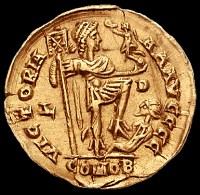
When Arcadius was still reigning, Honorius being consul the seventh time and Theodosius the second [i.e. in 407[*]], the troops in Britain revolted and promoted Marcus to the imperial throne, rendering obedience to him as sovereign there. Some time subsequently, having put him to death for not complying with their inclinations, they set up Gratian, whom they presented with a diadem and a purple robe, and attended him as an emperor. Being disgusted with him likewise, they four months afterwards deposed and murdered him, delivering the empire to Constantine.Zosimus New History VI, 2
… Arcadius being in his sixth consulate, and Probus was his colleague [i.e. in 406], the Vandals, uniting with the Alans and the Suebi, crossed in these places [Alpine passes, just mentioned], and plundered the countries beyond the Alps. Having there occasioned great slaughter they likewise became so formidable even to the armies in Britain, that they were compelled, through fear of their proceeding as far as that country, to choose several usurpers, that is Marcus, Gratian, and after them Constantine. A furious engagement ensued between them, in which the Romans gained the victory, and killed most of the barbarians. Yet by not pursuing those who fled, by which means they might have put to death every man, they gave them opportunity to rally, and by collecting an additional number of barbarians, to assume once more a fighting posture.Zosimus New History VI, 3
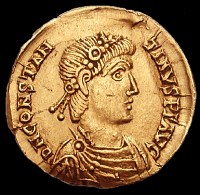
… two years before the breach of Rome [i.e. in 408], the Alans, Suebi, Vandals, and many other tribes with them, were, as I have mentioned, roused up by Stilicho, crushed the Franks, crossed the Rhine, invaded the Gallic provinces, and marched straight through them as far as the Pyrenees.[*] They were halted by this barrier for a time and poured back over the neighbouring provinces. While they indulged in an orgy of destruction in the Gallic provinces, in the British provinces Gratian, a citizen of that island, usurped power and was killed. Constantine, a man from the lowest ranks of the army, lacking in any ability, and whose only appeal was in his name, was chosen in his stead. Immediately he had usurped power, he invaded the Gallic provinces …Orosius Historiarum Adversus Paganos Libri Septem VII, 40
 (•)
(•)
The date Orosius attaches to the above passage, 408, is too late. Zosimus seems to contradict himself, placing the usurpations of Marcus, Gratian and Constantine firstly in 407 and then in 406. It so happens that a relevant fragment from the work, by Olympiodorus of Thebes, that underlies Zosimus during this period has been preserved. The fragment provides some clarity, specifying that Marcus was proclaimed emperor “before the seventh consulship of Honorius”, i.e. late in 406.[*] By the time Constantine was proclaimed emperor it would have been about spring 407. Gildas must have known something of these events and their consequences from his sources (Orosius, for instance), but he makes no mention of them. At any rate:
Having appointed Justin and Neobigastes to the command of his forces, he [Constantine] left Britain and crossed over to Bononia [Boulogne], a town on the coast, the first in Gallic territory. There he spent some time, gaining over all the soldiery of Gaul and Aquitaine, and occupied the whole of Gaul as far as the Alps which separate Italy and Gaul.Olympiodorus of Thebes Histories, Fragment 12
… Constantine placed guards in these places [Alpine passes], that those tribes should not have so free access into Gaul. He likewise secured the Rhine, which had been neglected since the time of the emperor Julian [d.363].Zosimus New History VI, 3
Stilicho sent an army, commanded by the Gothic chieftain Sarus, against Constantine. Sarus enjoyed initial success, killing both of Constantine’s generals. To replace them, Constantine appointed Edobichus, a Frank, and Gerontius, a Briton. The new commanders forced Sarus to flee back to Italy. Constantine established himself at Arelate (now Arles) in the south of Gaul. Fearing a two-pronged attack – from Italy and, by Honorius’ relatives, from Spain – Constantine despatched his son Constans, whom he had made Caesar,[*] and Gerontius to secure Spain. On 22nd August 408, Stilicho was executed.
Stilicho, the general of the troops of Honorius, was suspected of having conspired to proclaim his son Eucherius emperor of the East [*]… a report having been spread that he had conspired against the emperor, and had formed a scheme, in conjunction with those in power, to raise his son to the throne, the troops rose up in sedition, and slew the Praetorian prefect of Italy and of Gaul, the military commanders, and the chief officers of the court. Stilicho himself was slain by the soldiers at Ravenna. He had attained almost absolute power; and all men, so to speak, whether Romans or barbarians, were under his control. Thus perished Stilicho, on a suspicion of having conspired against the emperors. Eucherius, his son, was also slain.Sozomen Ecclesiastical History IX, 4
Meanwhile, having accomplished his mission, leaving Gerontius in Spain, Constans returned to his father with two captive relatives of Honorius: Verenianus and Didymus. Constantine promptly had the pair put to death. Early in 409:
… the rebel Constantine sent some eunuchs to Honorius, to intreat pardon from him for having accepted imperial power: he had not chosen to take it but rather it had been forced on him by the soldiers. When the emperor heard this petition, perceiving that it was not easy for him to prepare for other wars, since Alaric and his barbarians were so near; and considering the safety of his relations who were in the hands of the rebel, whose names were Verenianus and Didymus; he not only granted his request, but likewise sent him an imperial robe. But his care for his relations was in vain, they having been put to death before this embassy. Having done this, he sent home the eunuchs.Zosimus New History V, 43
Late in 409:
… Alaric, having received insult in return for his reasonable demands, hastened towards Rome with all his forces, designing closely to besiege that city. At the same time Jovius, a man of great learning and virtue, came to Honorius as ambassador from Constantine, who had usurped power among the Celts [i.e. in Gaul], desiring a confirmation of the peace which had formerly been agreed on, and requesting pardon for the death of Verenianus and Didymus, who were relations of the emperor Honorius. He pleaded in excuse, that they were not killed with the concurrence of Constantine. Finding Honorius in great perplexity, he told him that he would be well advised to make some concessions, since he was so much embroiled with the affairs of Italy, and that if he would suffer him to go back to Constantine to inform him of the circumstances in which Italy then stood, he would shortly return with all the forces in Celtica, Spain, and Britain, to the relief of Italy and Rome. On these conditions Jovius was permitted to depart.Zosimus New History VI, 1
Now, according to Zosimus, because Constantine had moved most of his army to Spain:
… the barbarians beyond the Rhine made such unbounded incursions over every province, as to reduce not only the inhabitants of Britain, but some of the Celtic nations also to the necessity of revolting from the empire, and living no longer under the Roman laws but as they themselves pleased. The Britons therefore took up arms, and incurred many dangerous enterprises for their own protection, until they had freed their cities from the barbarians who besieged them. In a similar manner, the whole of Armorica, with other provinces of Gaul, delivered themselves by the same means; expelling the Roman magistrates or officers, and erecting a government, such as they pleased, of their own.
Thus happened this revolt or defection of Britain and the Celtic nations, when Constantine usurped the empire, by whose negligent government the barbarians were emboldened to commit such devastations.Zosimus New History VI, 5–6
The Gallic Chronicle of 452 equates 396 with Honorius’ 1st year. In his 16th year, i.e. 411, appears the entry:
The British provinces were laid waste by an invasion of the Saxons.
The chronology of this chronicle is, though, erratically unreliable, so maybe its “invasion of the Saxons” refers to the events reported by Zosimus (VI, 5–6), which would be 408–9.[*]
Anyway, Sozomen (IX, 12) makes it plain that Constantine’s intention was, in fact, to take Italy for himself. Constantine’s fortunes, however, were already crumbling. He had decided to promote Constans to Augustus, and to send him back to Spain, accompanied by a general called Justus. Gerontius, apparently angered at the prospect of being superseded by Justus, stirred-up the Vandals, Suebi and Alans who had settled in Gaul since 406 into revolt against Constantine, and declared one Maximus emperor.[*] Further, the soldiers assigned to guard the Pyrenean passes – these too were barbarians, who had been recruited by Constantine – abandoned their posts, allowing the marauding Vandals, Suebi and Alans to cross into Spain in the autumn of 409.[*] It was perhaps early in 410 (the chronology of these events is not at all clear) when Constantine crossed the Alps into Italy, but he was obliged to withdraw back to Arles after he heard that Honorius’ magister equitum, Allobich (who was evidently in cahoots with Constantine), had been put to death:
… being suspected of conspiring to place the entire Western government under the domination of Constantine …Sozomen Ecclesiastical History IX, 12
Constans, having suffered a defeat in Spain, also had to retreat to Arles.
Alaric had, late in 409, installed his own puppet emperor, Attalus, at Rome (Honorius’ court was at Ravenna). In 410, Alaric:
… proceeded with his army to all the cities of Aemilia, which had refused to accept Attalus as their sovereign. Some of these he speedily reduced; but having besieged Bononia [Bologna], which resisted him many days, without being able to take it, he advanced towards Liguria, to compel that country likewise to acknowledge Attalus as its emperor. Honorius, having sent letters to the cities in Britain, counselling them to be watchful of their own security, and having rewarded his soldiers with the money sent by Heraclian, lived with all imaginable ease, since he had acquired the attachment of the soldiers in all places.Zosimus New History VI, 10
The message conveyed in the letters mentioned by Zosimus, sent “to the cities in Britain”, is known as the Rescript of Honorius – the assumption being that the emperor was responding to a plea for help. The Rescript, which in effect tells the Britons that they are on their own, is traditionally seen as marking the end of Roman Britain. There are, however, nagging scholarly suspicions that “the cities” weren’t in Britain at all![*]
In the summer of 410, Attalus was removed from office by Alaric. Shortly after, Alaric’s Visigoths sacked Rome – entering the city on 24th August 410.[*] In 411:
… the emperor Honorius, seeing that with so many usurpers opposing him, he was unable to do anything against the barbarians, ordered that these usurpers be suppressed first. Count Constantius was placed in charge of this campaign. It was then that the state finally realised what advantages there were to having a Roman leader again and how much she had suffered in the long period when she had been a subject to barbarian counts.Orosius Historiarum Adversus Paganos Libri Septem VII, 42
Meanwhile, Gerontius had invaded Gaul. He killed Constans at Vienne. He then besieged Constantine and his younger son, Julian, at Arles. At this point, Count Constantius arrived on the scene. Most of Gerontius’ army deserted to Constantius and Gerontius fled back to Spain. His troops turned on him:
The house where he seeks refuge is set on fire, but he offers a brave resistance to the mutineers, together with one of his servants, an Alan by birth. At last, he slays the Alan and then his wife, at their earnest request, and then stabs himself.Olympiodorus of Thebes Histories, Fragment 16
Count Constantius continued the siege of Arles. Constantine had sent for reinforcements – Franks and Alamanni, recruited beyond the Rhine – but they were defeated:
Constantine takes refuge in a church and is ordained priest, having been solemnly promised that his life should be spared. The city gates are thrown open to the besiegers, and Constantine and his son taken to Honorius. But the emperor, bearing a grudge against them for the murder of his cousins by Constantine, orders them to be put to death in violation of his oath, thirty miles from Ravenna.Olympiodorus of Thebes Histories, Fragment 16
Maximus was stripped of the purple, forsaken by his Gallic troops, who crossed to Africa and were then summoned back to Italy, and now lives as a poor exile among the barbarians in Spain.Orosius Historiarum Adversus Paganos Libri Septem VII, 42
… Constantine, defeated in battle, died with his sons. However the Romans never succeeded in recovering Britain, but it remained from that time on under tyrants.Procopius of Caesarea History of the Wars III, 2 (c.550)
Having failed to mention Constantine et al., Gildas continues his story:
As they [the Romans] were returning home, the terrible hordes of Scots and Picts eagerly come forth out of the coracles in which they sailed across the sea-valley, as on Ocean’s deep, just as, when the sun is high and the heat increasing, dark swarms of worms emerge from the narrow crevices of their holes. Differing partly in their habits, yet alike in one and the same thirst for bloodshed – in a preference also for covering their villainous faces with hair rather than their nakedness of body with decent clothing – these nations, on learning the departure of our helpers and their refusal to return, became more audacious than ever, and seized the whole northern part of the land as far as the wall, to the exclusion of the inhabitants. To oppose their attacks, there was stationed on the height of the stronghold, an army, slow to fight, unwieldy for flight, incompetent by reason of its cowardice of heart, which languished day and night in its foolish watch. In the meantime the barbed weapons of the naked enemies are not idle: by them the wretched citizens are dragged from the walls and dashed to the ground. This punishment of untimely death was an advantage, forsooth, to them that were cut off by such an end, in so far as it saved them, by its suddenness, from the wretched torments which threatened their brethren and relatives. Why should I tell more? They abandon their cities and lofty wall: there ensues a repetition of flight on the part of the citizens; again there are scatterings with less hope than ever, pursuit again by the enemy, and again still more cruel massacres. As lambs by butchers, so the unhappy citizens are torn in pieces by the enemy, insomuch that their life might be compared to that of wild animals. For they even began to restrain one another by the thieving of the small means of sustenance for scanty living, to tide over a short time, which the wretched citizens possessed. Calamities from without were aggravated by tumults at home, because the whole country by pillagings, so frequent of this kind, was being stripped of every kind of food supply, with the exception of the relief that came from their skill in hunting.Gildas De Excidio Britanniae §19
THE LONG AND THE SHORT OF IT
an archaeological postscript
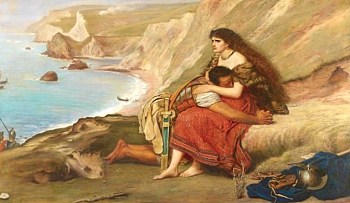
by Sir John Everett Millais (1829–1896)
Neil Faulkner, in an article titled ‘Decline and Fall’, British Archaeology magazine (Issue 55, October 2000):
It used to be thought, years ago, that Roman Britain ‘ended’ in AD 410. The impression was that, one day, the Roman army marched out in orderly fashion under their standards, and on the next, the barbarian Saxons sailed in and consigned everywhere to the Dark Ages.
More recently, archaeologists have taken a different line, arguing that Roman Britain hardly ended at all. Using evidence mainly from single sites like Wroxeter, they claim that some aspects of Roman culture – such as town life, bureaucracy and the use of Latin – continued, at least in the west, as late as the 7th century. Although some scholars have pointed to signs of early decline, the dominant view has been that of survival.
New research, however, throws that consensus into doubt. Taking the excavated evidence as a whole, it now seems that Roman culture was disintegrating in Britain from the early-200s and had almost completely gone by the end of the 4th century.
This gradual but inexorable collapse affected towns, villas and villages. Nothing was exempt. The imperial project, the bringing of civilised life to barbarian lands, started with enthusiasm but ended – and ended early – amid piles of refuse and squalor, with abandoned farms and villages, country houses turned into barns and workshops, and towns heavily fortified by an embattled class of state officials desperate to cling on to power.
Dr Faulkner analysed archaeological data from seventeen urban sites across England:
… ranging from Wroxeter to Canterbury and from Exeter to Lincoln. A clear pattern emerged. Most civic buildings were erected in about AD 75–150, most private town-houses in about AD 150–225, and urban occupation (measured by rooms in use) reached peak levels in the early-3rd century.
Civic construction work then collapsed as resources were diverted into building town walls in the mid-to-late-3rd century. There was a partial recovery in the early-4th – the so-called ‘Constantian renaissance’ – but it was a temporary blip, and, from around AD 325, Romano-British towns faced terminal decline. Few new buildings were erected, many old ones were abandoned, and by about AD 400 there was little left in most places but a wasteland of ruins and rubbish.
… What the archaeology as a whole shows is near-total collapse of the Roman settlement pattern – not just the disappearance of towns, but of villas too, and indeed many native villages and farmsteads.
Two further recent surveys add weight to this view – one by Jack Newman of 78 villas randomly selected from published reports, another by Katie Meheux from the Institute of Archaeology (UCL) of 162 possible villa sites in the Severn Valley/Welsh Marches region…
One favoured explanation for urban decline is that the Romano-British gentry ‘retreated to the countryside’ to escape the burdens of public service in towns, and there, from the late-3rd century onwards, invested heavily in the embellishment of their country seats. Because of this, Guy de la Bédoyère has described the 4th century as Roman Britain’s ‘golden age’ (BA July 1999[*]).
In fact, the boom in the villa economy seems to have ended early in that century. Newman’s survey showed that between AD 300 (the peak) and AD 350 the amount of new building-work undertaken on villas fell by almost two thirds. Both his survey and that of Meheux revealed that a majority of villas had been abandoned by about AD 375 and virtually all by about AD 400.
The odd exception – like Whitley Grange in Shropshire – cannot alter the general picture. Much more typical were sites like Gorhambury in Hertfordshire, where the grand house was a ruin and had been incorporated into the farmyard by the mid-4th century, and Thurnham in Kent, where one of the central rooms was being used as an iron smithy at an even earlier date.
Native villages and farmsteads fared somewhat better, but many were still deserted or contracted sharply in the 4th century. Katie Meheux surveyed 317 native rural sites in the Severn Valley/Welsh Marches region and discovered a fall of 27 per cent in the number occupied between AD 100–150 and AD 350–400. My own more modest survey of 177 rural sites excavated in 1969–96 (as listed in the Roman archaeology journal Britannia) showed a fall of 35 per cent for the same period.
… Taken as a whole, the evidence implies not a 4th century ‘golden age’, but after about AD 325 at any rate, an agricultural slump, a decaying class of gentry and an increasingly hard-pressed peasantry. There was, it seems, decline in both town and country – Roman Britain was in crisis long before AD 410…
… When the last Roman soldiers left the island or melted back into the countryside in the early-5th century, Britain’s fragile Romanitas had already rotted away to almost nothing.
The succeeding Dark Ages are ‘dark’ for archaeologists precisely because virtually none of the rich material culture of Roman Britain survived.
Almost the whole edifice of Romanization vanished in a generation or two – the forts, towns and villas, the mosaics, frescoes and hypocausts, the stone-quarries, potteries and markets. Late Roman Britain had been part of a world system in crisis, and because it was a distant, under-developed region, it was one of the first to fall.‘Decline and Fall’ BA 55, October 2000
Neil Faulkner had just published his book The Decline and Fall of Roman Britain when the above article appeared in print. Another book published in 2000 was Britain and the End of the Roman Empire, by Ken Dark. In a letter to British Archaeology (Issue 56, December 2000), Dr Dark takes Dr Faulkner to task over his article:
… his interpretation of the end of Roman Britain presented here is seriously flawed…
Archaeologists arguing for a longer survival of Romano-British culture do not usually rely solely on the evidence of single sites, nor suggest that late-4th century towns remained unchanged from their earlier form. Faulkner’s view of late-4th century towns as rubbish tips surrounded by walls is novel, but most aspects of his picture resemble those envisaged by other scholars. Proponents of what he calls the ‘long chronology’ agree that towns had changed, but were – as he admits – ‘still towns’.
Like Faulkner, those favouring a ‘long chronology’ argue that administration and defence were priorities. Unlike him, they envisage larger urban populations, for example interpreting ‘dark earth’ deposits common on 4th century sites as evidence of intensive low-status occupation, with an elite still living in (albeit far fewer) ‘Roman’ town houses. All we see is a change in the nature of towns, not urban decline.
… Nor do other scholars claim that villas survived in their 4th century form after the early-5th century. So-called ‘squatter occupation’ (and other indications) suggest 5th century occupation at some villa sites but most were disused in or by the early 5th century, even according to the ‘long chronology’. For Faulkner to cite the interesting work by Meheux and Newman is questionable, because their results could equally well be encompassed within a ‘long chronology’.
In conclusion, Dr Dark avers that:
… Faulkner’s view [is] untenable, and a ‘long chronology’ for the end of Roman Britain remains the best interpretation of the evidence as a whole.
The ‘long chronology’ vs ‘short chronology’ debate continues.