origins of the
PICTS AND SCOTS
To Tacitus, who wrote a biography of his father-in-law, the Roman governor of Britain from AD 77 to 84, Agricola, the whole of Britain north of the Forth-Clyde isthmus was “Caledonia”. However, Tacitus never refers to that country’s inhabitants as Caledonians, only as “Britons”. The geographer Ptolemy, writing in the mid-2nd century (but apparently using data gleaned during Agricola’s tenure), lists the Caledonians (Caledonii) as just one of several tribes living north of the Forth-Clyde isthmus. So, although the whole country was called Caledonia, the Caledonians were but one of the tribes inhabiting that country. (See British Tribes: Caledonia.)
Cassius Dio, discussing events in northern Britain during the period 197–211, notes:
There are two principal races of the Britons, the Caledonians and the Maeatae, and the names of the others have been merged in these two. The Maeatae live next to the cross-wall which cuts the island in half, and the Caledonians are beyond them.Roman History (Epitome, Xiphilinus) LXXVI, 12
It is generally believed that Dio’s “cross-wall” is the Antonine Wall (on the Forth-Clyde line), in which case, the tribes of Caledonia had amalgamated to produce two major groups: the Maeatae, to the immediate north of the Wall, and to the north of them the Caledonians. (See The Caledonian Campaigns of Septimius Severus.)
Almost a century later, in a panegyric delivered in 297, appears the earliest extant mention of the Picts. The anonymous author makes a poetic reference to Julius Caesar having had a relatively easy task invading Britain, since his opponents were:
… an uncivilised nation and accustomed to no enemies except the Picts [Picti] and the Irish [Hiberni], still half-naked …Panegyrici Latini VIII ‘Panegyric on Constantius Caesar’ §11
A little later, in 310, another panegyric, also anonymous, refers to the:
… forests and marshes of the Caledonians [Caledones] and other Picts[*]…Panegyrici Latini VI ‘Panegyric on Constantine’ §7
Appended to the Verona List – a list of Roman provinces, dating from about 314 (it survives in a 7th-century manuscript at Verona) – is a catalogue of forty “barbarian peoples that have sprung-up under the emperors”, which begins with the Scots, the Picts and the Caledonians. This is apparently the earliest historical reference to the Scots (Scoti or Scotti), and also the last reference to the Caledonians.
Ammianus Marcellinus, writing about the, so-called, Barbarian Conspiracy of 367:
… at that time the Picts, divided into two tribes, called Dicalydones and Verturiones, as well as the Attacotti, a warlike race of men, and the Scots, were ranging widely and causing great devastation …Res Gestae XXVII, 8
Presumably the Caledonians (Caledonii/Caledones) had evolved into the Dicalydones – the similarity of name is clear – and the Maeatae had metamorphosed into the Verturiones. It would seem, then, that by the early-4th century all the tribes beyond the Forth-Clyde line had come to be known, collectively, as Picti by the Romans. Scoti also seems to be a new name for an old foe – in this instance Irish raiders. The ‘Panegyric on Constantius Caesar’ of 297 linked the Picts with the Hiberni, but thereafter they are always linked with the Scoti. The poet Claudian (Claudius Claudianus), writing in 398, confirms that the Scots are indeed Irish:
… ice-bound Hibernia [Ireland] wept for the heaps of slain Scots.Panegyricus de Quarto Consulatu Honorii Augusti, line 33
(Panegyric on the Fourth Consulship of Honorius)
The etymology of the word Scoti is uncertain – it does not have a Latin root, nor has any proposed Goidelic derivation gained wide acceptance. According to one legend the Scots were named from, Pharaoh’s daughter, Scota – wife of the man who led their forebears from Egypt at the time of Moses.
The origins of the name Pict has been much debated (along with many other aspects of the Picts, who thrived for over five hundred years but about whom remarkably little is known). What they called themselves is not known – the Picts left no literature – but the Latin word Picti would appear to mean ‘painted people’ (pictus = ‘painted’, hence the English word ‘picture’).
Septimius Severus arrived in Britain, to campaign against the tribes of Caledonia (the Maeatae and the Caledonians), in 208. Herodian, a contemporary of Severus, writes:
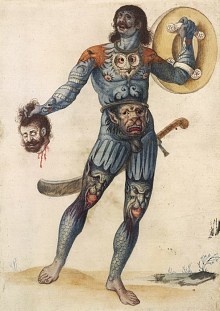
Most of the regions of [northern] Britain are marshy, since they are flooded continually by the tides of the ocean; the barbarians are accustomed to swimming or wading through these waist-deep marsh pools; since they go about naked, they are unconcerned about muddying their bodies. Strangers to clothing, they wear ornaments of iron at their waists and throats; considering iron a symbol of wealth, they value this metal as other barbarians value gold. They tattoo their bodies with coloured designs and drawings of all kinds of animals; for this reason they do not wear clothes, which would conceal the decorations on their bodies. Extremely savage and warlike, they are armed only with a spear and a narrow shield, plus a sword that hangs suspended by a belt from their otherwise naked bodies. They do not use breastplates or helmets, considering them encumbrances in crossing the marshes.History of the Empire after Marcus III, 14
Almost a century after Severus’ campaigns, the name Pict first appears (297). Another century onwards, in 400, the poet Claudian talks of Britain (in female personification) being:
… clothed in the skin of some Caledonian beast, her cheeks tattooed, and an azure cloak, rivalling the swell of Ocean, sweeping to her feet …De Consulatu Stilichonis II, lines 247–249
(On the Consulship of Stilicho)
And, in 402, of:
… the strange devices tattooed on dying Picts.De Bello Gothico, lines 417–418
(On the Gothic War)
And he had, in 396, referred to:
… the well-named Picts …Panegyricus de Tertio Consulatu Honorii Augusti, line 54
(Panegyric on the Third Consulship of Honorius)
Possibly, then, it was their tendency to decorate themselves with extravagant body-art that caused the Romans to nickname the inhabitants of northernmost Britain Picti: ‘painted people’. On the other hand, maybe the association of tattooing with these British “barbarians” was based not on reality, but on a stereotyped notion of those distant savages. In other words, perhaps it was a myth that the Picts tattooed their bodies. The British cleric Gildas, writing in about 545(?), likens “the terrible hordes of Scots and Picts” to “dark swarms of worms”, and says of them:
Differing partly in their habits, yet alike in one and the same thirst for bloodshed – in a preference also for covering their villainous faces with hair rather than their nakedness of body with decent clothing …De Excidio Britanniae §19
It is difficult to believe that Gildas would have passed-up the opportunity to make disparaging remarks about tattoos if the Picts were particularly noted for them. Perhaps Picti was simply a Latinization of their native name (which could have had a completely different meaning). Nevertheless, the Spanish bishop and encyclopaedist, Isidore of Seville, in the early-600s, wrote:
Some nations lay claim to distinguishing marks not only in clothing but also on their bodies: as we see the curly hair of the Germans; the whiskers and red pigment of the Goths; the tattoos of the Britons. The Jews cut around their foreskin; the Arabs bore holes in their ears; the Getae have yellow hair which they do not cover; the Albanians are resplendent with white hair. Black night possesses the bodies of the Moors; the Gauls have white skin; without horses the Alans are idle. The race of the Picts is not absent from this list, for their name is from their body, which an artisan abuses with tiny needle pricks and the juice of native grass, so it bears things which look like scars – their nobility is spotted with painted limbs.[*]Etymologiae (or Origines) XIX, 23.7
The image of the highly-decorated, naked, Pict still seems to be stuck in the public imagination. Whatever its derivation, it is apparent that Picti was a new collective name for the disparate tribes already living beyond the Forth-Clyde isthmus. According to the mythology that developed, however, the Picts were a migrant race of people who eventually settled in Britain. In the 8th century, the Anglo-Saxon monk and historian, Bede, wrote:
… at first this island had no other inhabitants but the Britons, from whom it derived its name, and who, coming over into Britain, as is reported, from Armorica, possessed themselves of the southern parts thereof. Starting from the south, they had occupied the greater part of the island, when it happened, that the nation of the Picts, putting to sea from Scythia, as is reported, in a few ships of war, and being driven by the winds beyond the bounds of Britain, came to Ireland and landed on its northern shores. There, finding the nation of the Scots, they begged to be allowed to settle among them … The Scots answered that the island could not contain them both; but “We can give you good counsel,” said they, “whereby you may know what to do; we know there is another island, not far from ours, to the eastward, which we often see at a distance, when the days are clear. If you will go thither, you can obtain settlements; or, if any should oppose you, we will help you.” The Picts, accordingly, sailing over into Britain, began to inhabit the northern parts thereof, for the Britons had possessed themselves of the southern. Now the Picts had no wives, and asked them of the Scots; who would not consent to grant them upon any other terms, than that when any question should arise, they should choose a king from the female royal race rather than from the male: which custom, as is well known, has been observed among the Picts to this day.Historia Ecclesiastica Gentis Anglorum I, 1