Bede Historia Ecclesiastica Gentis Anglorum Book V Chapter 19:
… about the life and death of Bishop Wilfrid.
… [in 709] the great bishop, Wilfrid, ended his days in the province called Oundle, after he had been bishop 45 years. His body, being laid in a coffin, was carried to his monastery, which is called Ripon, and buried in the church of the blessed Apostle Peter, with the honour due to so great a prelate. Concerning whose manner of life, let us now turn back, and briefly make mention of the things which were done. Being a boy of a good disposition, and virtuous beyond his years, he conducted himself so modestly and discreetly in all points, that he was deservedly beloved, respected, and cherished by his elders as one of themselves. At 14 years of age he chose rather the monastic than the secular life; which, when he had signified to his father, for his mother was dead, he readily consented to his godly wishes and desires, and advised him to persist in that wholesome purpose. Wherefore he came to the isle of Lindisfarne, and there giving himself to the service of the monks, he strove diligently to learn and to practise those things which belong to monastic purity and piety; and being of a ready wit, he speedily learned the psalms and some other books, having not yet received the tonsure, but being in no small measure marked by those virtues of humility and obedience which are more important than the tonsure; for which reason he was justly loved by his elders and his equals. Having served God some years in that monastery, and being a youth of a good understanding, he perceived that the way of virtue delivered by the Scots was in no wise perfect, and he resolved to go to Rome, to see what ecclesiastical or monastic rites were in use at the Apostolic See. When he told the brethren, they commended his design, and advised him to carry out that which he purposed. He forthwith went to Queen Eanflæd [wife of King Oswiu], for he was known to her, and it was by her counsel and support that he had been admitted into the aforesaid monastery, and he told her of his desire to visit the threshold of the blessed Apostles. —
— She, being pleased with the youth’s good purpose, sent him into Kent, to King Eorcenberht, who was her uncle’s son, requesting that he would send him to Rome in an honourable manner. At that time, Honorius, one of the disciples of the blessed Pope Gregory, a man very highly instructed in ecclesiastical learning, was archbishop there. When he had tarried there for a space, and, being a youth of an active spirit, was diligently applying himself to learn those things which came under his notice, another youth, called Biscop, surnamed Benedict, of the English nobility, arrived there, being likewise desirous to go to Rome, of whom we have before made mention[*]. The king gave him Wilfrid for a companion, and ordered him to conduct him to Rome [in 653]. When they came to Lyon, Wilfrid was detained there by Dalfinus, the bishop of that city; but Benedict hastened on to Rome. For the bishop was delighted with the youth’s prudent discourse, the grace of his comely countenance, his eager activity, and the consistency and maturity of his thoughts; for which reason he plentifully supplied him and his companions with all necessaries, as long as they stayed with him; and further offered, if he would have it, to commit to him the government of no small part of Gaul, to give him a maiden daughter of his own brother to wife, and to regard him always as his adopted son. But Wilfrid thanked him for the loving-kindness which he was pleased to show to a stranger, and answered, that he had resolved upon another course of life, and for that reason had left his country and set out for Rome. Hereupon the bishop sent him to Rome, furnishing him with a guide and supplying plenty of all things requisite for his journey, earnestly requesting that he would come that way, when he returned into his own country. Wilfrid arriving at Rome, and daily giving himself with all earnestness to prayer and the study of ecclesiastical matters, as he had purposed in his mind, gained the friendship of the most holy and learned Boniface, the archdeacon, who was also counsellor to the Apostolic Pope, by whose instruction he learned the 4 books of the Gospels in order, and the true computation of Easter; and many other things appertaining to ecclesiastical discipline, which he could not learn in his own country, he acquired from the teaching of that same master. When he had spent some months there, in successful study, he returned into Gaul, to Dalfinus; and having stayed with him 3 years, received from him the tonsure, and Dalfinus esteemed him so highly in love that he had thoughts of making him his heir; but this was prevented by the bishop’s cruel death, and Wilfrid was reserved to be a bishop of his own, that is, the English, nation. For Queen Baldhild sent soldiers with orders to put the bishop to death; whom Wilfrid, as his clerk, attended to the place where he was to be beheaded, being very desirous, though the bishop strongly opposed it, to die with him; but the executioners, understanding that he was a stranger, and of the English nation, spared him, and would not put him to death with his bishop. —
— Returning to Britain [c.658], he won the friendship of King Alhfrith [Oswiu’s son, sub-king of Deira], who had learnt to follow always and love the catholic rules of the Church; and [Alhfrith] therefore finding him [Wilfrid] to be a Catholic, he gave him presently land of 10 families at the place called Stanford [location uncertain]; and not long after, the monastery, with land of 30 families, at the place called Ripon; which place he had formerly given to those that followed the doctrine of the Scots, to build a monastery there. But, forasmuch as they afterwards, being given the choice, had rather quit the place than adopt the Catholic Easter and other canonical rites, according to the custom of the Roman Apostolic Church, he gave the same to him whom he found to be instructed in better discipline and better customs. At the same time, by the said king’s command, he [Wilfrid] was ordained priest in the same monastery, by Agilbert, bishop of the Gewisse [i.e. the West Saxons] above mentioned[*], the king being desirous that a man of so much learning and piety [i.e. Wilfrid] should attend him constantly as his special priest and teacher; and not long after, when the Scottish sect had been exposed and banished, as was said above, he, with the advice and consent of his father Oswiu, sent him into Gaul [664], to be consecrated as his bishop, when he [Wilfrid] was about 30 years of age, the same Agilbert being then bishop of the city of Paris.[*] 11 other bishops met at the consecration of the new bishop, and that function was most honourably performed. —
— Whilst he yet tarried beyond the sea, the holy man, Chad, was consecrated bishop of York by command of King Oswiu, as has been said above [*]; and having nobly ruled that church for three years, he retired to take charge of his monastery of Lastingham, and Wilfrid was made bishop of all the province of the Northumbrians [669]. —
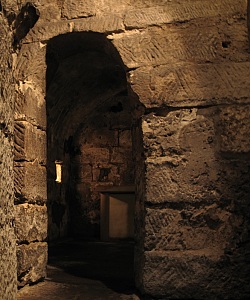
Only the crypt of Wilfrid’s church survives at Hexham Abbey. It uses stone robbed from the remains of nearby Roman structures.[*]Only the crypt of Wilfrid’s church survives at Hexham Abbey. It uses stone robbed from the remains of nearby Roman structures.[*]
— Afterwards, in the reign of Ecgfrith, he was expelled from his bishopric [678], and others were consecrated bishops in his stead, of whom mention has been made above. —
— Designing to go to Rome, to plead his cause before the Apostolic Pope, he took ship, and was driven by a west wind into Frisia, and honourably received by that barbarous people and their King Aldgisl, to whom he preached Christ, and he instructed many thousands of them in the Word of truth, washing them from the defilement of their sins in the Saviour’s font.[*] Thus he began there the work of the Gospel which was afterwards finished with great devotion by the most reverend bishop of Christ, Willibrord.[*] Having spent the winter there successfully among this new people of God, he set out again on his way to Rome,[*] where his cause being tried before Pope Agatho and many bishops, he was pronounced by the judgement of them all to have been falsely accused, and to be worthy of his bishopric. At the same time, the said Pope Agatho assembling a synod at Rome, of 125 bishops, against those who asserted that there was only one will and operation in our Lord and Saviour,[*] ordered Wilfrid also to be summoned, and, sitting among the bishops, to declare his own faith and the faith of the province or island whence he came; and when he and his people were found to be catholic in their faith, it was thought fit to record the same among the acts of that synod, which was done in this manner: “Wilfrid, the beloved of God, bishop of the city of York, appealing to the Apostolic See for his cause, and being by that authority acquitted of all charges, specified and unspecified, and being appointed to sit in judgement with 125 other bishops in the synod, made confession of the true and catholic faith, and confirmed the same with his subscription in the name of all the northern part of Britain and Ireland, and the islands inhabited by the nations of the English and Britons, as also by the Scots and Picts.” After this, returning into Britain [680], —
— he converted the province of the South Saxons from their idolatrous worship to the faith of Christ. He also sent ministers of the Word to the Isle of Wight;[*] and in the second year of Aldfrith, who reigned after Ecgfrith [i.e. in 687], was restored to his see and bishopric by that king’s invitation. —
— Nevertheless, five years after [i.e. in 692], being again accused, he was deprived of his bishopric by the same king and certain bishops. —
— Coming to Rome [704], he was allowed to make his defence in the presence of his accusers, before a number of bishops and the Apostolic Pope John. It was shown by the judgement of them all, that his accusers had in part laid false accusations to his charge; and the aforesaid pope wrote to the kings of the English, Æthelred and Aldfrith, that they should cause him to be restored to his bishopric, because he had been unjustly condemned. His acquittal was much forwarded by the reading of the acts of the synod of Pope Agatho, of blessed memory, which had been formerly held when Wilfrid was present in the city and sat in council among the bishops, as has been said before. For the acts of that synod being, as the cause required, read, by order of the Apostolic Pope, before the nobility and a great number of the people for some days, they came to the place where it was written, “Wilfrid, the beloved of God, bishop of the city of York, appealing to the Apostolic See for his cause, and being by that authority acquitted of all charges, specified and unspecified,” and the rest as above stated. This being read, the hearers were amazed, and the reader ceasing, they began to ask of one another, who that Bishop Wilfrid was. Then Boniface, counsellor to the Apostolic Pope, and many others who had seen him there in the days of Pope Agatho, said that he was the same bishop that lately came to Rome, to be tried by the Apostolic See, being accused by his people, and “who,” said they, “having long since come here upon the like accusation, the cause and contention of both parties being heard and examined, was proved by Pope Agatho, of blessed memory, to have been wrongfully expelled from his bishopric, and was held in such honour by him, that he commanded him to sit in the council of bishops which he had assembled, as a man, of untainted faith and an upright mind.” This being heard, the pope and all the rest said, that a man of so great authority, who had held the office of a bishop for nearly 40 years, ought by no means to be condemned, but being altogether cleared of the faults laid to his charge, should return home with honour.[*] When he came to Gaul, on his way back to Britain, on a sudden he fell sick, and the sickness increasing, he was so weighed down by it, that he could not ride, but was carried in a litter by the hands of his servants. Being thus come to the city of Meaux, in Gaul, he lay four days and nights, as if he had been dead, and only by his faint breathing showed that he had any life in him. Having continued thus four days, without meat or drink, without speech or hearing, at length, on the fifth day, at daybreak, as it were awakening out of a deep sleep, he raised himself and sat up, and opening his eyes, saw round about him a company of brethren singing psalms and weeping. Sighing gently, he asked where Acca, the priest, was.[*] This man, straightway being called, came in, and seeing him somewhat recovered and able to speak, knelt down, and gave thanks to God, with all the brethren there present. When they had sat awhile and begun to discourse, with great awe, of the judgements of heaven, the bishop bade the rest go out for a time, and spoke to the priest, Acca, after this manner: “A dread vision has even now appeared to me, which I would have you hear and keep secret, till I know what God will please to do with me. There stood by me a certain one, glorious in white raiment, and he told me that he was Michael, the archangel, and said, ‘I am sent to call you back from death: for the Lord has granted you life, through the prayers and tears of your disciples and brethren, and the intercession of His Blessed Mother Mary, of perpetual virginity; wherefore I tell you, that you shall now recover from this sickness; but be ready, for I will return and visit you at the end of four years. And when you come into your country, you shall recover the greater part of the possessions that have been taken from you, and shall end your days in peace and quiet.’” The bishop accordingly recovered, whereat all men rejoiced and gave thanks to God, and setting forward on his journey, he arrived in Britain. Having read the letters which he brought from the Apostolic Pope, Berhtwald, the archbishop, and Æthelred, sometime king [of Mercia], but then abbot, readily took his part; for the said Æthelred, calling to him Cenred, whom he had made king in his own stead, begged him to be friends with Wilfrid, in which request he prevailed; nevertheless Aldfrith, king of the Northumbrians, disdained to receive him. —
— But he [Aldfrith] died soon after [14th December 705[*]], and so it came to pass that, during the reign of his son Osred, when a synod was assembled before long by the river Nidd [706], after some contention on both sides, at length, by the consent of all, he [Wilfrid] was restored to the government of his own church; —
— and thus he lived in peace four years, that is, till the day of his death. He died in his monastery, which he had in the province of Oundle, under the government of the Abbot Cuthbald;[*] and by the ministry of the brethren, he was carried to his first monastery which is called Ripon, and buried in the church of the blessed Apostle Peter, hard by the altar on the south side, as has been mentioned above, and this epitaph was written over him: “Here rests the body of the great Bishop Wilfrid, who, for love of piety, built these courts and consecrated them with the noble name of Peter, to whom Christ, the Judge of all the earth, gave the keys of Heaven. And devoutly he clothed them with gold and Tyrian purple; yea, and he placed here the trophy of the Cross, of shining ore, uplifted high; moreover he caused the four books of the Gospel to be written in gold in their order, and he gave a case meet for them of ruddy gold. And he also brought the holy season of Easter, returning in its course, to accord with the true teaching of the catholic rule which the Fathers fixed, and, banishing all doubt and error, gave his nation sure guidance in their worship. And in this place he gathered a great throng of monks, and with all diligence safeguarded the precepts which the Fathers’ rule enjoined. And long time sore vexed by many a peril at home and abroad, when he had held the office of a bishop thrice fifteen years, he passed away and with joy departed to the heavenly kingdom.[*] Grant, Jesus, that the flock may follow in the path of the shepherd.”
Actually, a Vita, i.e. a saint’s Life, of Baldhild (Balthild) was written shortly after her death (c.680) – which doesn’t seem very likely if she was a notorious Church persecuting bishop-slayer.
In the early days of Christianity, Quartodecimans celebrated Easter on the fourteenth day of Nisan, whether it was a Sunday or not. This was not the practice in the, so-called, Celtic Church, and Stephen seemingly uses the word (he actually puts it into Wilfrid’s mouth) as a slight. (The Catholic Easter was adopted on Iona in 716.)
Bede clearly places Aldfrith’s death in the year 705 (HE V, 18 and HE V, 24), but he apparently didn’t know the precise date. Manuscripts D and E of the Anglo-Saxon Chronicle provide the full date: 19th of the Kalends of January, i.e. 14th December, 705.
Monothelitism asserts that Jesus had only one will even though he had two natures (human and divine), which is contrary to the orthodox position that he had two wills corresponding to his two natures. It enjoyed considerable support in the seventh century before being rejected as heretical at the Sixth Ecumenical Council, held at Constantinople, in 680–681.
Bede makes it seem as though Wilfrid ended up in Frisia by accident, but Stephen the Priest tells a different story. Wilfrid’s “enemies” had sent messengers to Ebroin, “a wicked duke” – actually, ‘mayor of the palace’, i.e. de facto ruler, of Neustria (roughly, northern France, inc. Paris) – with bribes to intercept Wilfrid and “to condemn him to the greater exile, or to slay his comrades and rob him of all his substance.” (Ch.25). Wilfrid avoided the trap by sailing to Frisia. Stephen claims that Bishop Wynfrith, “who had been driven out” of the see of Lichfield, was en route to Rome at that time. Misled by the similarity of his name (Wynfrith = Winfrithus; Wilfrid = Wilfrithus), it was Wynfrith’s party that was attacked, the bishop being “left naked”, though many of his party were killed. This yarn, however, receives no support from Bede, who mentions (HE IV, 6) that Wynfrith was deposed by Theodore for “some act of disobedience”, but says he retired to his monastery “and there ended his life in holy conversation”. Anyway, according to Stephen (Ch.27), Ebroin offered Aldgisl “a bushel full of gold solidi” to send him Wilfrid, dead or alive, but the Frisian king made a great show of destroying Ebroin’s letter in front of Wilfrid, and, indeed, Stephen himself.
On the journey from Frisia to Rome, according to Stephen the Priest (Ch.28), Dagobert II (r.676–9), king of Austrasia (roughly, north-eastern France and parts of Germany), offered Wilfrid the bishopric of Strasbourg. Dagobert had been exiled in Ireland after his father’s death. Stephen says that Wilfrid had been instrumental in arranging his return to Austrasia: “he sent him forth to his own country in great state, well supplied with weapons and supported by the strength of his companions.” Stephen also says that Perctarit, called “king of Campania” by Stephen, but actually of Lombardy, told Wilfrid that “some enemies” of Wilfrid’s had sent messengers from Britain offering “very great rewards” if he would prevent Wilfrid from reaching his destination. Perctarit, however, treated Wilfrid well and provided guides to take him to Rome.
Tunberht, who had been appointed bishop of Hexham in 681, was deposed, and replaced by Cuthbert in 685. Cuthbert switched positions with Eata, bishop of Lindisfarne. Hence Eata was the bishop of Hexham who evidently died just before Wilfrid’s return to Northumbria. Bede (HE V, 2) places Eata’s death “at the beginning of Aldfrith’s reign”, but indicates that Eata was immediately replaced by John of Beverley. On the other hand, when Cuthbert, bishop of Lindisfarne, died, in March 687, Bede (HE IV, 29) notes: “the venerable Bishop Wilfrid held the episcopate of that church one year, until one was chosen to be ordained bishop in the place of Cuthbert.”
“thrice fifteen years” (i.e. forty-five years) – “a suspiciously round number, more attuned perhaps to metre than to accuracy”, comments Kenneth Harrison (The Framework of Anglo-Saxon History to A.D. 900, 1976, Chapter 5, p.91).
Previously (HE III, 28), Bede had reported: “King Alhfrith sent the priest, Wilfrid, to the king of Gaul, in order that he should cause him to be consecrated bishop for himself and his people… He stayed some time in the parts beyond the sea for his ordination, and King Oswiu, following the example of his son’s zeal, sent into Kent a holy man, of modest character, well read in the Scripture, and diligently practising those things which he had learned therein, to be ordained bishop of the church of York. This was a priest called Chad [Ceadda]”.
Willibrord, a Northumbrian, was raised in Wilfrid’s monastery at Ripon. At the age of twenty he moved to a monastery in Ireland, from where, twelve years later, in 690, he was dispatched to convert the Frisians. He was consecrated archbishop of the Frisians in 695, with his seat at Utrecht. He died in 739. His mission was not, however, as conclusive as Bede, writing in 731, believed. In 754 another English missionary, a West Saxon called Wynfrith (better known as St Boniface), was killed by pagans in Frisia.
Stephen (Chs.64–65) says that Wilfrid had travelled to Mercia to see the new king, Ceolred. It would seem that Wilfrid never met the king – having made a tour of his Mercian monasteries, he finally came ad monasterium eius quod in Undolum positum est, i.e. ‘to his monastery which is situated in Oundle’, where he fell ill and died. In Bede’s telling, the monastery where Wilfrid died is “in the province of Oundle”, all of which tends to suggest that this monastery, though in the vicinity, is not to be found in Oundle itself. In his paper ‘Saint Wilfrid’s Church at Hexham’ (published in Saint Wilfrid at Hexham, 1975) Edward Gilbert notes that he: “is inclined to believe that Peterborough was Wilfrid’s monastery. Certainly the architectural evidence is plentiful for a monastery of this date at Peterborough, but totally absent at Oundle. There is even at Peterborough a stone carving resembling items at both Hexham and Ripon, and such an affinity could only belong to the time of Wilfrid.”
Acca would become bishop of Hexham after Wilfrid’s death. He urged Stephen to produce his Vita of Wilfrid, and he was a friend and source of information to Bede. Bede writes that Acca: “was brought up from boyhood and instructed among the clergy of the most holy and beloved of God, Bosa, bishop of York. Afterwards, coming to Bishop Wilfrid in the hope of a better plan of life, he spent the rest of his days in attendance on him till that bishop’s death” (HE V, 20). Although Wilfrid had clearly taken the direct route back from Rome, via Meaux, his outward journey had evidently been via Frisia. “The most reverend prelate, Acca, is wont to relate”, says Bede, that: “in his journey to Rome, he and his bishop Wilfrid stayed some time with Willibrord, the holy archbishop of the Frisians.” (HE III, 13). Willibrord’s see was at Utrecht. In the same year that Bede completed HE, Acca was, for unrecorded reasons, driven from his see – the event is noted in a brief annal, dated 731, added to the oldest surviving manuscript of HE (the Moore Bede).
The Roman town of Coria (Corbridge) is some three miles east of Hexham, and Hadrian’s Wall is a similar distance to the north.
Bede says that Wilfrid had been a bishop “for nearly 40 years” at this time. Stephen, however, on whom Bede is drawing, actually states (Ch.53) that Wilfrid had been a bishop “for 40 years and more”. Stephen says (Ch.47) that Wilfrid had been a bishop “for nearly 40 years” at the time of the synod held at Austerfield (of which Bede makes no mention). Wilfrid was chosen to be Alhfrith’s bishop in 664, therefore, Austerfield can be dated c.703 and, since Pope John VI died in January 705, Wilfrid’s appearance in Rome to 704.
Having been made welcome in Sussex by King Æthelwalh, Wilfrid subsequently allied himself with an exiled West Saxon prince, Cædwalla, who invaded Sussex and killed Æthelwalh (which Stephen the Priest does not mention), established himself as king of the West Saxons, and conquered the Isle of Wight.
Stephen the Priest (Ch.12) says that “the kings”, i.e. Oswiu and Alhfrith, equipped Wilfrid with “a ship and a force of men as well as a large sum of money, so as to enable him to enter Gaul in great state.”
The dating evidence is contradictory and confusing, but it would appear that Agilbert was no longer bishop of the West Saxons at the time he ordained Wilfrid as a priest, nor was he yet bishop of Paris at the time he officiated at Wilfrid’s consecration as a bishop. Following a falling-out with the king of the West Saxons, Cenwalh, it seems likely that Agilbert resigned his position in 663 and travelled to Northumbria, where he ordained Wilfrid at Ripon and subsequently attended the synod of Whitby. He returned to Gaul after the synod, in 664, and officiated at Wilfrid’s consecration at Compiègne. It would appear that he didn't become bishop of Paris until about 667/8, i.e. after Wilfrid’s return to Britain.
Janet L. Nelson* suggests: “that Wilfrid was not in fact present at Aunemundus’s death, and that Eddius’s [i.e. Stephen’s] account therefore derives from information which Wilfrid acquired on one of his subsequent visits to Gaul (or perhaps from some other peregrinus) on which either Eddius or Wilfrid himself superimposed the tale of Wilfrid’s youthful heroism – satisfying to upholders of Germanic and monastic values alike.”
* ‘Queens as Jezebels: The Careers of Brunhild and Balthild in Merovingian History’, Studies in Church History, Subsidia 1, Medieval Women (1978).
Agilbert arrived in Wessex, from Ireland, about 648/9. He was, says Bede (HE III, 7): “a native of Gaul, but who had then lived a long time in Ireland, for the purpose of reading the Scriptures.” Agilbert was already a bishop – evidently consecrated in Gaul – when he arrived. He “attached himself” to Cenwalh, the West Saxon king, and was made bishop of the West Saxons in 650.
Stephen (Ch.43) quotes a letter purportedly written by Archbishop Theodore, after he had made peace with Wilfrid, to Æthelred, urging the king to be a friend to Wilfrid.
There were evidently only three Northumbrian bishops at the time of the synod on the Nidd, so Bosa, bishop of York, would have been present. (The other two bishops being John at Hexham and Eadfrith at Lindisfarne.) It is not clear whether John had to stand-down to allow Wilfrid to take over at Hexham, or if Wilfrid had to wait until Bosa’s death to replace John at Hexham.