THE
CALEDONIAN
CAMPAIGNS
OF
SEPTIMIUS SEVERUSTHE CALEDONIAN CAMPAIGNS OF SEPTIMIUS SEVERUS
When the governor of Roman Britain, Clodius Albinus, took an army to Gaul in pursuit of his ambitions for the throne of the Empire, he left his province’s northern frontier, with its garrison for the time being depleted, vulnerable to incursion. Albinus’ adventure ended in his death, following the defeat of his forces by those of Septimius Severus, in a battle which saw heavy losses on both sides, near Lyon, on 19th February 197. Severus quickly despatched one Virius Lupus to govern Britain.
div01
The Emperor Caesar Lucius Septimius Severus Pius Pertinax Augustus and Antoninus Caesar, (emperor) designate, restored this under the charge of Virius Lupus, their propraetorian legate.The other (RIB 730) is on an altar from Bowes, County Durham:
To the Goddess Fortuna, Virius Lupus, propraetorian legate of the emperor, restored this bath-house, burnt by the violence of fire, for the 1st Cohort of Thracians; Valerius Fronto, prefect of cavalry of the Ala Vettonum, had charge of the work.The phraseology might imply that the Bowes inscription is a little earlier than the one from Ilkley, since it refers to a singular emperor but no ‘emperor designate’. Unfortunately it does not indicate whether the fire was accidental or the result of hostilities. The third Lupus inscription (RIB 1163) is on part of a dedication-slab from Corbridge, about 2½ miles south of Hadrian’s Wall:
A detachment of Legio VI Victrix Pia Fidelis, built this under the charge of Virius Lupus …Lupus disappears from history after his term in Britain. Presumably he was replaced after about three years in office, around the year 200.
Lupus arrived in the north of his new province. Cassius Dio reports that:
Inasmuch as the Caledonians did not abide by their promises and had made ready to aid the Maeatae, and in view of the fact that Severus at the time was devoting himself to the neighbouring war, Lupus was compelled to purchase peace from the Maeatae for a large sum; and he received a few captives.Roman History LXXV, 5 (fragment)
This is the first mention of the Maeatae. Dio explains:
There are two principal races of the Britons, the Caledonians and the Maeatae, and the names of the others have been merged in these two. The Maeatae live next to the cross-wall which cuts the island in half, and the Caledonians are beyond them.Roman History (Epitome, Xiphilinus) LXXVI, 12
The “cross-wall” referred to by Dio is probably the Antonine Wall, on the Forth-Clyde line.
div02
Both tribes inhabit wild and waterless mountains and desolate and swampy plains, and possess neither walls, cities, nor tilled fields, but live on their flocks, wild game, and certain fruits; for they do not touch the fish which are there found in immense and inexhaustible quantities. They dwell in tents, naked and unshod, possess their women in common, and in common rear all the offspring. Their form of rule is democratic for the most part, and they are very fond of plundering; consequently they choose their boldest men as rulers. They go into battle in chariots, and have small, swift horses; there are also foot-soldiers, very swift in running and very firm in standing their ground. For arms they have a shield and a short spear, with a bronze apple attached to the end of the spear-shaft, so that when it is shaken it may clash and terrify the enemy; and they also have daggers. They can endure hunger and cold and any kind of hardship; for they plunge into the swamps and exist there for many days with only their heads above water, and in the forests they support themselves upon bark and roots, and for all emergencies they prepare a certain kind of food, the eating of a small portion of which, the size of a bean, prevents them from feeling either hunger or thirst. Such is the general character of the island of Britain and such are the inhabitants of at least the hostile part of it.To which Herodian adds some more:Roman History (Epitome, Xiphilinus) LXXVI, 12
Most of the regions of [northern] Britain are marshy, since they are flooded continually by the tides of the ocean; the barbarians are accustomed to swimming or wading through these waist-deep marsh pools; since they go about naked, they are unconcerned about muddying their bodies. Strangers to clothing, they wear ornaments of iron at their waists and throats; considering iron a symbol of wealth, they value this metal as other barbarians value gold. They tattoo their bodies with coloured designs and drawings of all kinds of animals; for this reason they do not wear clothes, which would conceal the decorations on their bodies. Extremely savage and warlike, they are armed only with a spear and a narrow shield, plus a sword that hangs suspended by a belt from their otherwise naked bodies. They do not use breastplates or helmets, considering them encumbrances in crossing the marshes.History of the Empire after Marcus III, 14
For a few years Britain slips from notice.
The sons of Severus, Antoninus [Caracalla] and Geta … went to all lengths in their conduct. They outraged women and abused boys, they embezzled money, and made gladiators and charioteers their boon companions, emulating each other in the similarity of their deeds, but full of strife in their rivalries; for if the one attached himself to a certain faction, the other would be sure to choose the opposite side…
At this period [the few years starting 205] one Bulla, an Italian, got together a robber band of about six hundred men, and for two years continued to plunder Italy under the very noses of the emperors and of a multitude of soldiers. For though he was pursued by many men, and though Severus eagerly followed his trail, he was never really seen when seen, never found when found, never caught when caught, thanks to his great bribes and his cleverness… Severus, informed of these various occurrences, was angry at the thought that though he was winning the wars in Britain through others, yet he himself had proved no match for a robber in Italy … [Bulla was eventually captured, and “given to wild beasts”]Cassius Dio Roman History (Epitome, Xiphilinus) LXXVI, 7 & 10
In the midst of the emperor’s distress at the kind of life his sons were leading and their disgraceful obsession with shows, the governor of Britain informed Severus by dispatches that the barbarians there were in revolt and overrunning the country, looting and destroying virtually everything on the island. He told Severus that he needed either a stronger army for the defence of the province or the presence of the emperor himself. Severus was delighted with this news: glory-loving by nature, he wished to win victories over the Britons to add to the victories and titles of honour he had won in the East and the West. But he wished even more to take his sons away from Rome so that they might settle down in the soldier’s life under military discipline, far from the luxuries and pleasures in Rome.Herodian History of the Empire after Marcus III, 14
div03
It is better to reject Herodian’s story about the British governor’s letter as pure invention.Britain’s governor at the time was probably Lucius Alfenus Senecio. The inscription (RIB 1337) on a no-longer extant dedication-slab from Benwell fort, on Hadrian’s Wall, read:Chapter 15 (p.172)
To the Victory of the Emperors while Alfenus Senecio was consular governor. Fortunate is the 1st Ala of Asturians.Building work carried out at forts in the north of England during Senecio’s tenure is recorded on several inscriptions. For instance, at Bainbridge (in the Yorkshire Dales) “the 6th Cohort of Nervians built this rampart of uncoursed masonry with annexe-wall” (RIB 722), whilst at Birdoswald, on Hadrian’s Wall “the 1st Aelian Cohort of Dacians and the 1st Cohort of Thracians, Roman citizens, built the granary” (RIB 1909). One inscription (RIB 1234) records repair work on the outpost-fort at Risingham (a dozen or so miles along Dere Street, beyond the Wall):
For the Emperors Caesars, Lucius Septimius Severus Pius Pertinax Arabicus Adiabenicus Parthicus Maximus, consul 3 times, and Marcus Aurelius Antoninus Pius, consul 2 times, the Augusti, and for Publius Septimius Geta, the most noble Caesar, the First Cohort of Vangiones, one thousand strong, equitata, with its own tribune Aemilius Salvianus, restored from ground-level this gate and its walls, which had collapsed through age, by order of Alfenus Senecio, senator and consular governor; Oclatinius Adventus, procurator of our emperors, having charge.[*]The reference to Caracalla “consul 2 times” dates the inscription 205–207.
Severus, seeing that his sons were changing their mode of life and that the legions were becoming enervated by idleness, made a campaign against Britain, though he knew [from omens] that he should not return… He took along with him an immense amount of money.Cassius Dio Roman History (Epitome, Xiphilinus) LXXVI, 11
The year was 208.
… although he was now well advanced in years and crippled with arthritis [or gout], Severus announced his expedition to Britain, and in his heart he was more enthusiastic than any youth. During the greater part of the journey he was carried in a litter, but he never remained very long in one place and never stopped to rest. He arrived with his sons at the coast sooner than anyone anticipated, outstripping the news of his approach. He crossed the Ocean and landed in Britain; levying soldiers from all areas, he raised a powerful army and made preparations for the campaign. Disconcerted by the emperor’s sudden arrival, and realizing that this huge army had been assembled to make war upon them, the Britons sent envoys to Severus to discuss terms of peace, anxious to make amends for their previous errors. Seeking to prolong the war so as to avoid a quick return to Rome, and still wishing to gain a victory over the Britons and the title of honour too, Severus dismissed the envoys, refusing their offers, and continued his preparations for the war. He especially saw to it that dikes were provided in the marshy regions so that the soldiers might advance safely by running on these earth causeways and fight on a firm, solid footing… When it seemed to him that all was in readiness for the campaign, Severus left the younger of his two sons, Geta, in the section of the province under Roman control; he instructed him to administer justice and attend to imperial affairs, leaving with him as advisers his more elderly friends. Then, accompanied by Antoninus, he marched out against the barbarians.Herodian History of the Empire after Marcus III, 14
Its [Britain’s] length is 7,132 stades, its greatest breadth 2,310, its least 300. Of all this territory we hold a little less than one half.
Severus, accordingly, desiring to subjugate the whole of it, invaded Caledonia.Cassius Dio Roman History (Epitome, Xiphilinus) LXXVI, 12–13
It was probably 209 by now.
After the troops had crossed the rivers and the earthworks [presumably the Antonine Wall] which marked the boundary of the Roman empire in this region, frequent battles and skirmishes occurred, and in these the Romans were victorious. But it was easy for the Britons to slip away; putting their knowledge of the surrounding area to good use, they disappeared in the woods and marshes. The Romans’ unfamiliarity with the terrain prolonged the war.Herodian History of the Empire after Marcus III, 14
… as he [Severus] advanced through the country he experienced countless hardships in cutting down the forests, levelling the heights, filling up the swamps, and bridging the rivers;[*] but he fought no battle and beheld no enemy in battle array. The enemy purposely put sheep and cattle in front of the soldiers for them to seize, in order that they might be lured on still further until they were worn out; for in fact the water caused great suffering to the Romans, and when they became scattered, they would be attacked. Then, unable to walk, they would be slain by their own men, in order to avoid capture, so that a full fifty thousand died.[*] But Severus did not desist until he had approached the extremity of the island. Here he observed most accurately the variation of the sun’s motion and the length of the days and the nights in summer and winter respectively. Having thus been conveyed through practically the whole of the hostile country (for he actually was conveyed in a covered litter most of the way, on account of his infirmity), he returned to the friendly portion, after he had forced the Britons to come to terms, on the condition that they should abandon a large part of their territory.
div04
Antoninus was causing him alarm and endless anxiety by his intemperate life, by his evident intention to murder his brother if the chance should offer, and, finally, by plotting against the emperor himself… when both were riding forward to meet the Caledonians, in order to receive their arms and discuss the details of the truce, Antoninus attempted to kill his father outright with his own hand. They were proceeding on horseback, Severus also being mounted, in spite of the fact that he was weakened by infirmity in his feet, and the rest of the army was following; the enemy’s force were likewise spectators. At this juncture, while all were proceeding in silence and in order, Antoninus reined in his horse and drew his sword, as if he were going to strike his father in the back. But the others who were riding with them, upon seeing this, cried out, and so Antoninus, in alarm, desisted from his attempt. Severus turned at their shout and saw the sword, yet he did not utter a word, but ascended the tribunal, finished what he had to do, and returned to headquarters. Then he summoned his son … ordered a sword to be placed within easy reach, and upbraided the youth for having dared to so such a thing at all and especially for having been on the point of committing so monstrous a crime in the sight of all, both the allies and the enemy. And finally he said: “Now if you really want to slay me, put me out of the way here; for you are strong, while I am an old man and prostrate. For, if you do not shrink from the deed, but hesitate to murder me with your own hands, there is Papinian, the [Praetorian] prefect, standing beside you, whom you can order to slay me; for surely he will do anything that you command, since you are virtually emperor.” Though he spoke in this fashion, he nevertheless did Antoninus no harm … on the present occasion he allowed his love for his offspring to outweigh his love for his country; and yet in doing so he betrayed his other son, for he well knew what would happen.Cassius Dio Roman History (Epitome, Xiphilinus) LXXVI, 13–14
div05
… a very witty remark is reported to have been made by the wife of Argentocoxus, a Caledonian, to Julia Augusta. When the empress was jesting with her, after the treaty, about the free intercourse of her sex with men in Britain, she replied: “We fulfil the demands of nature in a much better way than do you Roman women; for we consort openly with the best men, whereas you let yourselves be debauched in secret by the vilest.” Such was the retort of the British woman.About 90 miles south of Corbridge, along Dere Street, was Eboracum (modern York) – location of the fortress of the 6th Legion (Legio VI Victrix Pia Fidelis) and an important Roman town. It seems clear that, when he wasn’t on campaign, Eboracum was Severus’ base in Britain. An inscription (L’ Année épigraphique 1986, 628) from Aenus, in Thrace, shows that, on some 12th September (208?), Caracalla and Geta received a delegation from Aenus at Eboracum. A rescript dated 5th May 210 (Code of Justinian III, 32.1) was issued jointly by Severus and Caracalla at Eboracum. And Severus was to die there on 4th February 211. The Historia Augusta begins a somewhat tedious anecdote, about a portent of Severus’ impending death, with the remark:Cassius Dio Roman History (Epitome, Xiphilinus) LXXVI, 16
After giving a Moor his discharge from the army, on the Wall, he [Severus] was returning to the nearest halting-place [mansio], not merely as victor but having established eternal peace…The anecdote would seem to be set during Severus’ journey south, bound for Eboracum, after concluding his treaty with the Britons (though the peace established at that time was to be far from “eternal”). The Wall in question would be, what we know today as, Hadrian’s Wall. Subsequent to Severus’ campaigns, however, it appears the story was put-about that it was he who had built a wall across the island, ‘from sea to sea’, for the protection of Roman Britain – indeed, in the Historia Augusta, Aelius Spartianus, the purported author of Severus’ biography, maintains (§18) that “this was the greatest glory of his reign”. Though there was rebuilding on the Hadrianic frontier during his reign, the Wall was not, of course, the work of Severus (see The Wall of Severus). After coming to terms with the Britons, Geta was raised to the rank of Augustus, and the, now three, emperors took the title Britannicus Maximus (Most Great Conqueror of Britain).[*] Roof-tiles found at Carpow, stamped with the legend: LEG VI VIC B P F, can only mean that the 6th Legion had acquired the title Britannica. It is possible the other legions were similarly styled. Just to the south of Hadrian’s Wall, around 14 miles along the Stanegate to the west of Corbridge, is the Roman fort of Vindolanda. There were actually a number of forts built successively on the same site. The archaeological evidence suggests that, in the Severan period, the existing fort buildings were demolished and replaced with as many as three hundred, native-style, circular stone-built huts. Unfortunately, no helpful inscriptions have been found, so the purpose of the huts is the subject of conjecture. Perhaps the site was a refugee camp, or perhaps a prisoner-of-war camp built to house British hostages? Whatever, the huts were soon demolished to make way for a new fort.‘Severus’ 22
The peace did not last long. In 210 the Maeatae rebelled, and, according to Cassius Dio, Severus ordered their extermination:
When the inhabitants of the island [the Maeatae, it turns out] again revolted, he summoned the soldiers and ordered them to invade the rebels’ country, killing everybody they met; and he quoted these words [from Homer]:
“Let no one escape sheer destruction,
No one our hands, not even the babe in the womb of the mother,
If it be male; let it nevertheless not escape sheer destruction.”Roman History (Epitome, Xiphilinus) LXXVI, 15
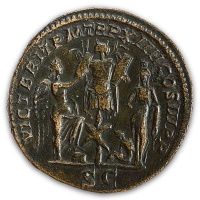 (•)
(•)
VICT(oriae) BRIT(annicae)
(Victory in Britain).[*]
Dio doesn’t mention it, but Severus’ failing health apparently forced him to delegate conduct of the campaign against the Maeatae to Caracalla. According to Herodian (who makes no mention of Maeatae or Caledonians – to him they are all simply “barbarians”):
Now a more serious illness attacked the aged emperor and forced him to remain in his quarters; he undertook, however, to send his son out to direct the campaign. Antoninus, however, paid little attention to the war, but rather attempted to gain control of the army. Trying to persuade the soldiers to look to him alone for orders, he courted sole rule in every possible way, including slanderous attacks upon his brother. Considering his father, who had been ill for a long time and slow to die, a burdensome nuisance, he tried to persuade the physicians to harm the old man in their treatments so that he would be rid of him more quickly.History of the Empire after Marcus III, 15
Anyway, the harsh treatment meted out to the Maeatae evidently persuaded the Caledonians to join them in rebellion.
When this had been done, and the Caledonians had joined the revolt of the Maeatae, he [Severus] began preparing to make war upon them in person. While he was thus engaged, his sickness carried him off on the fourth of February [in the year 211], not without some help, they say, from Antoninus.Cassius Dio Roman History (Epitome, Xiphilinus) LXXVI, 15
He died at Eboracum in Britain, having subdued the tribes which appeared hostile to Britain, in the 18th year of his reign, stricken by a very grave illness, now an old man [Severus wasn’t yet 66 years-old].Historia Augusta ‘Severus’ 19
… [Severus] was succeeded by his young sons, to whom he left an invincible army and more money than any emperor had ever left to his successors. After his father’s death, Antoninus seized control and immediately began to murder everyone in the court; he killed the physicians who had refused to obey his orders to hasten the old man’s death and also murdered those men who had reared his brother and himself because they persisted in urging him to live at peace with Geta. He did not spare any of the men who had attended his father or were held in esteem by him. He undertook secretly to bribe the troop commanders by gifts and lavish promises, to induce them to persuade the army to accept him as sole emperor, and he tried every trick he knew against his brother. He failed to win the backing of the soldiers, however, for they remembered Severus and knew that the youths had been one and the same to him, and had been reared as equals from childhood; consequently they gave each brother the same support and loyalty. When the soldiers refused to uphold him, Antoninus signed a treaty with the barbarians, offering them peace and accepting their pledges of good faith. And now he abandoned this alien land and returned to his brother and mother [at Eboracum]. When the boys were together again, their mother tried to reconcile them, as did also men of repute and the friends of Severus who were their advisers. Since all these opposed his wishes, Antoninus, from necessity, not from choice, agreed to live with Geta in peace and friendship, but this was pretended, not sincere.Herodian History of the Empire after Marcus III, 15
… before Severus died, he is reported to have spoken thus to his sons (I give his exact words without embellishment): “Be harmonious, enrich the soldiers, and scorn all other men.” After this his body, arrayed in military garb, was placed upon a pyre, and as a mark of honour the soldiers and his sons ran about it; and as for the soldiers’ gifts, those who had things at hand to offer as gifts threw them upon it, and his sons applied the fire. Afterwards his bones were put in an urn of purple stone, carried to Rome, and deposited in the tomb of the Antonines. It is said that Severus sent for the urn shortly before his death, and after feeling of it, remarked: “Thou shalt hold a man that the world could not hold.”Cassius Dio Roman History (Epitome, Xiphilinus) LXXVI, 15
Thus, with both of them managing imperial affairs with equal authority, the two youths prepared to sail from Britain and take their father’s remains to Rome. After burning his body and putting the ashes, together with perfumes, into an alabaster urn, they accompanied this urn to Rome and placed it in the sacred mausoleum of the emperors.[*] They now crossed the Ocean with the army and landed as conquerors on the opposite shore of Gaul.Herodian History of the Empire after Marcus III, 15
… Antoninus assumed the entire power; nominally, it is true, he shared it with his brother, but in reality he ruled alone from the very outset. With the enemy he came to terms, withdrew from their territory, and abandoned the forts; as for his own people, he dismissed some, including Papinian, the prefect, and killed others … As for his own brother, Antoninus had wished to slay him even while his father was yet alive, but had been unable to do so at the time because of Severus, or later, on the march, because of the legions; for the troops felt very kindly toward the younger brother, especially as he resembled his father very closely in appearance. But when Antoninus got back to Rome, he made away with him also [on 26th December 211].[*]Cassius Dio Roman History (Epitome, Xiphilinus) LXXVII, 1
Caracalla’s abandonment of Caledonia saw Hadrian’s Wall become, once more and finally, the Empire’s frontier – though a number of outpost-forts, between-the-walls, were garrisoned. His, apparently hastily concluded, treaty would appear to have been rather more successful than might be expected – there is no record of trouble on the frontier for the best part of a century.
div06
To the Saving Gods, for the welfare of the Emperor Caesar Marcus Aurelius Antoninus Augustus Britannicus Maximus [the next two lines of the inscription, which would have had Geta’s name and titles, have been erased], the military unit at Lugudunum paid its vow for their safe return.(Lugudunum was probably the name of South Shields at this time – later it was called Arbeia.) The murder of Geta may have caused unease amongst the troops in Britain. In a number of dedications from the northern frontier area, datable to 213, and to the governorship of Gaius Julius Marcus, various units pledge their “duty and devotion” to Caracalla, and also to his mother, Julia. One inscription (RIB 1265), apparently from the outpost-fort at High Rochester, talks of Caracalla: “reigning for the good of the human race”. Evidently Marcus felt it necessary to order this conspicuous display of loyalty on behalf of himself and the army. It seems, though, that the governor nevertheless fell foul of Caracalla, since his name has been deliberately erased from several of his inscriptions – as, indeed, it has from RIB 1265.[*]RIB 1054
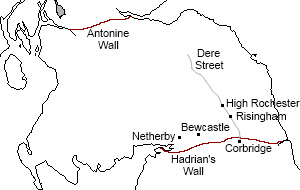 Outpost-forts at Netherby, Bewcastle, Risingham and High Rochester were garrisoned – probably all with ‘one thousand strong’ (milliaria), part-mounted (equitata) auxiliary cohorts. At High Rochester (Roman name: Bremenium) the 1st Cohort of Vardulli were augmented by a unit of scouts (exploratores): the Scouts of Bremenium (RIB 1262). At Risingham (Roman name: Habitancum) the 1st Cohort of Vangiones were augmented by the Raetian Spearmen and the Scouts of Habitancum (RIB 1235). At Netherby, the garrison was the 1st Aelian Cohort of Spaniards, who are well attested in inscriptions, but presumably there was also a unit of scouts, since the fort’s Roman name was Castra Exploratorum. The evidence for Bewcastle is rather thin. There are two undated altars (RIB 988 & 989) set-up by men who had been promoted to tribune, and who would, therefore, have commanded a ‘one thousand strong’ cohort.
Mention should be made of a very fragmentary inscription (RIB 3512) from the fortress at Carpow, on the Tay, which could conceivably imply that, although Dio and Herodian indicate Caledonia had been abandoned promptly after Severus’ death, building work was still going on at Carpow after Geta’s murder.
Outpost-forts at Netherby, Bewcastle, Risingham and High Rochester were garrisoned – probably all with ‘one thousand strong’ (milliaria), part-mounted (equitata) auxiliary cohorts. At High Rochester (Roman name: Bremenium) the 1st Cohort of Vardulli were augmented by a unit of scouts (exploratores): the Scouts of Bremenium (RIB 1262). At Risingham (Roman name: Habitancum) the 1st Cohort of Vangiones were augmented by the Raetian Spearmen and the Scouts of Habitancum (RIB 1235). At Netherby, the garrison was the 1st Aelian Cohort of Spaniards, who are well attested in inscriptions, but presumably there was also a unit of scouts, since the fort’s Roman name was Castra Exploratorum. The evidence for Bewcastle is rather thin. There are two undated altars (RIB 988 & 989) set-up by men who had been promoted to tribune, and who would, therefore, have commanded a ‘one thousand strong’ cohort.
Mention should be made of a very fragmentary inscription (RIB 3512) from the fortress at Carpow, on the Tay, which could conceivably imply that, although Dio and Herodian indicate Caledonia had been abandoned promptly after Severus’ death, building work was still going on at Carpow after Geta’s murder.
Cassius Dio explains that Caracalla, following at least part of his father’s deathbed advice:
… was fond of spending money upon the soldiers, great numbers of whom he kept in attendance upon him, alleging one excuse after another and one war after another …Roman History (Epitome, Xiphilinus) LXXVII, 9
In order to fund his extravagance, Caracalla increased taxation. He also (by what is known as the Constitutio Antoniniana, of 212) conferred Roman citizenship on all of the Empire’s free inhabitants.
… nominally he was honouring them, but his real purpose was to increase his revenues by this means, inasmuch as aliens did not have to pay most of these taxes.Cassius Dio Roman History (Epitome, Xiphilinus) LXXVII, 9
All of its free people were now Roman citizens, but that was not the only major constitutional change applied to Britannia. In order to reduce the forces a single governor would have at his disposal, should he choose to emulate Clodius Albinus and mount an attempt on the throne, it may well be that Severus had decided to split the province in two – he had done exactly that to Syria, province of another of his erstwhile rivals, Niger. Indeed, according to Herodian (III, 8), Severus divided Britannia immediately after his defeat of Albinus, in 197. The balance of evidence, however, indicates that the division was carried out rather later, under Caracalla. The northern part of the province became Britannia Inferior (Lower Britain), with Eboracum (York) as its capital, and the south became Britannia Superior (Upper Britain), with Londinium (London) as its capital. There were two legions, II Augusta and XX Valeria Victrix, based in Britannia Superior and one legion, VI Victrix, based at Eboracum in Britannia Inferior. The border between the two provinces would seem to have run, more or less, from the Wash to the Mersey – Deva (Chester), being the home of XX Valeria Victrix, was in Britannia Superior; Lindum (Lincoln) was in Britannia Inferior. Incidentally, II Augusta were based at Isca (Caerleon, near Newport, South Wales). Before division, Britannia had always had a governor of consular rank, and Britannia Superior was similarly governed. Britannia Inferior, however, had a lower (praetorian) ranking governor. The known governors in the North under Severus were consular, so, although it may have been Severus’ plan to divide Britannia, it seems it was under Caracalla that it was finally implemented.
div07
… the Second, Augusta, with its winter quarters in Upper Britain … the two Sixths, of which the one, Victrix, is stationed in Lower Britain, the other, Ferrata, in Judea … the Twentieth, called both Valeria and Victrix, in Upper Britain.Provinces with more than one legion were governed by a man of consular rank, and each legion had its own dedicated commander. In provinces with just one legion, the legion’s commander and the governor were the same man. An inscription on an altar from Bordeaux (L’ Année épigraphique 1922, 116) notes that both Eboracum (York) and Lindum (Lincoln) were in Britannia Inferior (Lower Britain) – which name, by the way, simply means that it is furthest from Rome of the two Britannias. The inscription, which is dated 237, also says that both Lindum and Eboracum were coloniae (singular: colonia) – the highest status of Roman town. Originally, coloniae, i.e. ‘colonies’, were towns set up in conquered territory for retired legionaries – Lindum and the other two known coloniae in Britain, Camulodunum (Colchester) and Glevum (Gloucester), had started that way – but by this time the title had become honorific. It is generally supposed that Eboracum, that is to say the town which had developed on the opposite bank of the Ouse to the legionary fortress of Eboracum, was elevated to the status of colonia, by Caracalla, at the time of the division of Britannia. The date of the division cannot be pinpointed. Inscriptions might indicate that the future Emperor Gordian I (emperor for less than a month in 238) was serving as governor of Britannia Inferior by 216.[*] The rank of Gaius Julius Marcus, shown by inscriptions from the northern frontier region to have been governor in 213, is not clear, and, though he could conceivably be the last consular governor of an undivided province, he can often be found listed as the first known governor of Britannia Inferior. Despite the serious reservations concerning Herodian’s reliability, it is, perhaps, rather unsatisfactory to simply dismiss his claim that Severus divided Roman Britain in 197 as a mistake. In a paper entitled ‘The Division of Britain in AD 197’ (Zeitschrift für Papyrologie und Epigraphik Vol. 119, 1997, freely available online), J.C. Mann presents an argument that Severus did indeed divide Britain in 197 – but it was Britannia Inferior that was the consular province. This means that, in the west, the border would have been to the south of Chester, to include XX Valeria Victrix in Britannia Inferior. Such a division would, however, have given Inferior not only two legions, but also all of the auxiliary units employed on the northern frontier. Caracalla, therefore, unsettled by the support which Geta had received, redrew the boundary between the two Britannias, to more equally balance their forces. Unfortunately, there is no evidence to add weight to this neat notion, and it is usually assumed that Britannia was a single province until Caracalla’s reign. (Though Caracalla did redraw the border between the two Pannonias, to reduce Pannonia Superior – the three-legion province from which his father had launched the military campaigns that established him as emperor – to a two-legion province, whilst increasing Pannonia Inferior from a one-legion to a two-legion province.)Roman History LV, 23
Caracalla came to a suitable end – he was stabbed whilst urinating by the side of a road in Mesopotamia, on 8th April 217.