THE IRON AGE
c. 800 BC – AD 43
2: First Contacts
Around 325 BC, Pytheas, a Greek from the Mediterranean port of Massalia, embarked on a voyage to explore the northern coasts of Europe. His motivation may have been commercial, seeking sources of tin and amber. He, apparently, travelled widely in Britain, which was unknown territory to the classical world. On his return to Massalia (c.320 BC), Pytheas wrote a book: On the Ocean. This book has, unfortunately, not survived. Fragments of it, however, have been preserved in the works of other authors. Pliny the Elder (AD 23–AD 79), in his Natural History, writes:
Opposite to this region [the Rhine delta] lies the island of Britain [Britannia], famous in the Greek records and in our own; it lies to the north-west, facing, across a wide channel, Germany, Gaul and Spain, countries which constitute by far the greater part of Europe. It was itself named Albion, while all the islands about which we shall soon briefly speak were called the Britains [Britanniae]… Its circumference is reported by Pytheas and Isidorus to measure 4875 miles …[*]Natural History IV, 16
Actually, an earlier form of the name Britannia was Pretannia (Greek: Prettanikē). It seems then, that, when Pytheas arrived, the inhabitants of Albion, as they called the island, were themselves called the Pretani or Priteni.[*] So it was that Albion became known as Pretannia, and then Britannia, to the classical world. Pliny’s source was not Pytheas’ original text. He got his information second hand, from a, now lost, work by Timaeus of Tauromenium (c.356 BC–c.270 BC). Timaeus was a Greek of Sicilian birth, as was Diodorus Siculus (c.90 BC–c.30 BC). Diodorus, too, made use of Timaeus in his own work: Library of History. Though he doesn’t say, it seems probable that the information in Diodorus’ description of Britain originated with Pytheas:
Britain is triangular in shape, very much as is Sicily, but its sides are not equal. This island stretches obliquely along the coast of Europe, and the point where it is least distant from the mainland, we are told, is the promontory which men call Kantion [Kent], and this is about one hundred stades from the land, at the place where the sea has its outlet, whereas the second promontory, known as Belerion [the Penwith peninsula of Cornwall], is said to be a voyage of four days from the mainland, and the last, writers tell us, extends out into the open sea and is named Orkas [Orkney]. Of the sides of Britain the shortest, which extends along Europe, is seven thousand five hundred stades,[*] the second, from the Strait to the [northern] tip, is fifteen thousand stades, and the last is twenty thousand stades, so that the entire circuit of the island amounts to forty-two thousand five hundred stades.[*] And Britain, we are told, is inhabited by tribes which are autochthonous and preserve in their ways of living the ancient manner of life. They use chariots, for instance, in their wars, even as tradition tells us the old Greek heroes did in the Trojan War, and their dwellings are humble, being built for the most part out of reeds or logs. The method they employ of harvesting their grain crops is to cut off no more than the ears and store them away in roofed barns, and then each day they pick out the ripened ears and grind them, getting in this way their food.[*] As for their habits, they are simple and far removed from the shrewdness and vice which characterize the men of our day. Their way of living is modest, since they are well clear of the luxury which is begotten of wealth. The island is also thickly populated, and its climate is extremely cold, as one would expect, since it actually lies under the Great Bear. It is held by many kings and potentates, who for the most part live at peace among themselves.
But we shall give a detailed account of the customs of Britain and of the other features which are peculiar to the island when we come to the campaign which Caesar undertook against it, and at this time we shall discuss the tin which the island produces.[*] The inhabitants of Britain who dwell about the promontory known as Belerion are especially hospitable to strangers and have adopted a civilized manner of life because of their intercourse with merchants of other peoples. They it is who work the tin, treating the bed which bears it in an ingenious manner. This bed, being like rock, contains earthy seams and in them the workers quarry the ore, which they then melt down and cleanse of its impurities. Then they work the tin into pieces the size of knuckle-bones and convey it to an island which lies off Britain and is called Ictis; for at the time of ebb-tide the space between this island and the mainland becomes dry and they can take the tin in large quantities over to the island on their wagons. (And a peculiar thing happens in the case of the neighbouring islands which lie between Europe and Britain, for at flood-tide the passages between them and the mainland run full and they have the appearance of islands, but at ebb-tide the sea recedes and leaves dry a large space, and at that time they look like peninsulas.) On the island of Ictis the merchants purchase the tin of the natives and carry it from there across the Strait to Gaul; and finally, making their way on foot through Gaul for some thirty days, they bring their wares on horseback to the mouth of the river Rhône.[*]Library of History V, 21–22
As an adjunct to his campaigns in Gaul, Julius Caesar mounted expeditions to Britain in 55 BC and 54 BC. Although his sojourns in Britain were short, and confined to the south-eastern corner, Caesar’s observations, recorded in his commentaries on The Gallic War, are first hand:
The interior of Britain is inhabited by a people who, according to oral tradition – so the Britons themselves say – are aboriginal; the maritime districts by immigrants who crossed over from Belgium to plunder, and attack the aborigines, almost all of them being called after the tribes from whom the first comers were an offshoot. When the war was over they remained in the country and settled down as tillers of the soil. The population is immense: homesteads, closely resembling those of the Gauls, are met with at every turn; and cattle are very numerous. Bronze or Gold coins are in use, or, instead of coins, iron bars of fixed weight. Tin is found in the country in the inland, and iron in the maritime districts, but the latter only in small quantities; bronze is imported. Trees exist of all the varieties which occur in Gaul, except the beech and the fir. Hares, fowls, and geese they think it impious to taste; but they keep them for pastime or amusement. The climate is more equable than in Gaul, the cold being less severe.The Gallic War V, 12
By far the most civilized of all the natives are the inhabitants of Kent [Cantium] – a purely maritime district – whose culture does not differ much from that of the Gauls. The people of the interior do not, for the most part, cultivate grain, but live on milk and flesh-meat and clothe themselves with skins. All the Britons, without exception, stain themselves with woad, which produces a blueish tint; and this gives them a wild look in battle. They wear their hair long, and shave the whole of their body except the head and the upper lip. Groups of ten or twelve men have wives in common, brothers generally sharing with each other and fathers with their sons; the offspring of these unions are counted as the children of the man to whose home the mother, as a virgin, was originally taken.The Gallic War V, 14
Diodorus Siculus describes the apparel of men in Gaul, though it seems clear that his comments would apply as well to, at least parts of, Britain:
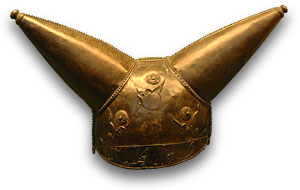
The clothing they wear is striking – shirts which have been dyed and embroidered in varied colours, and breeches, which they call in their tongue bracae; and they wear striped coats, fastened by a buckle on the shoulder, heavy for winter wear and light for summer, in which are set checks, close together and of varied hues. For armour they use long shields, as high as a man, which are wrought in a manner peculiar to them, some of them even having the figures of animals embossed on them in bronze, and these are skilfully worked with an eye not only to beauty but also to protection. On their heads they put bronze helmets which have large embossed figures standing out from them and give an appearance of great size to those who wear them; for in some cases horns are attached to the helmet so as to form a single piece, in other cases images of the fore-parts of birds or four-footed animals… Some of them have iron cuirasses, chain-wrought, but others are satisfied with the armour which Nature has given them and go into battle naked.Library of History V, 30
Julius Caesar, who campaigned in Gaul during the years 58–51 BC, is the earliest source to provide details of, the priestly, Druids:
Everywhere in Gaul two classes only are of any account or enjoy any distinction; for the masses are regarded almost as slaves, never venture to act on their own initiative, and are not admitted to any council… One of the two classes consists of the Druids, the other of the Knights [i.e. the nobility]. The former officiate at the worship of the gods, regulate sacrifices, private as well as public, and expound questions of religion. Young men resort to them in large numbers for study, and the people hold them in great respect. They are judges in nearly all disputes, whether between tribes or individuals; and when a crime is committed, when a murder takes place, when a dispute arises about inherited property or boundaries, they settle the matter and fix the awards and fines. If any litigant, whether an individual or a tribe, does not abide by their decision, they excommunicate the offender – the heaviest punishment which they can inflict. Persons who are under such a sentence are looked upon as impious monsters: everybody avoids them, everybody shuns their approach and conversation, for fear of incurring pollution; if they appear as plaintiffs, they are denied justice; nor have they any share in the offices of state. The Druids are all under one head, who commands the highest respect among the order. On his death, if any of the rest is of higher standing than his fellows, he takes the vacant place: if there are several on an equality, the question of supremacy is decided by the votes of the Druids, and sometimes actually by force of arms. The Druids hold an annual session on a settled date at a hallowed spot in the country of the Carnutes – the reputed centre of Gaul. All litigants assemble here from all parts and abide by their decisions and awards. Their doctrine is believed to have been found existing in Britain, and thence to have been imported into Gaul; and nowadays most people who wish to acquire a thorough knowledge of it go there [to Britain] to study.
The Druids, as a rule, take no part in war, and do not pay taxes conjointly with other people: they enjoy exemption from military service and immunity from all burdens. Attracted by these great privileges, many persons voluntarily come to learn from them, while many are sent by their parents and relatives. During their novitiate it is said that they learn by heart a great number of verses; and accordingly some remain twenty years in a state of pupilage. It is against the principles of the Druids to commit their doctrines to writing, though, for most other purposes, such as public and private documents, they use Greek characters. Their motive, I take it, is twofold: they are unwilling to allow their doctrine to become common property, or their disciples to trust to documents and neglect to cultivate their memories; for most people find that, if they rely upon documents, they become less diligent in study and their memory is weakened. The doctrine which they are most earnest in inculcating is that the soul does not perish, but that after death it passes from one body to another: this belief they regard as a powerful incentive to valour, as it inspires a contempt for death. They also hold long discussions about the heavenly bodies and their motions, the size of the universe and of the earth, the origin of all things, the power of the gods and the limits of their dominion, and instruct their young scholars accordingly.
The second of the two classes consists of the Knights. On occasion, when war breaks out, as happened almost every year before Caesar’s arrival,[*] the Knights either attacking or repelling attack, they all take to the field, and surround themselves with as many armed servants and retainers as their birth and resources permit. This is the only mark of influence and power which they recognize.
The Gallic people, in general, are remarkably addicted to religious observances; and for this reason persons suffering from serious maladies and those whose lives are passed in battle and danger offer or vow to offer human sacrifices, and employ the Druids to perform the sacrificial rites; for they believe that unless for man’s life the life of man be duly offered, the divine spirit cannot be propitiated. They also hold regular state sacrifices of the same kind. They have, besides, colossal images, the limbs of which, made of wickerwork, they fill with living men and set on fire; and the victims perish, encompassed by the flames. They regard it as more acceptable to the gods to punish those who are caught in the commission of theft, robbery, or any other crime; but, in default of criminals, they actually resort to the sacrifice of the innocent.
The god whom they most reverence is Mercury, whose images abound. He is regarded as the inventor of all arts and the pioneer and guide of travellers; and he is believed to be all-powerful in promoting commerce and the acquisition of wealth. Next to him they reverence Apollo, Mars, Jupiter, and Minerva. Their notions about these deities are much the same as those of other peoples: Apollo they regard as the dispeller of disease, Minerva as the originator of industries and handicrafts, Jupiter as the suzerain of the celestials, and Mars as the lord of war. To Mars, when they have resolved upon battle, they commonly dedicate the spoils: after victory they sacrifice the captured cattle, and collect the rest of the booty in one spot. In the territories of many tribes are to be seen heaps of such spoils reared on consecrated ground; and it has rarely happened that any one dared, despite religion, either to conceal what he had captured or to remove what had been consecrated. For such an offence the law prescribes the heaviest punishment with torture.
The Gauls universally describe themselves as descendants of Dis Pater, affirming that this is the Druidical tradition. For this reason they measure all periods of time not by days but by nights, and reckon birthdays, the first of the month, and the first of the year on the principle that day comes after night. As regards the other customs of daily life, about the only point in which they differ from the rest of mankind is this – they do not allow their children to come near them openly until they are old enough for military service; and they regard it as unbecoming for a son, while he is still a boy, to appear in public where his father can see him.
It is the custom for married men to take from their own property an amount equivalent, according to valuation, to the sum which they have received from their wives as dowry, and lump the two together. The whole property is jointly administered and the interest saved; and the joint shares of husband and wife, with the interest of past years, go to the survivor. Husbands have power of life and death over their wives as well as their children: on the death of the head of a family of high birth, his relations assemble, and, if his death gives rise to suspicion, examine his wives under torture, like slaves, and, if their guilt is proved, burn them to death with all kinds of tortures. Funerals, considering the Gallic standard of living, are splendid and costly: everything, even including animals, which the departed are supposed to have cared for when they were alive, is consigned to the flames; and shortly before our time slaves and retainers who were known to have been beloved by their masters were burned along with them after the conclusion of the regular obsequies.The Gallic War VI, 13–19
Everything that Caesar says about Gallic customs might not be relevant to Britain, but what he says about Druidism, presumably, is relevant to Britain – Druidism’s supposed birthplace. Similarly relevant is the following note by Pliny the Elder, concerning mistletoe:
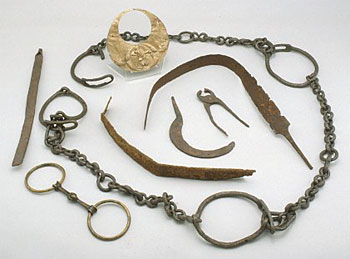
… we also must not omit the respect shown to this plant by the Gallic provinces. The Druids — that is what they call their magicians – hold nothing more sacred than mistletoe and a tree on which it is growing, provided it is a hard-oak [robur]. Groves of hard-oaks are chosen even for their own sake, and the magicians perform no rites without using the foliage of those trees, so that it may be supposed that it is from this custom that they get their name of Druids, from the Greek word meaning ‘oak’;[*] but further, anything growing on oak-trees they think to have been sent down from heaven, and to be a sign that the particular tree has been chosen by God himself.[*] Mistletoe is, however, rather seldom found on a hard-oak, and when it is discovered it is gathered with great ceremony, and particularly on the sixth day of the moon – which for these tribes constitutes the beginning of the months and the years, and after every thirty years of a new age [i.e. timekeeping cycle] – because it is then rising in strength and not one half of its full size. Hailing the moon in a native word that means ‘healing all things’, they prepare a ritual sacrifice and banquet beneath a tree and bring up two white bulls, whose horns are bound for the first time on this occasion. A priest arrayed in white vestments climbs the tree and with a golden sickle cuts down the mistletoe, which is caught in a white cloak. Then finally they sacrifice the victims [i.e. the bulls], praying to God to render his gift propitious to those on whom he has bestowed it. They believe that mistletoe given in drink will impart fertility to any animal that is barren. and that it is an antidote for all poisons. So powerful is the superstition in regard to trifling matters that frequently prevails among peoples.Natural History XVI, 95
In the years following the Roman invasion of AD 43, Druids based on the island of Anglesey, off the coast of north-west Wales, were evidently in the forefront of the British resistance movement. In AD 60, the Romans decided to subdue the island:
On the beach stood the adverse array, a serried mass of arms and men, with women flitting between the ranks. In the style of Furies, in robes of deathly black and with dishevelled hair, they [the women] brandished their torches; while a circle of Druids, lifting their hands to heaven and showering imprecations, struck the troops with such an awe at the extraordinary spectacle that, as though their limbs were paralysed, they exposed their bodies to wounds without an attempt at movement. Then, reassured by their general, and inciting each other never to flinch before a band of females and fanatics, they charged behind the standards, cut down all who met them, and enveloped the enemy in his own flames. The next step was to install a garrison among the conquered population, and to demolish the groves consecrated to their savage cults: for they considered it a pious duty to slake the altars with captive blood and to consult their deities by means of human entrails.Tacitus Annals XIV, 30